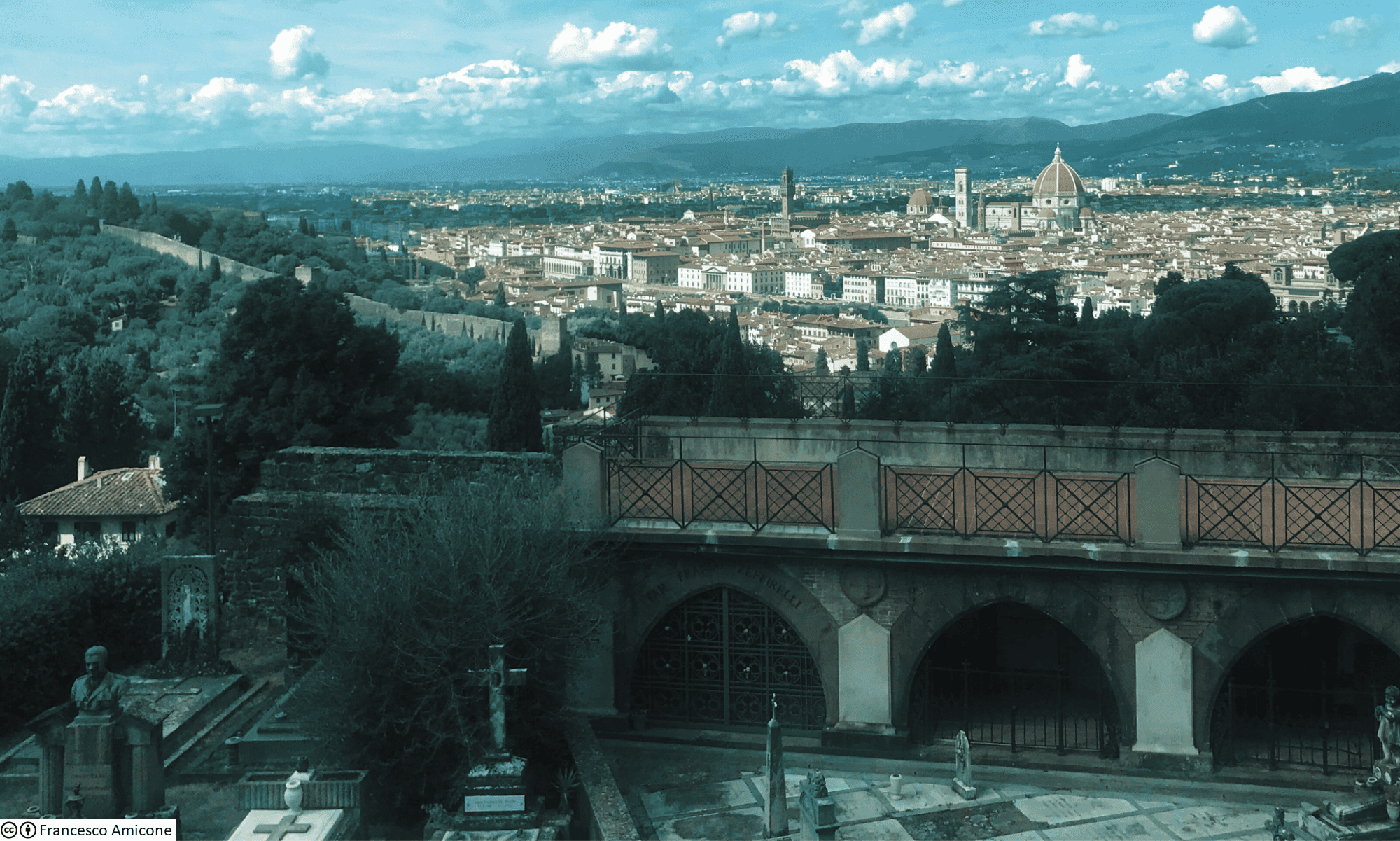


This biographical article on Joe Bevilacqua, born Joseph alias Giuseppe (1935 – 2022), originates from pieces of information on his life I received from him, several of which were noted during our talks/interviews in 2017.
The facts here reported are partly corroborated by official records obtained during my journalistic investigation into Zodiac-Monster connection of Florence and made public.
At the bottom of the post you can download the responses to my FOIA requests on Bevilacqua, with records relevant to his career, and a press review dedicated to him.
For years I have forwarded this and other documentation to the Florence DA’s Office, which in 2018 opened an investigation into Bevilacqua following a denunciation I made for his admission of guilt in the Monster and Zodiac crimes (dismissed in 2021).
I also sent it to the competent authorities for the Zodiac case, before transmitting his genetic profile in 2023.
Although I give a brief summary in chapter 4, I delve into the topic of Bevilacqua’s undercover operations at this link.
LINKS TO MAIN NEWS ARTICLES (2018 – 2021) – TRANSLATION
Misdirection and mistakes (Libero, 2021)
The American lead (Libero, 2021)
The magazine (tempi.it, 2020)
The admission of “Ulysses” (il Giornale, 2018)
Zodiac-Monster connection (tempi.it, 2018)
Index
Click on the titles below to go directly to the chapter.
To return to the index, just click the “back” arrow on the browser
INTRODUCTION
1. BIOGRAPHY IN BRIEF
2. PRIVATE LIFE
3. CAREER IN THE ARMY
4. UNDERCOVER INVESTIGATIONS
5. CAREER IN THE ABMC
6. INVOLVEMENT IN THE MONSTER CASE
7. RECORDS
INTRODUCTION ON MY RELIABILITY
On March 1, 2018, I stated to the Carabinieri (Italian gendarmes) that Bevilacqua admitted to being responsible of the Zodiac and Monster’s murders in a phone conversation on September 12, 2017 (I backdated it to 11 due to an oversight). He would have turn himself in, but he changed idea.
I did not recorded the discussion for an ethical and professional reason.
Although one of Bevilacqua’s daughters has publicly stated the opposite, in 2017 the Italian-American was in good health and showed no signs of neurodegenerative diseases. Indeed, he seemed to have a sharp mind. This last fact is confirmed by his wife Meri Torelli in a hearing of my defamation trial in 2023.

The admission of guilt followed a few interviews in person between me and Bevilacqua. Their existence wase then confirmed by a phone records analysis by the Florence ROS Carabinieri in 2018.
According to Carabinieri’s analysis, I went to Bevilacqua’s house seven times between May 26 and August 10, 2017. Most of the interviews lasted three/four hours circa. Two, the shorter one. They focused first on his life, then on the Zodiac and Monster cases.
Both Bevilacqua and his wife Meri (transcription of her testimony at my trial) confirmed that the cases of the two serial killers were subjects of the interviews.
It was also established that on 28 July, we moved to Falciani, as I tell in an account handed over to the Carabinieri and on Il Giornale in 2018.
However, in his lawsuit, Bevilacqua falsely stated that my notes had been taken on loose sheets of paper and not in a notebook (which he had obviously seen), probably with the intention of making the investigators believe that I had made false notes.

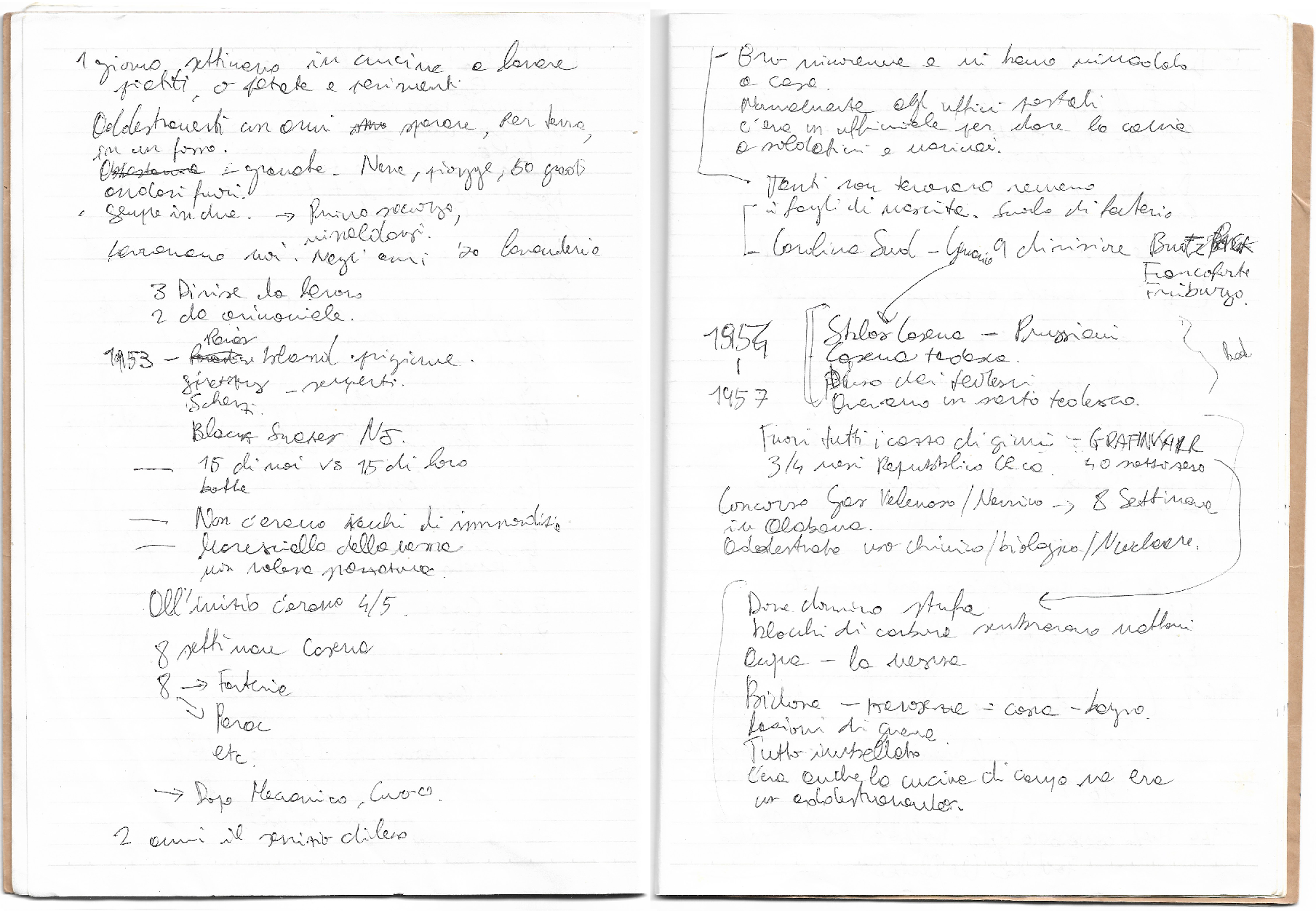
My notes examined by forensic psychologists of the RaCIS Carabinieri 2018 (report in Italian), compared with the documentation obtained subsequently, demonstrate that I reported real names of people, colleagues of Bevilacqua, true facts that were not in the public domain, some of which were not even reported in his official records – for example, his undercover activities for the Army CID.
The notes contain true and valuable information that proved to be very useful during the subsequent research activity.
I have gradually attached them to the supplements to my denunciation, over the years, and I have also shared them with the US law enforcement agencies.


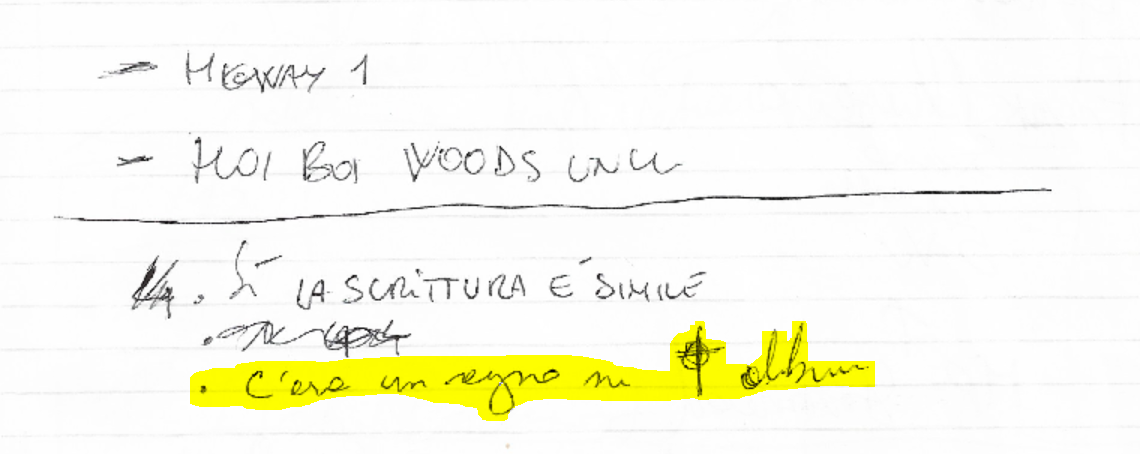
Considering it counterproductive to take notes while we were discussing the Monster and Zodiac, there are no direct references on these issues in my notes, apart from a note on the presence of a Celtic cross on a ’60s photo album shown to me by Bevilacqua.
In any case, despite giving false information to law enforcement and judicial authorities, both Bevilacqua and his wife Meri Torelli (transcript of her testimony at my trial)) confirmed that Zodiac and the Monster were the subjects of our conversations.
The complete phone records entered into the Bevilacqua case file by the Carabinieri in 2023 confirm the existence of the phone calls between be and the Italian-American of 12 September 12, 2017, the “admission call” I had backdated in my statements by one day due to an oversight.
In their analysis of five years earlier, however, the Carabinieri “missed” these phone calls that are not mentioned in the investigative notes by the then Florence ROS co, colonel Giuseppe Colizzi.

I did not secretly record the “admission call”, even though Italian law allowed it. The reason was ethical-professional.
I had made a commitment not to disclose information received from Bevilacqua without his consent.
During the phone conversation, after telling me that he had not turned himself in “not to get others into trouble” (his family members), Bevilacqua and I discussed the fact that he should turn himself in.
The American asked me twice if he should bring “the gun”, referring to the weapon with which the Monster shot couples in Florence between ’74 and ’85.
The admission was heard by his wife Meri, who denied it in court.
Immediately after that, Bevilacqua contacted a criminal lawyer I knew who had been advised by me to help him turn himself in.
The next day, Bevilacqua decided not to. We have not spoken since then.
After waiting in vain for him to turn himself in, and some informal reports to the DA’s Office and the police, I reported Bevilacqua’s admission at the Lecco Carabinieri office on March 1, 2018.

The Florence DA’s Office and the judicial police ascertained the day after the actual start of their investigation that Bevilacqua had lied to the court at the Pacciani trial on the Monster homicides, obtaining confirmation of my reliability.
I had anticipated in the brief account of our meetings submitted to the Carabinieri of Monza on their request on February 22, 2018, that Bevilacqua had lied about his knowledge of Pietro Pacciani, the main suspect of the Monster case.
On April 16, I delivered to the DA’s Office an almost identical document (the date of admission changes – in the first one I reported the correct one of September 12, 2017) in which I reported the same information about Pacciani (next image).
"'Do you want to break the Monster's balls?'
Regarding the events linked to the Monster of Florence, on 28 July, Bevilacqua told me that he knew Pietro Pacciani well, and that he had met him several times in the woods behind the Falciani cemetery [TN the Florence American Cemetery]. He also knew Mario Vanni and Giancarlo Lotti…"

On May 30, 2018, Bevilacqua himself confirmed what I had previously reported about Pacciani, telling the Carabinieri that he had come across the “Vampa” several times near the cemetery, in contradiction with what he stated in ’94, when he said to the court:
"No, I did not know who he was."


The officers in charge of the investigation in Florence decided to ignore Bevilacqua’s false testimony and my reliability, making other mistakes.
Despite my reliability, Bevilacqua’s false testimony, circumstantial evidence, and the legal possibility to do so, his home was not searched, the DA’s Office did not take his DNA or contact and transmit his genetic profile to US law enforcement.
Bevilacqua’s DNA was acquired in 2020 by Siena DA’s Office, deputy attorney Nicola Marini.
In November 2023, thanks to an authorization from the Sienese prosecutor, I managed to transmit the genetic profile of the Italian-American to the US authorities for defensive purpose in my defamation trial.
1. BIOGRAPHY IN BRIEF
Joseph aka Giuseppe Bevilacqua, known as “Joe“, was born into an Italian-American family in Totowa, New Jersey, on December 20, 1935. He died at the age of 87 in Sesto Fiorentino (Florence), on December 23, 2022.
He is survived by his last wife, Meri Torelli, and three daughters.
Job career
In ’53, Bevilacqua attempts to enlist in the Marine Corps but is rejected because he is not yet of age.
In ’54 he joins the Army, which he serves for 20 years, working for the Army CID, also carrying out undercover investigations in the last decade.
A highly decorated soldier with a tour of duty in Vietnam, after his honorably discharge in ’74, Bevilacqua becomes an officer with the American Battle Monuments Commission, serving in Italy for 36 years.
Involvement in the “Mostro di Firenze” case
In early ’90s Bevilacqua contacts the Carabinieri to “help” the Italian police in the investigation on the “Monster of Florence” case, a span of homicides of couples occurred in the countryside of Tuscan capital between ’74 and ’85 (linked to a ’68 case), when he lived and worked in the crime area at the local American Cemetery.
In ’94, Bevilacqua is called to testify at the Pacciani trial on the Monster case.
In his deposition of June 6, 1994, he claims he spotted the defendant at the edge of the Scopeti woods, in San Casciano Val di Pesa, a few days before the last definite double murder by the Monster.
He says he did not know who Pacciani was. He does not know him.
Bevilacqua also states that, in the same days, he saw Monster’s last victims accamped in the spot where they would be killed, 300 yards away from the Florence American Cemetery.

Bevilacqua retires in 2010 and goes to live in Sesto Fiorentino.
In 2017, we have talks regarding his life and the Monster and Zodiac cases, at his home and in Falciani, near the Florence American Cemetery. The existence of the meetings is confirmed by the subsequent ROS Carabinieri’s analysis of the cell coverage of our phones.
Contrary to what he stated to the Court in the Pacciani trial in ’94, Bevilacqua tells me he knew Paccian, as I report in an account on the talks given to the Florence DA’s office on April 16, 2018.
On March 1, 2018, I report Bevilacqua to the police for an admission of guilt regarding the Monster and Zodiac Killer’s crimes.
I did not secretly record the “admission call”, even though Italian law allowed it. The reason was ethical-professional.
I had given my word to Bevilacqua that I would not disclose information received from him without his consent.
He admitted after reading a stylized Zodiac’s name cipher solution, discovered thanks to his indication and completed in the following years.
After I reported Bevilacqua’s admission of guilt and my first articles on the Zodiac-Monster connection were published by tempi.it and Il Giornale, the ROS Carabinieri and the Florence DA’s Office carry out an investigation committing various mistakes.
They do not search Bevilacqua’s home, nor collect his DNA nor contact the US Department of Justice, even if they immediately obtaines confirmation of his perjury at the Pacciani trial from the American himself.
Bevilacqua also confirm the content of the talks in our meetings, although he denied the admission.
In 2021, the case is unlawfully and silently dismissed by Florence assistant DA Luca Turco and his colleague magistrate Gianluca Mancuso, without citing my statements to the Carabinieri on Bevilacqua’s admission of guilt and without notifying the offended parties.
In September 2022, I send the main results of my journalistic investigation on Bevilacqua and the Zodiac-Monster connection to the SFPD.
Bevilacqua dies of natural causes on December 23, 2022. He plays the role of “victim” in my defamation trial currently underway.


Bevilacqua’s DNA profile transmitted to US Authorities
In 2020, Siena deputy DA Nicola Marini had Bevilacqua’s DNA collected, with his consent, for the murder case of cab driver Alessandra Vanni occured in Castellina in Chianti in ’97.
Bevilacqua’s DNA did not match with that obtained from the DNA under victim’s nail nor the samples in the Monster case (which are not directly attributable to the killer).
In March 2022, Florentine prosecutor Turco denied the request made by my lawyers to transmit Bevilacqua’s genetic profile to US law enforcement agencies.
So, in 2023, I ask and obtain a copy of the profile from prosecutor Marini to defend myself from the accusation brought forward by Florence DA’s magistrates in my defamation criminal trial.
In November 2023, I transmit Bevilacqua’s genetic profile to the US authorities in charge of the Zodiac case, which I have informed in vain for years.
In the following months, I send my decryptions of the Mt. Diablo Code, the Z408 final anagram, Zodiac’s name cipher to the FBI.


Photos
In the gallery below, Bevilacqua as superintendent of the Sicily-Rome American Cemetery (1989 – 2010) is in the company of prominent public figures. From top left to right, presidents Bill Clinton and George Bush Sr., vice president Dick Cheney.


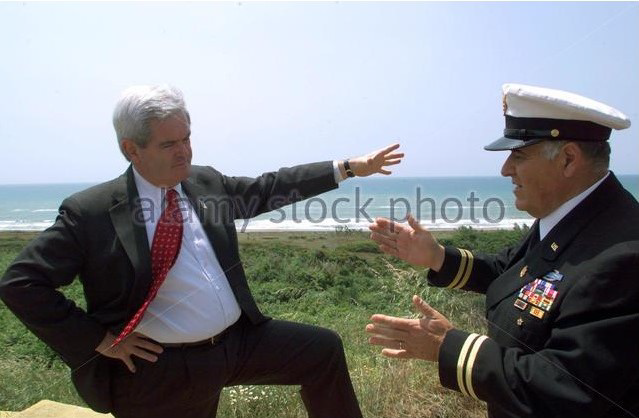
Bevilacqua’s medals for valor (proved to be authentic) can be glimpsed on his ABMC cemetery superintendent’s uniform in the next picture with the then speaker of the House Newt Gingrich. A Soldier’s Medal, two Bronze Stars with V device, and a Silver Star, the third honor for valor awarded by the US armed forces.
Physical appearence
As a young man, Bevilacqua resembled eyewitness descriptions of Zodiac.
Bevilacqua’s military card shows his height in his youth, 68 inches, i.e. 5′ and 8”, approximately 1.73 cm, like Zodiac’s height, according to four eyewitness accounts in ’69.
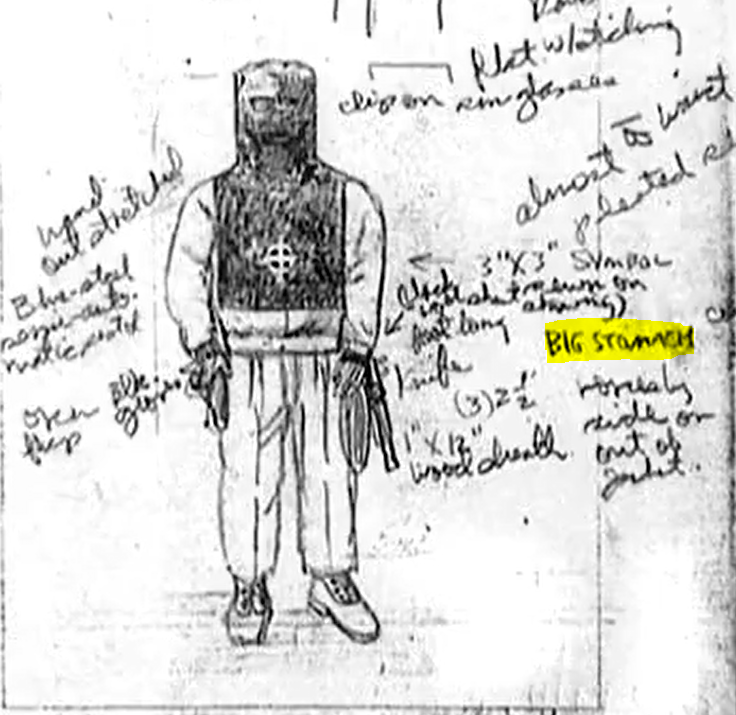
Bevilacqua also shares two other somatic characteristics with the serial killer: he too was stocky at the time, and he had a prominent stomach (also when elder), like Zodiac’s, as noted by surviving victim Bryan Hartnell.

The strange stocky man who was walking “bent forward” with a “shuffling lope”, “almost limping”, nearby Stine’s cab soon after his murder, as described by officer Donald Fouke, accords with my personal experience of Bevilacqua’s way of walking.
The conflicting testimonies on the color of Zodiac’s hair (light brown, dark, reddish) suggest that the serial killer dyed it or used wigs.
Bevilacqua has dark brown hair that has been bleaching since the ’80s.

2. PRIVATE LIFE
Joe Bevilacqua is the eldest son of Michael Bevilacqua, a shoemaker, and Celeste Zaccaro, a housewife. He has three brothers, Anthony, Michael, Patsy, and a sister, Irene.
In my notes examined by the Carabinieri in 2018 (RaCIS report) I note that his father Michael is a shoemaker at Rafferty (Paterson, NJ, ed.).
The information is confirmed by his obituary which I published in the press review (p. 25) which can be found together with other documents at the bottom of this page.

According to the same article, Michael Bevilacqua was also a member of the local Merchant Marine band.
His paternal grandfather, Joseph, was a member of the Regia Marina Society.
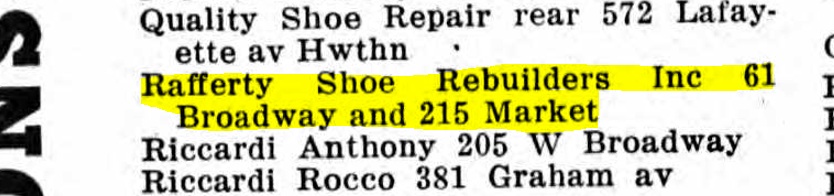

Bevilacqua’s favorite game in childhood is step-ball, noted in 2017.
Passionate about baseball, he will become honorary president of the Nettuno Lions.
In the photos with his family (images above) he is often seen wearing a San Francisco Giants cap.

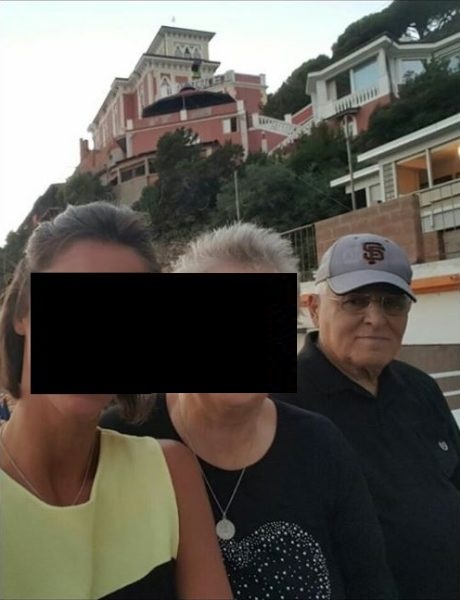

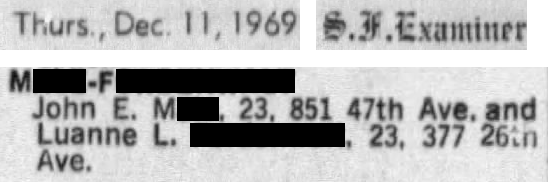
John David M., Bevilacqua’s son-in-law, is from San Francisco. His mother, Luanne F., resided in the city and attended the local university during Zodiac’s time.

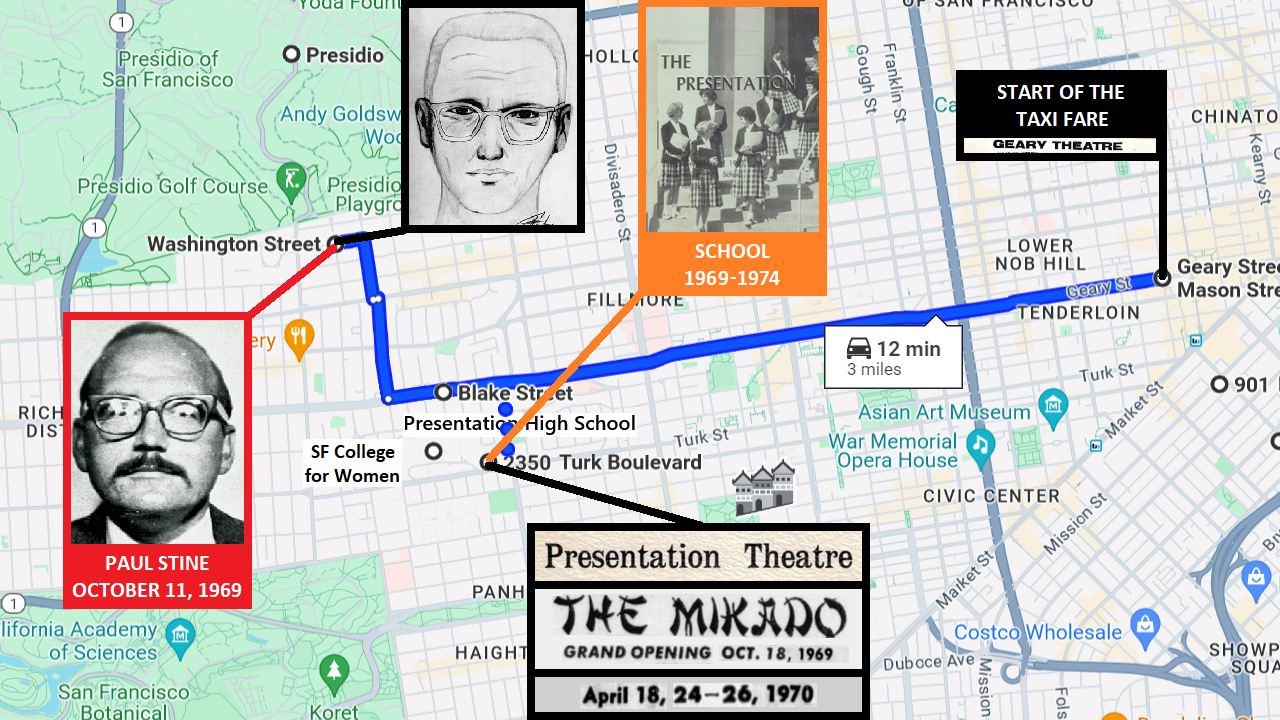
Ms. Luanne F. graduated from Sisters of the Presentation school whose theater, the “Presentation Theater”, for years sent on scene the performances by the Lamplighters, a San Francisco company locally famous for staging the works of the Gilbert and Sullivan duo.
In ’69, shortly after the Stine murder, an in April ’70, when Zodiac sends his encrypted name, the Lamplighters act in a successful version of “The Mikado”, an operetta mentioned two times by Zodiac in his letters, including an excerpt used as a signature.
In the 60s – 70s, Bevilacqua has two daughters from Valeriana T. (Italian), Maria and Stella.
On August 23, 1984, he married Meri Torelli in San Casciano Val Di Pesa (Florence), who the following year was resident with her husband together with their little daughter Anna Maria in via Scopeti n. 136, municipality of San Casciano. From Bevilacqua’s testimony it can be deduced that it was the house number attributed to the American Cemetery, which is no longer in use today.
Since he has been married to Mrs. Torelli, Bevilacqua has been mentioned in official Italian documents sometimes with the name “Giuseppe” sometimes as “Joseph” (next images).

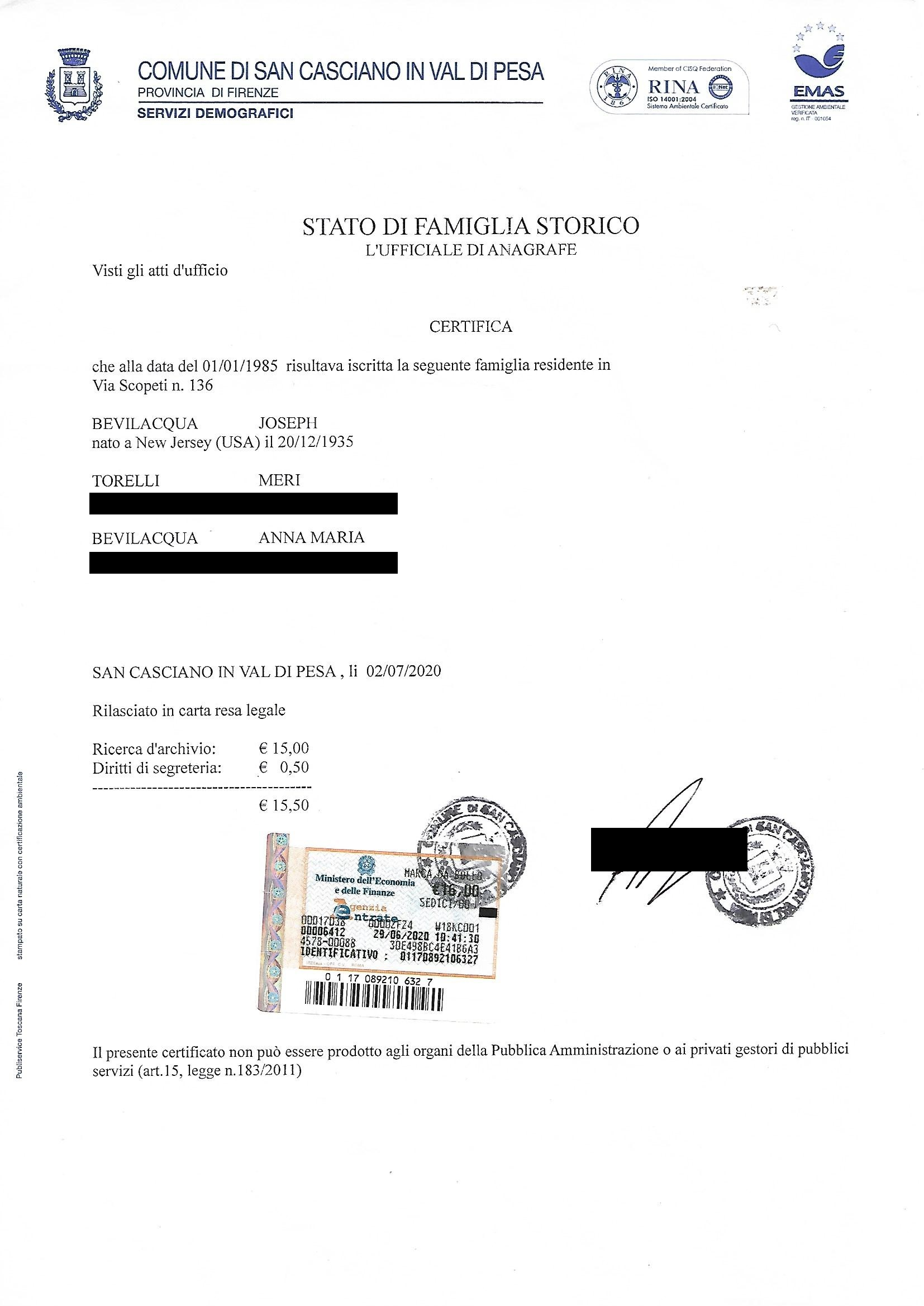
A check on the vehicle registration documents by researcher Valeria Vecchione confirms that Bevilacqua used the two names with two different tax codes at the same time for decades.
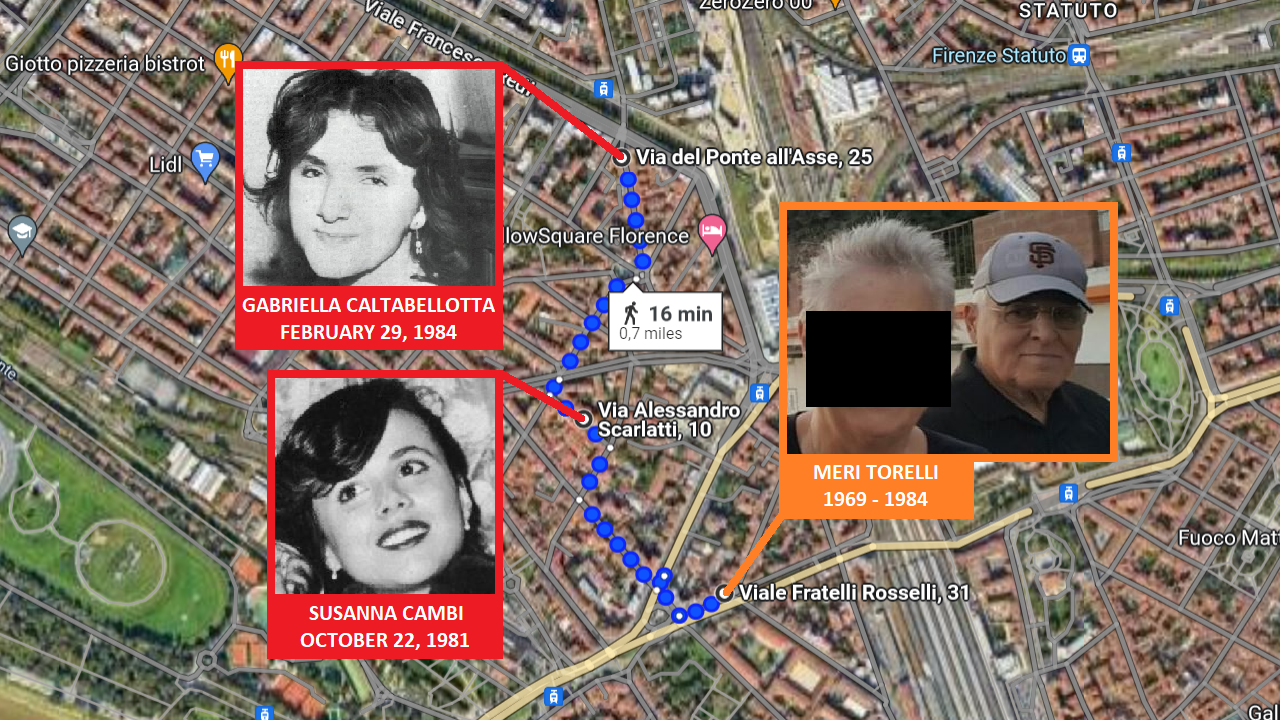
According to the Municipality of Florence, Mrs. Torelli lived in Florence in Viale Fratelli Rosselli from ’69 to the summer of ’84, when after her marriage to Bevilacqua she moved to the American cemetery. Here residence was near where Susanna Cambi was staying at the time she was killed by the Monster, on 22 October 1981 (Anna Maria Bevilacqua was born the following year).
Bottom right, a map showing the walking distance between the two homes.
Gabriella Caltabellotta, killed on 29 February 1984, lived in the same area. Her unsolved murder is included by some researchers among the possible cases attributable to the Monster.
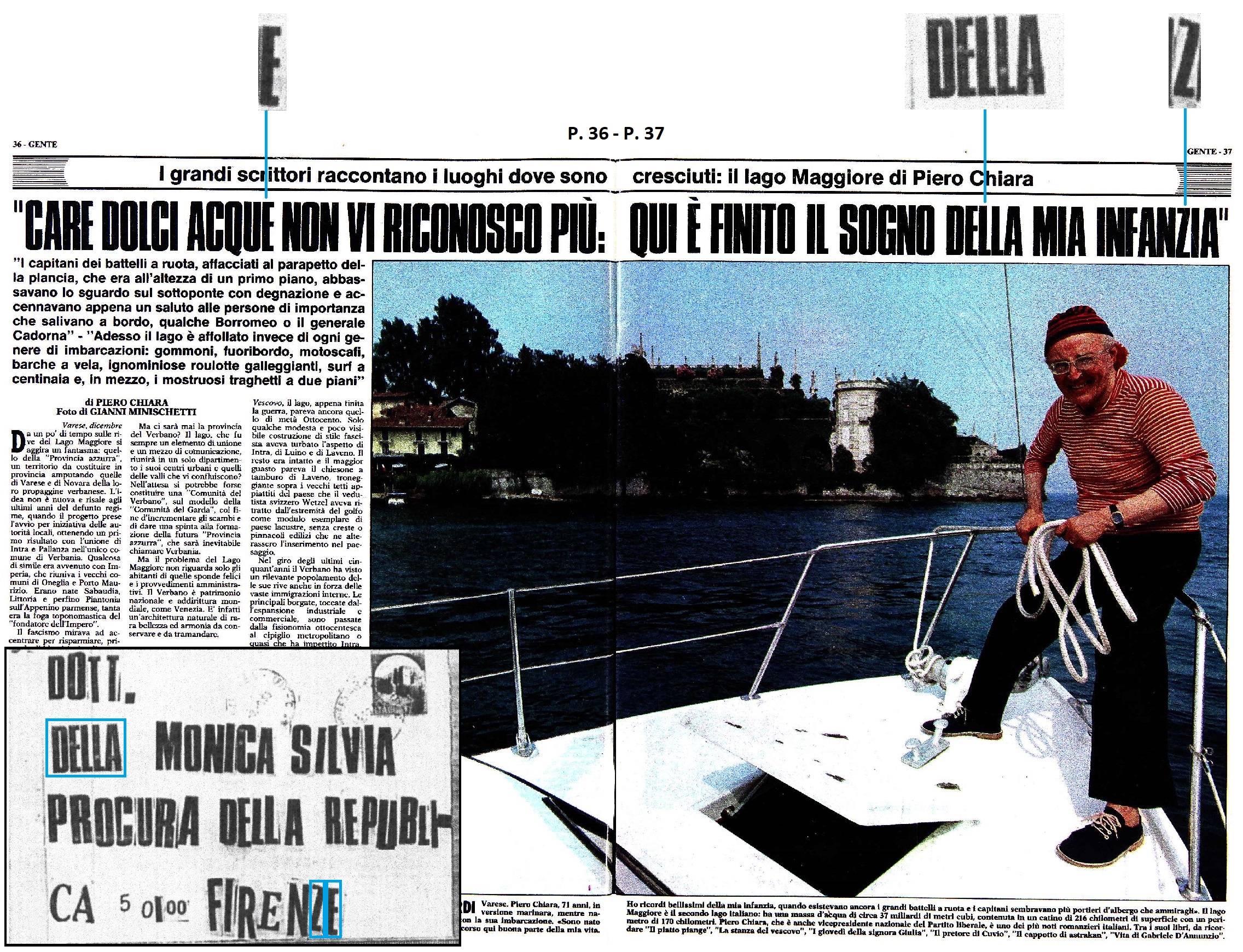
Four months after Bevilacqua’s marriage, between 14 and 20 December 1984 (the Italian-American’s birthday and a date which also occurs twice in the Zodiac case), the issue of the magazine identified by Valeria Vecchione that il Mostro di Florence will use the letter to Silvia Della Monica for its “last act” in 1985.
After his retirement in 2010, Bevilacqua returns to live in the province of Florence, in Sesto Fiorentino. He found a little company, “G & G spic and span the cleaning man”, with some relatives.
At the bottom, records of the Camera di Commercio relating to Bevilacqua, who appears under the name “Joseph”. Below, an excerpt.

3. CAREER IN THE ARMY
In 2017, Bevilacqua talks to me about trying to join the Marine Corps in ’53, and about his training on Parris Island. He says he was sent back because a minor.
The first official public record attesting to Bevilacqua’s military career is just a Marine Corps muster roll from ’53, where his name is present.

The information is found in his official records, denying that provided in his autobiography (next image), in which he claims to have been part of it for two years.

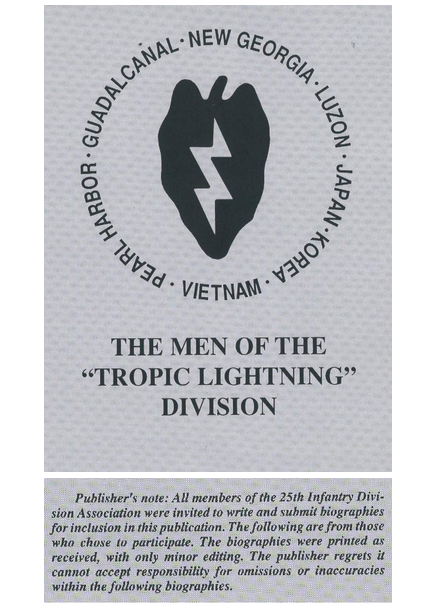
The official records on Bevilacqua’s Army career are contained in the Official Military Personnel File (excerpt downloadable along with a supplement at the bottom of the page).
I obtained these documents after the interviews.
To request them, it was not enough to provide the veteran’s name and surname but also other information such as the base where he was enlisted and the place of discharge.
In them, much of what my notes report is confirmed, but not his undercover activities, which are obviously not mentioned (on the other hand, I get feedback from one of his commanders in 2019, next chapter).
Bevilacqua’s military file is in the custody of the National Personnel Records Center in Saint Louis and includes the main information on his military career, such as the list of assignments and the list of his military awards.
The downloadable file is an excerpt obtained through a request under the Freedom Of Information Act (FOIA).
I have had three responses from the NPRC: in 2018, 2019, and a supplement in 2023.


Official records confirm that Bevilacqua joined the army in ’54.
The American tells me that he was transferred to Germany with the 8th Infantry Regiment at the Butzbach shloss-kaserne, after the initial training.
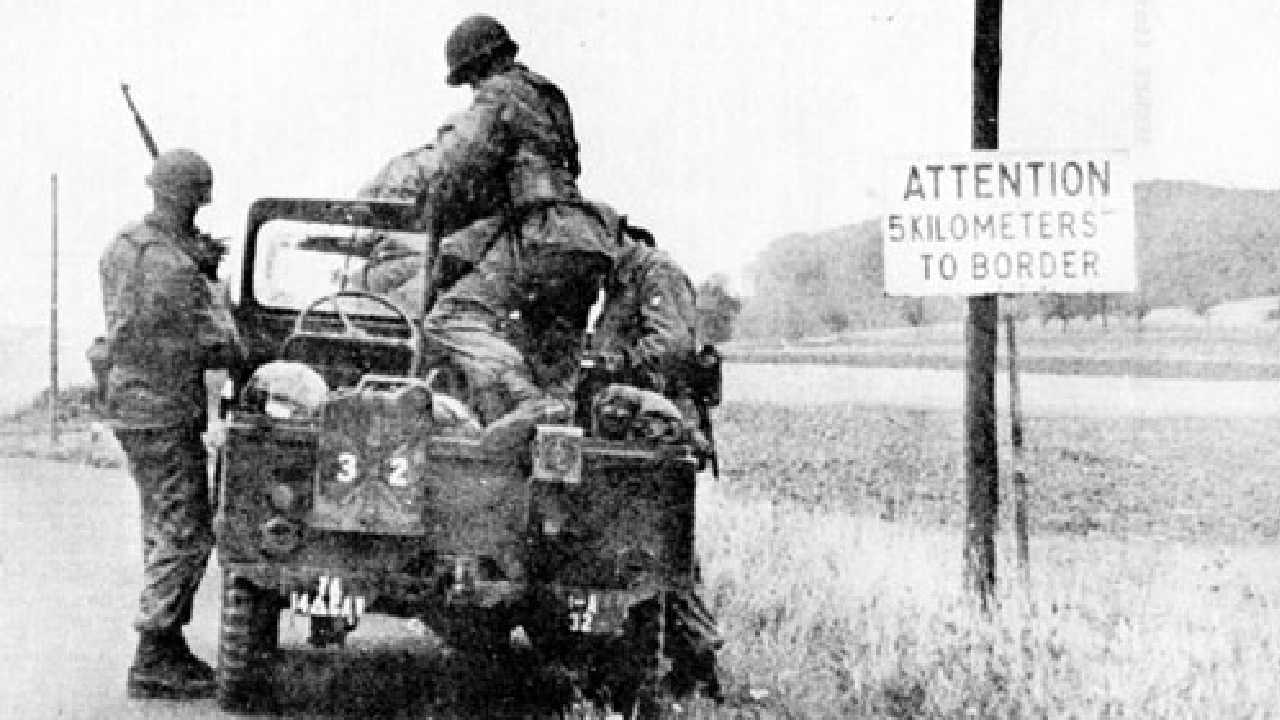
A photo of Butzbach Castle from the mid-1950s, showing the insignia of the 8th Regiment, and articles finded on newspapers.com, confirm the information in the notes (images below).

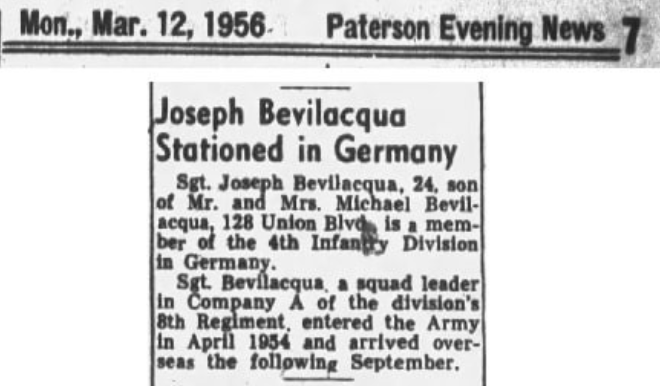
In the line relating to the transfer to Butzbach it is noted that Bevilacqua’s list of assignments also contains some inaccuracies. For example, it is reported that the young recruit would have been a squad leader, i.e. a trainer (unlikely). Additionally, the word USA is missing four letters to form the correct acronym for US Army Europe, USAREUR.

Bevilacqua tells me that he remained in German territory for three years, moving from infantry to an armored unit that patrolled the Fulda gap along the Iron Curtain. And to have opted for the job of cook to be carried out as a secondary task in addition to patrol activity. He claims that back then it was not as professional a job in the Army as it is nowadays.
He tells me that he worked alongside former Nazi soldiers.
The two lines following the assignment to the 8th regiment show the transfer to the 14th cavalry regiment which guarded the border with East Germany.
In ’57, the American is selected for being a chemical, biological, nuclear (CBR) instructor. He remains in this sector of activity until ’64, when, in Livorno, he enters the 5th CID (Criminal Investigation detachment) of Military Police in Livorno and becomes “assistant criminal investigator”, maintaining his specialization in the CBR sector.

Bevilacqua’s records doe not show any assignments in the Army investigative units after the two-year period as assistant detective in Livorno.
In 2017, however, the retired sergeant confides to me that he worked for the Army CID until ’74, carrying out undercover assignments (I get confirmation in 2019, next chapter).
In August ’66, Bevilacqua returns to his homeland.
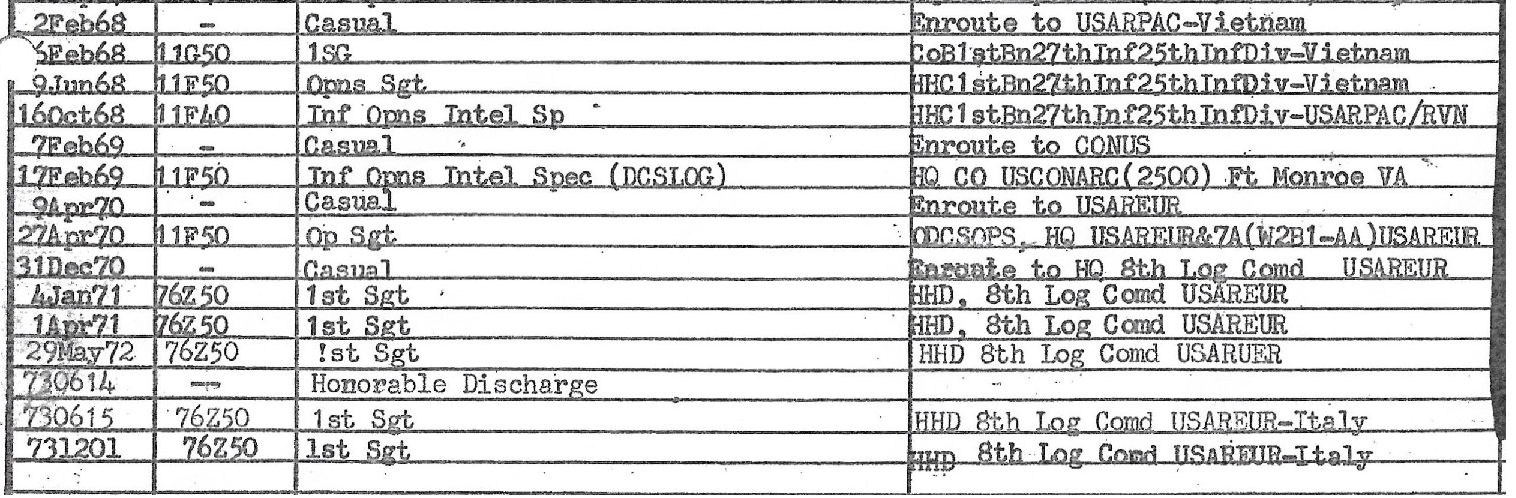
Between February ’68 and February ’69 he is in Vietnam where he earns a Silver Star, two Bronze Stars, a Soldier’s Medal, and a Purple Heart.
He is transferred to the Continental Army Command, CONARC (headquarters in Virginia), in ’69-’70. Under the CONARC there are all the continental armies including the 6th Army headquartered in the Presidio of San Francisco.
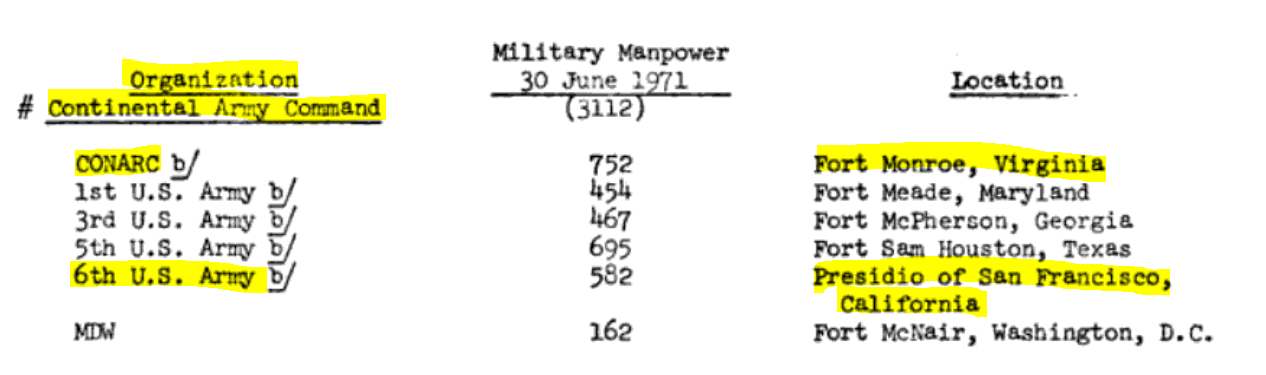
In March 1970 he was formally assigned to command the 7th Army in Heidelberg, Germany. In that period, investigative activities were underway on the so-called “Khaki Mafia” in connection with various locations, including San Francisco (next chapter – I’ll go into more detail here).
Bevilacqua was stationed at Camp Darby for three years between ’71 and ’74.
He concluded his active career in the Army with the rank of First Sergeant in June 1974, moving to the Florence American Cemetery where he was hired by the American Battle Monuments Commission as a trainee Deputy Warden (chapter 5).
4. UNDERCOVER INVESTIGATIONS
On October 30, 1966, student Cheri Jo Bates was killed in Riverside. Zodiac confirms responsibility for this murder (to date unattributed) in a letter from 1971.
Has Bevilacqua been at Riverside in ’66?
I ask him three times on July 28, 2017, and three times he says “yes”.
During the homicide period, “Joe” appears as a “mess steward” at Fort Dix, New Jersey. It is an anomalous occupation for a former CBR instructor who has just concluded a two-year job as an Army CID “investigative assistant”.
However, that is what is on his assignment list.
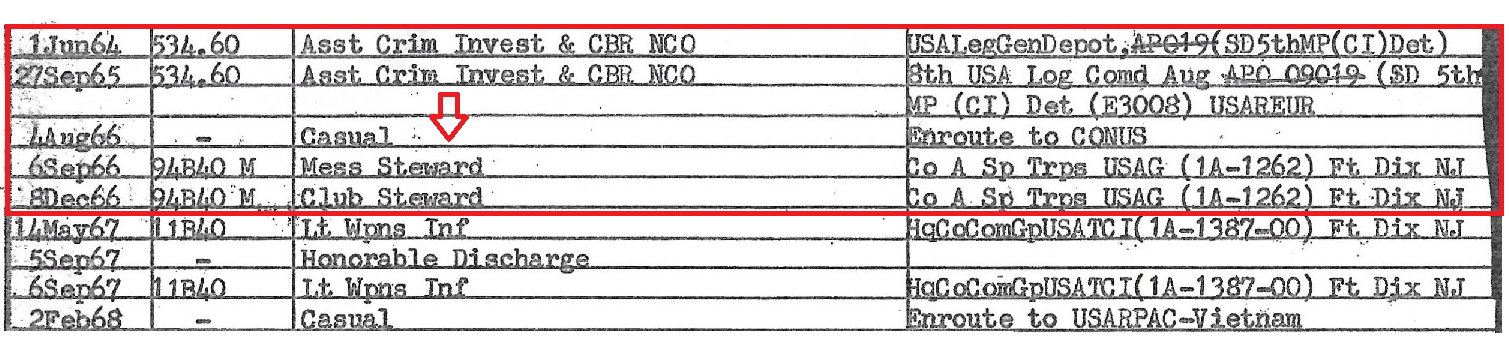
Bevilacqua joined the 5th Criminal Investigation Detachment in Livorno, Italy, in ’64.
He tells me that chief warrant officer Robert Colombo is leading that unit, information later confirmed to me by his military records.
Colombo’s name name appears several times in my notes, being mentioned together with that of Raymond D’Addario (I delve deeper into the topic here).
Bevilacqua was assistant investigator until the summer of ’66. A two-year period that seems to correspond to the apprenticeship to become a detective. Instead, his official records show that he returned to Fort Dix, where he previously worked as a CBR trainer, and carried out a task related to messes and clubs.
Why?
And why is there no reference to the military police between ’66 and ’74, if what the Italian-American told me in 2017 is true, telling me that he worked with the CID units until his discharge in ’74?
The answer is that Bevilacqua carried out undercover investigations. In 2017, he told me that for this very reason his real investigative assignments from that period are not present in his official records. They had to remain secret.
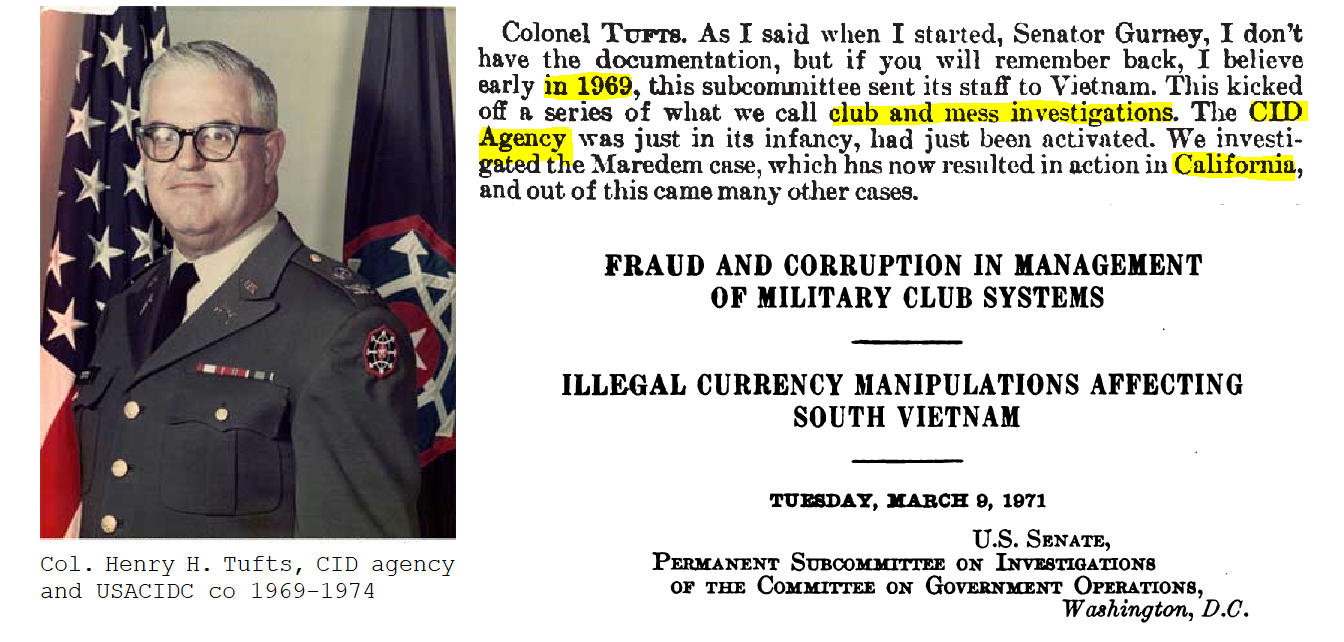
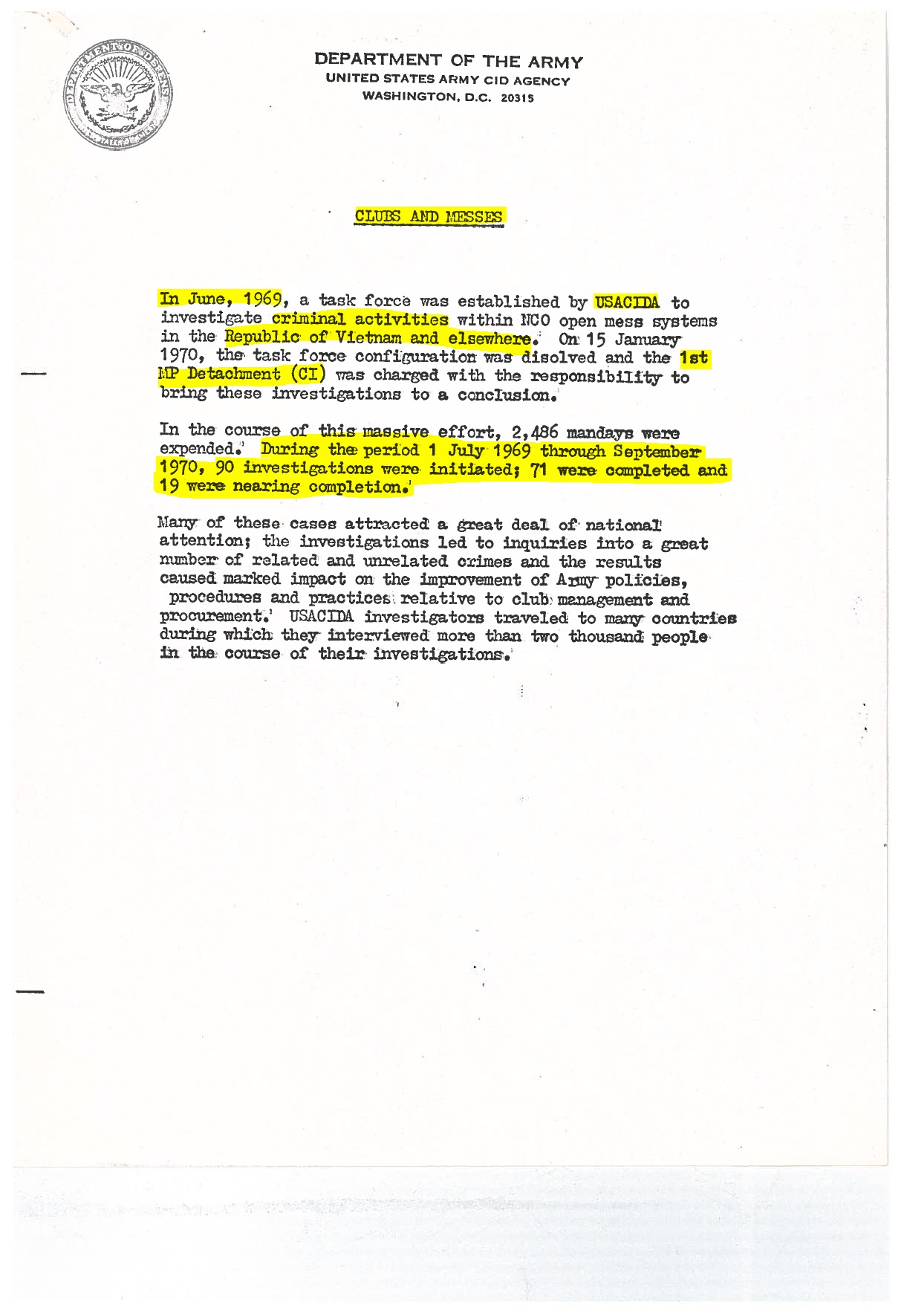
The assignment as a canteen and club attendant is in line with the subject of the investigation into the “Khaki Mafia” in which Bevilacqua tells me he participated.
This is a series of investigations conducted by the CID in the second half of the 1960s which mainly focus on the management of military clubs and messes, as confirmed by Colonel Henry Tufts, commander of the CID Agency, in a Senate hearing in 1971 ( previous image).
In January 2019, I obtain direct evidence of Bevilacqua’s undercover activity from his commander in Vietnam, Lieutenant Colonel Mark. L. Reese.
This is what Reese wrote to me:
"When I assumed command of the First Wolfhounds in September, 1968, SFC Bevilacqua was my Operations Sergeant... I considered him an outstanding soldier.
Shortly after I assumed command, the Division Commander charged him with a special undercover assignment.
He was sent to the Division NCO Academy to determine if illegal activities were being committed within that unit. It took him about a week to get the goods on several NCO's and, I believe, at least one officer, for dealing in drugs and prostitution.
When he returned to my command, he had a very interesting story to tell."


D’Addario was likely Bevilacqua’s supervisor during this undercover activity. At the time Reese talks about, in fact, D’Addario was a CID detective assigned to the 25th Infantry Division, as his military records confirm. In my notes, just under his name, I write the word “chief” in relation to Saigon and Maryland, where the CID First Region headquarters is located at the time.

I would attach Reese’s email to a supplement of the denunciation filed with the Florence DA’s Office on March 19, 2019. It is within the file on the investigation into Bevilacqua dismissed in 2021.
In his statements to the Carabinieri on May 30, 2018, the Italian-American never mention his “undercover” work and his presence in the San Francisco Bay Area during Zodiac’s attacks.
The Khaki Mafia
In 2017, Bevilacqua tells me several times that he worked in California in ’69.
I also report it in my notes taken during the interviews, associating this information with CONARC and a 16-month “undercover” activity.
On July 28, 2017, after a few seconds of silence, Bevilacqua responds in the affirmative when I ask him if he was at Lake Thaoe in ’70. In this area, that year, a possible Zodiac victim, Donna Lass, was kidnapped.

The Italian-American doesn’t give me precise information on what he was doing in California.
“I can’t talk about my job,” he repeats when I ask him about investigative assignments.
Precisely because of the secrecy of his activity, during the “admission call”, he tells me that it cannot be proven that he was in California during the Zodiac period.
On the other hand, however, during the meetings he advises me to read the book “The Khaki Mafia”, claiming to have participated in the investigation into malfeasance in clubs and military messes from which this story set in Vietnam is based.


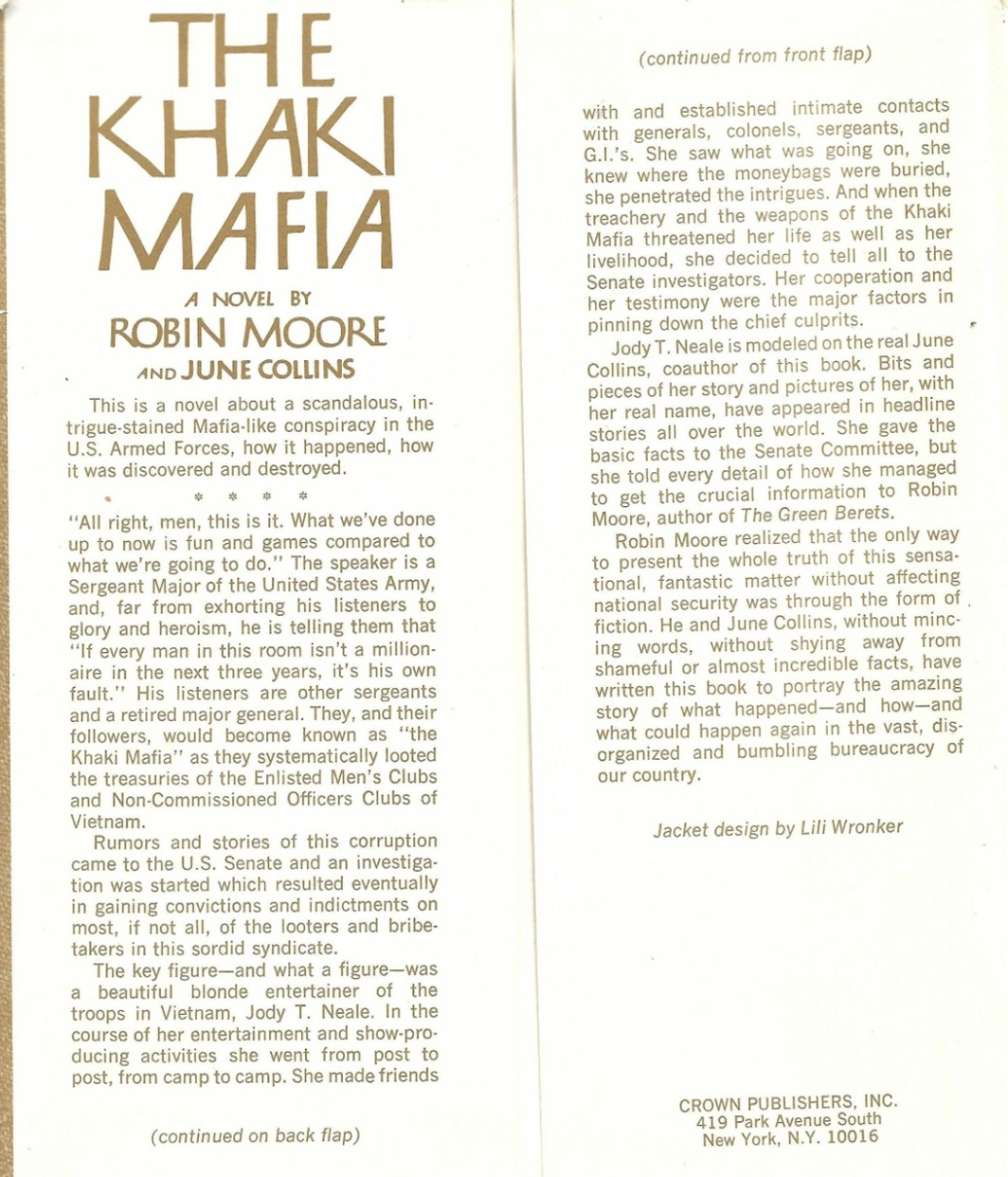
“Khaki Mafia” is a journalistic label given to a group of Army noncommissioned officers following the first Sergeant Major of the Army William O. Wooldridge who are indicted in Los Angeles in February ’71.
Director and story teller Hugo Berkeley will advise me on the importance of this case in summer 2018. For further information, see the “Khaki Mafia” chapter of the post on the journalistic investigation.
By carrying out research between 2018 and 2021, I will trace the CID investigations into the Khaki Mafia that took place in the San Francisco area during the period of Zodiac’s activity. As well as other investigations compatible with his assignment to Germany at the same time as his presence in California in 1970, including Lake Tahoe which we talk about in the meeting of 28 July 2017.
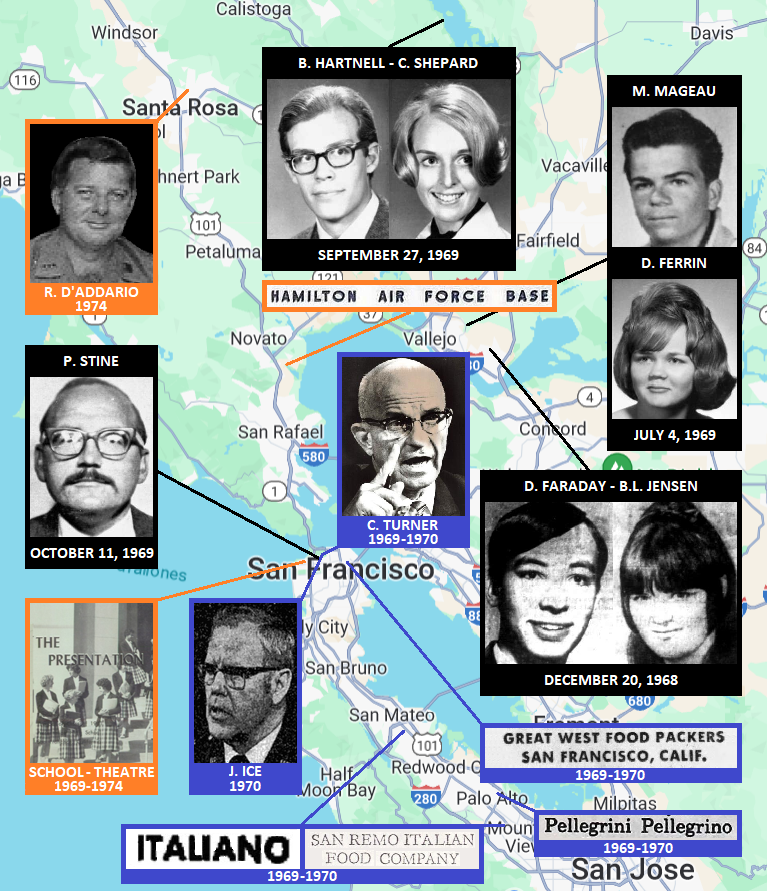
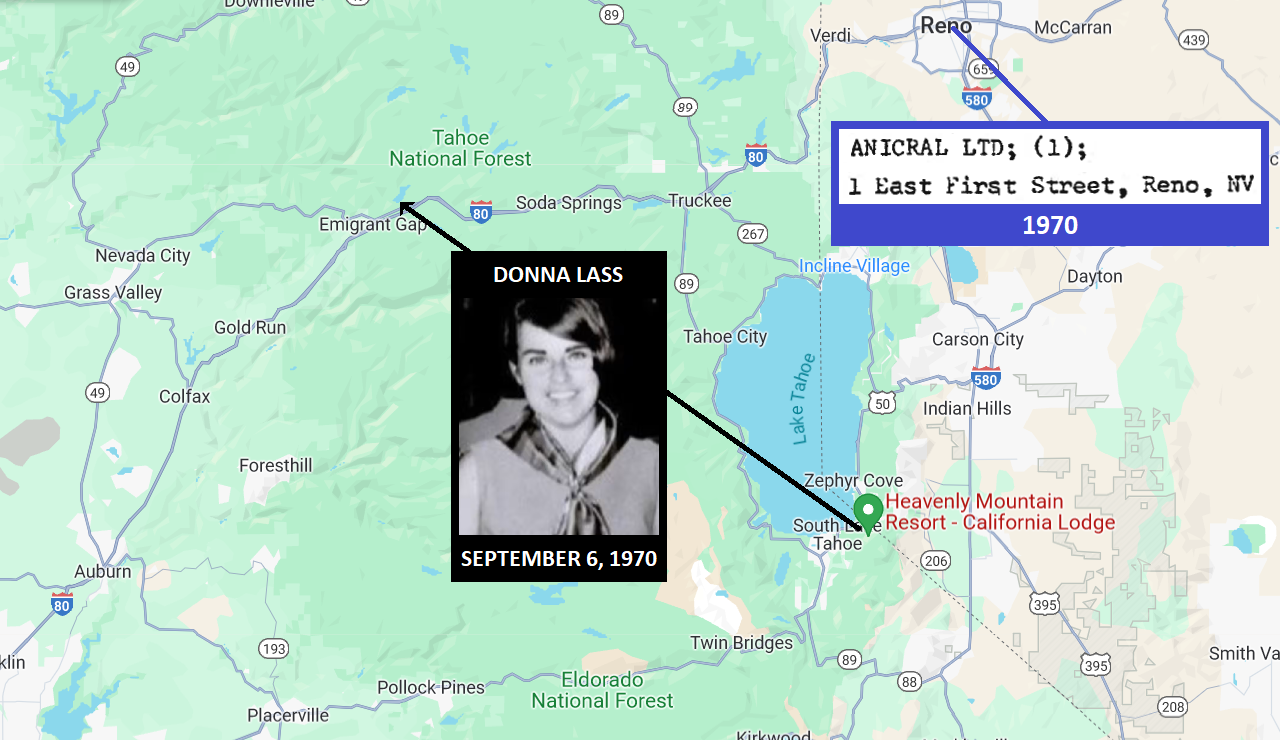
After years of research, I was able to identify at least four investigations into the Khaki Mafia carried out by the CID in the San Francisco area in conjunction with the Zodiac’s crimes and communications.
Again, I talk about it here.


Alibis?
Putting aside both the Khaki Mafia and the hypothetical connection between the Monster series and the Signa crime (never confirmed by the sentences, and over which the enigma of the gun looms), there are assignments in Bevilacqua’s official records that seem to provide alibis to him.
Of particular interest are the entries relating to assignments in Vietnam, in ’68, and in Germany, in ’70.
It should be noted that the list sent to me by the NPRC does not exclude Bevilaqua’s presence in San Francisco on December 20, 1968, when Zodiac committs a murder near Vallejo, and sporadically between the end of April 1970 and March 1971, when he sends some letters from the city and the Bay Area, starting with a card postmarked on April 28, 1970.
I address Bevilacqua’s alleged alibi for the Zodiac crime of December 20, 1968, separately here.
From reading the Pan Am time tables of December 1968 there are no particular difficulties in reaching the Californian city from Saigon (image below).

Bevilacqua was apparently transferred from the United States to Germany in April 1970. Zodiac’s correspondence includes some letters subsequently sent from San Francisco.
An alibi?
First, it should be noted that it would not have been difficult to reach San Francisco even from the Seventh Army headquarters in Heidelberg, Germany, to which Bevilacqua was assigned between April and December 1970, and where his daughter Stella was born that same year.
Frankfurt Airport is less than an hour’s drive from Heidelberg and is also one of the busiest airports in the world.

Bevilacqua was assigned to Heidelberg starting April 27, 1970. Zodiac’s first communication after this date is a postcard depicting Don Quixote and Sancho Panza called “Dragon Card.” The stamp on the envelope reads “April 28, 1970, afternoon,” meaning the day after Bevilacqua’s transfer.
At the time, San Francisco mail was generally picked up and postmarked twice a day.
What could have happened?
Perhaps “Zodiac” sent the postcard before boarding the plane, on Saturday or Sunday morning, and the envelope was postmarked late, as Valeria Vecchione suggests. Even assuming that this is not the case and that Bevilacqua was indeed in Heidelberg on April 27, the undercover CID detective would still have two flights with a stopover in London available that would make him arrive in San Francisco that same evening, as the Pan Am timetable of that period proves (extract above).
Once in the city, Bevilacqua would have time to buy a postcard at a kiosk, jot down a few humorous and threatening phrases with the usual blue felt-tip pen, and send it, before it is stamped by the post office the afternoon of the following day.


If it is true that the passage to San Francisco during the Christmas period of ’68 is compatible with a short leave (I explain it here) and with the fact that the attack by Zodiac on December 20, 1968 (Bevilacqua’s 33rd birthday), is claimed only in July of the following year, one wonders why the gallant sergeant was assigned to an overseas command, traveling to California several times.
The answer, once again, is found in the chapter “Khaki Mafia” in the article on the steps of the Monster-Zodiac investigation.
In any case, using investigators stationed at other bases to carry out undercover activities in the restricted military environment in which to start should be a practice of CID departments. I will find an example of this relating to an anti-drug operation carried out by the Carabinieri and the CID at Camp Darby, Livorno, dating back to when Bevilacqua is stationed there in ’71 (next image).
"A florentine and four Americans were arrested for drugs in Tirrenia
Large-scale trafficking around the Camp Darby base has been stopped - 700 grams of narcotic substances have been seized by the Carabinieri - an investigator disguised as a hippy - sensational developments are expected..."

"....The chief of the local CID, Cornelius, had an officer come from Germany who, with the appearance of a hippy, managed to camouflage himself in certain environments entering quite easily and without arousing too much suspicion in the circle of drug users..."

If the description given by the military to the press was false, the “blond” and “lanky” hippy detective could also be Bevilacqua. In fact, his transfer from the base in Germany where he was officially assigned to Camp Darby seems concomitant with this investigation.

From March 1971, Zodiac stopped writing for three years, which roughly corresponds to the period of Bevilacqua’s assignment to Camp Darby, Italy (1971-1974).
The last letter attributed by the police to the serial killer is sent on January 29, 1974, five months before Bevilacqua’s discharge from the army.
D’Addario has recently moved to Santa Rosa, north of the San Francisco Bay Area.

5. Career in the ABMC
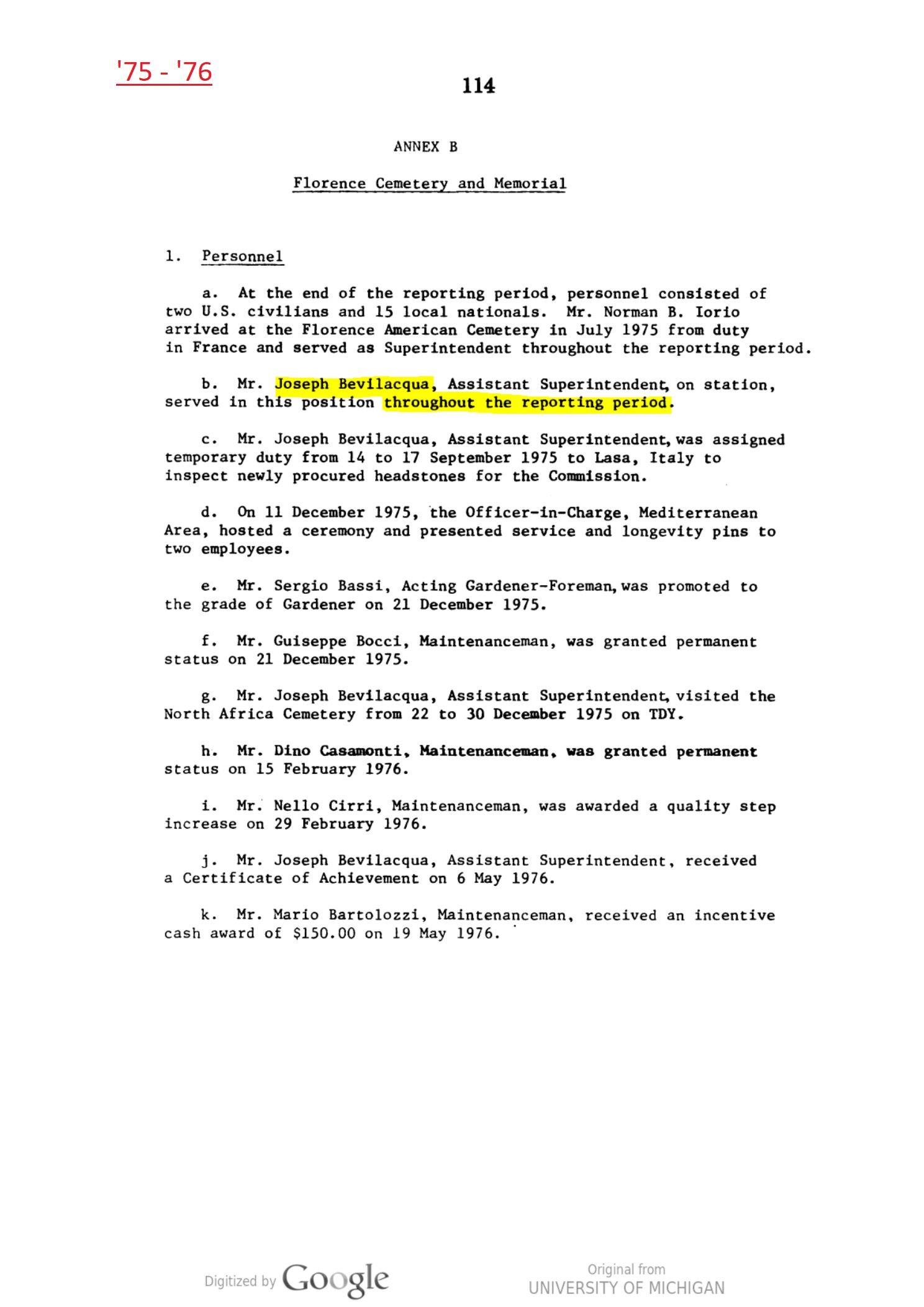
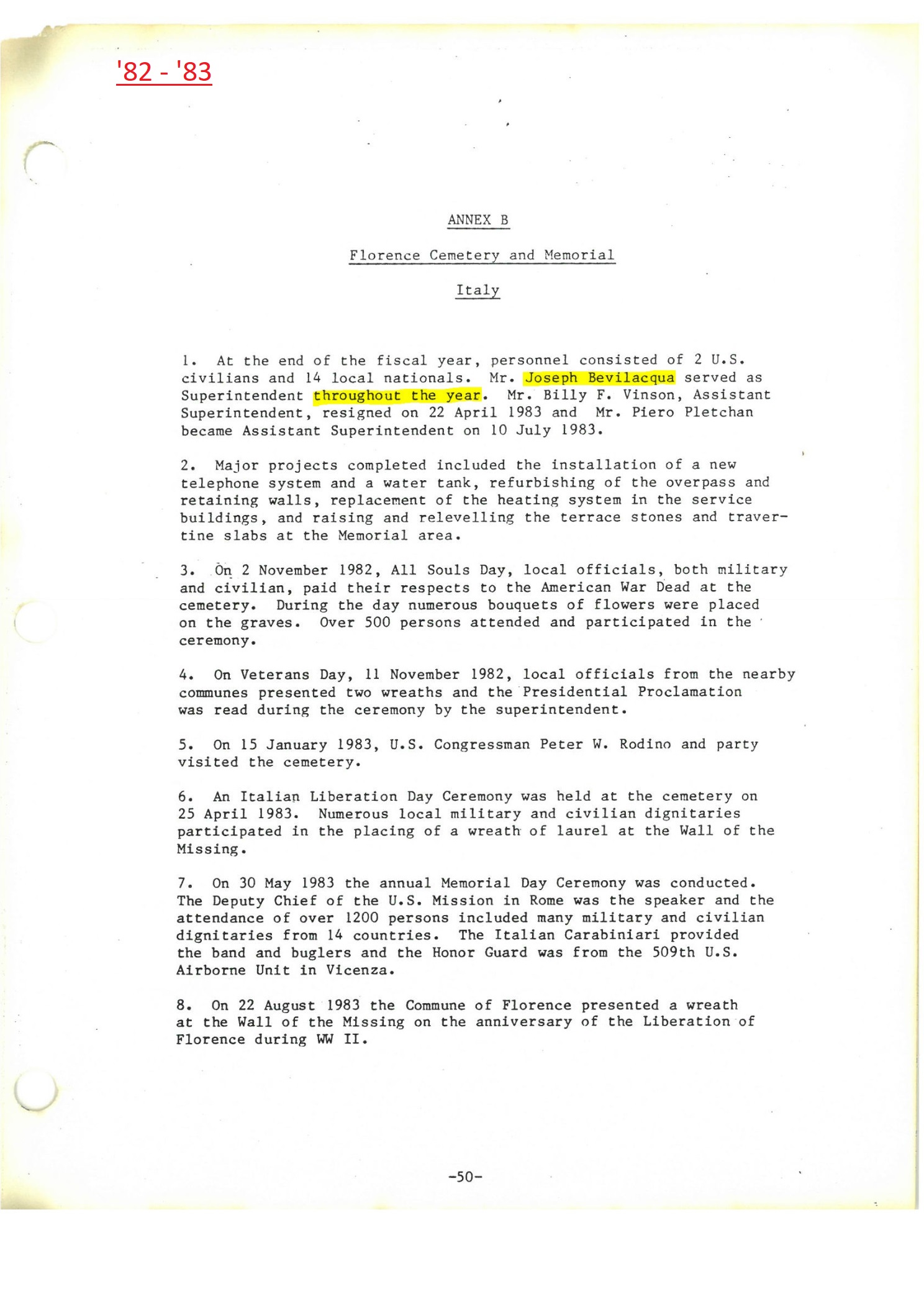
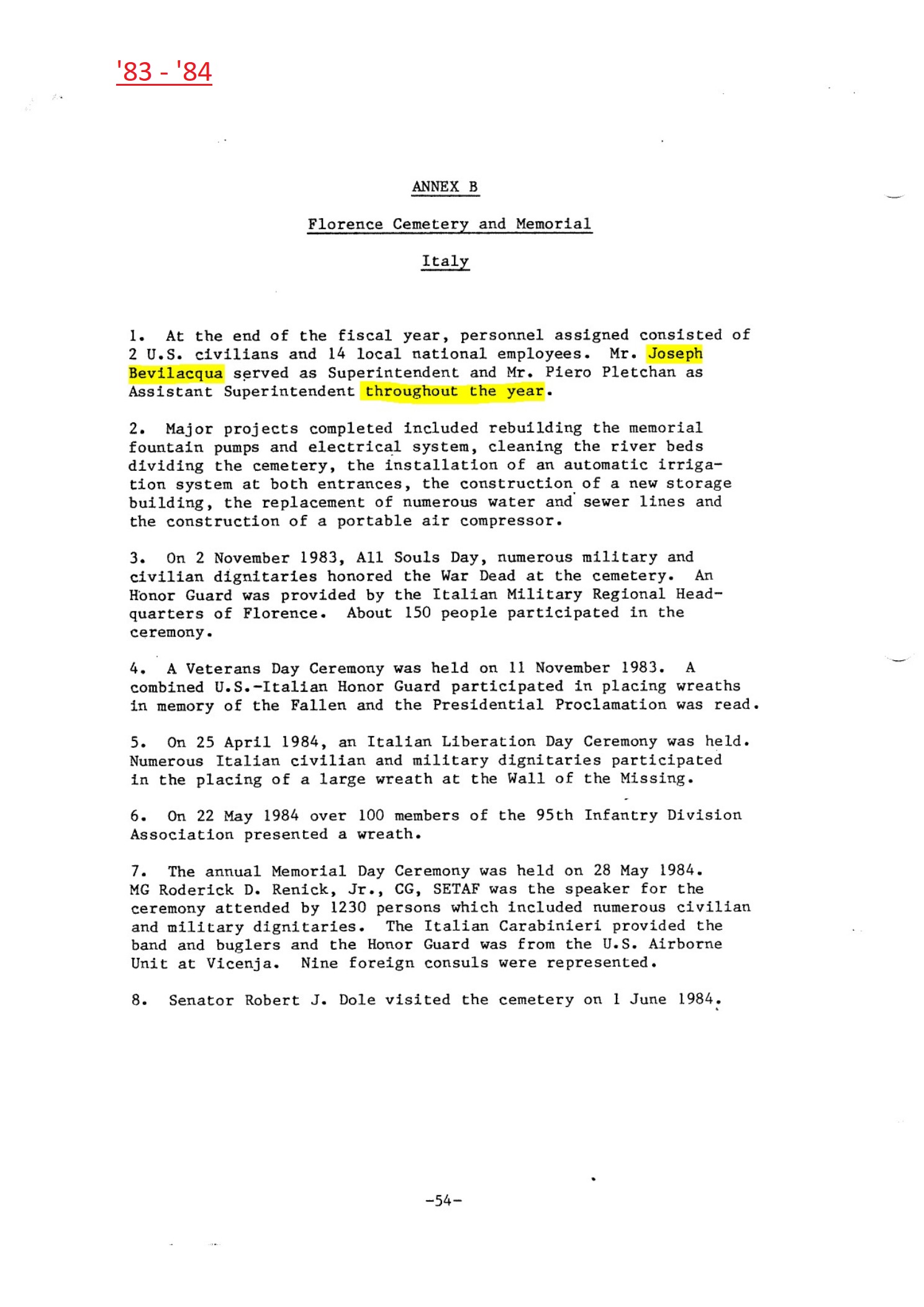
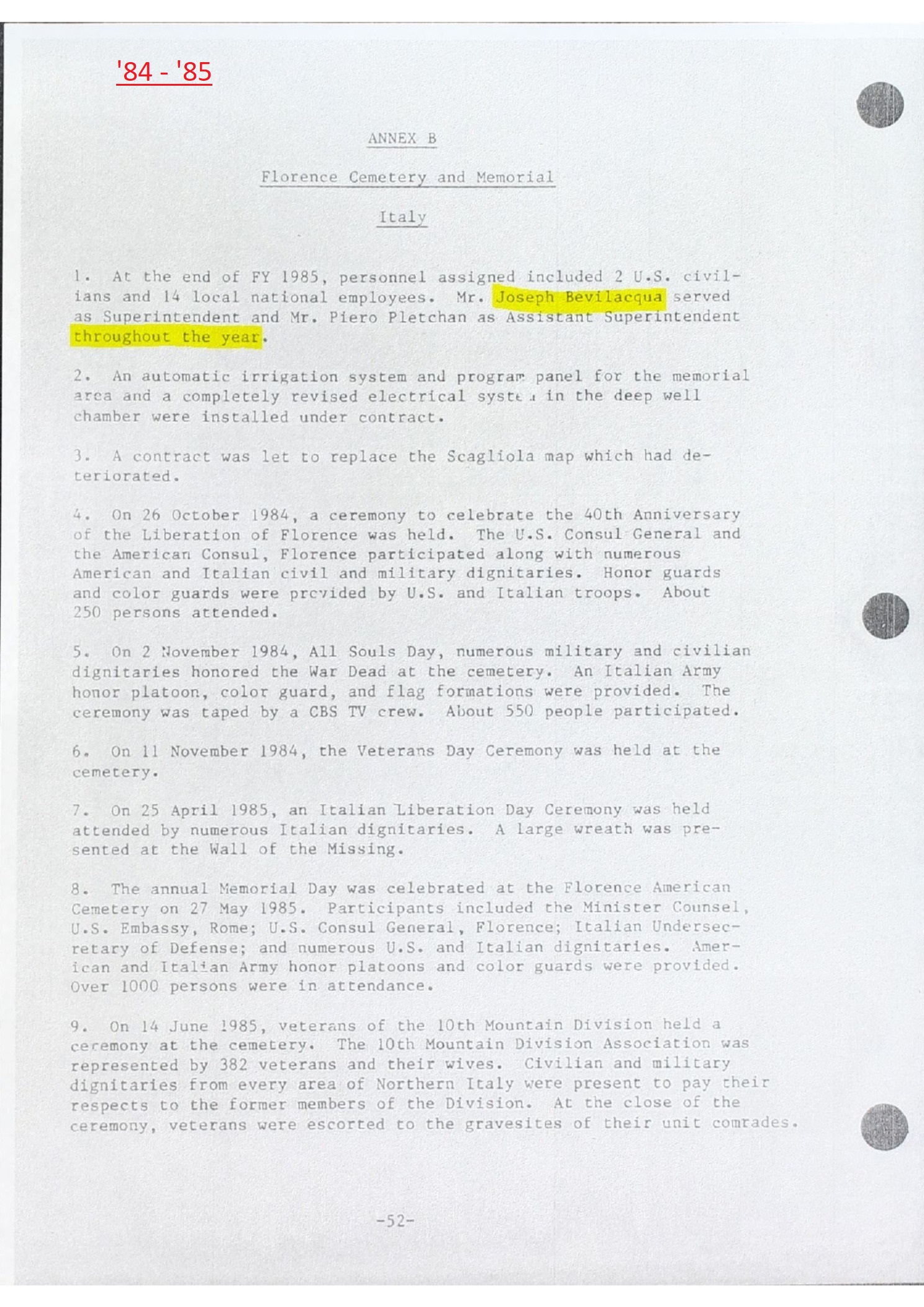
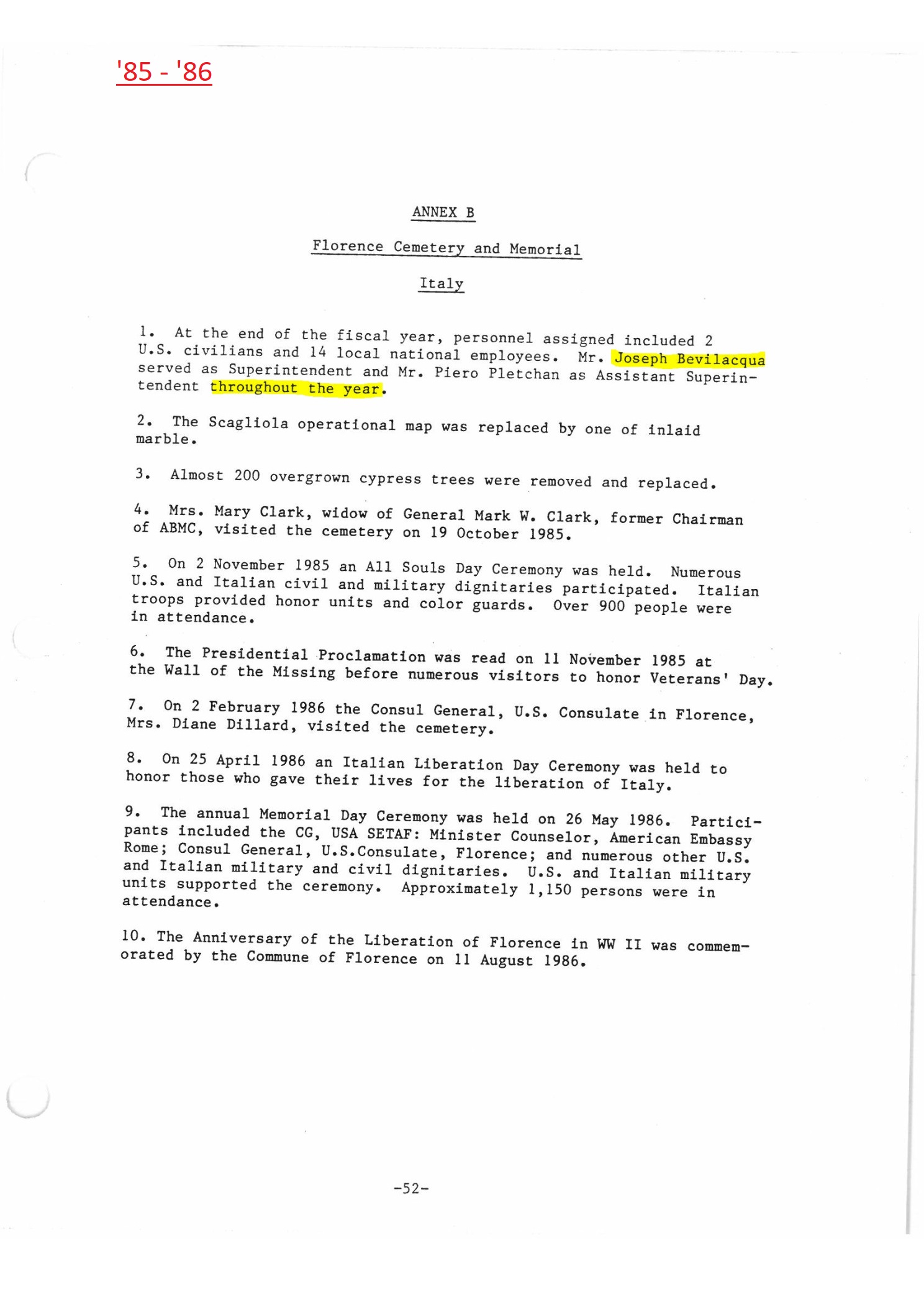
In the summer of ’74, between the last letter from Zodiac and the first definite attack of the Monster of Florence, Bevilacqua retires from the Army with the rank of first sergeant and settles near the Italian city, in the local American Cemetery, where he works for the American Battle Monuments Commission.

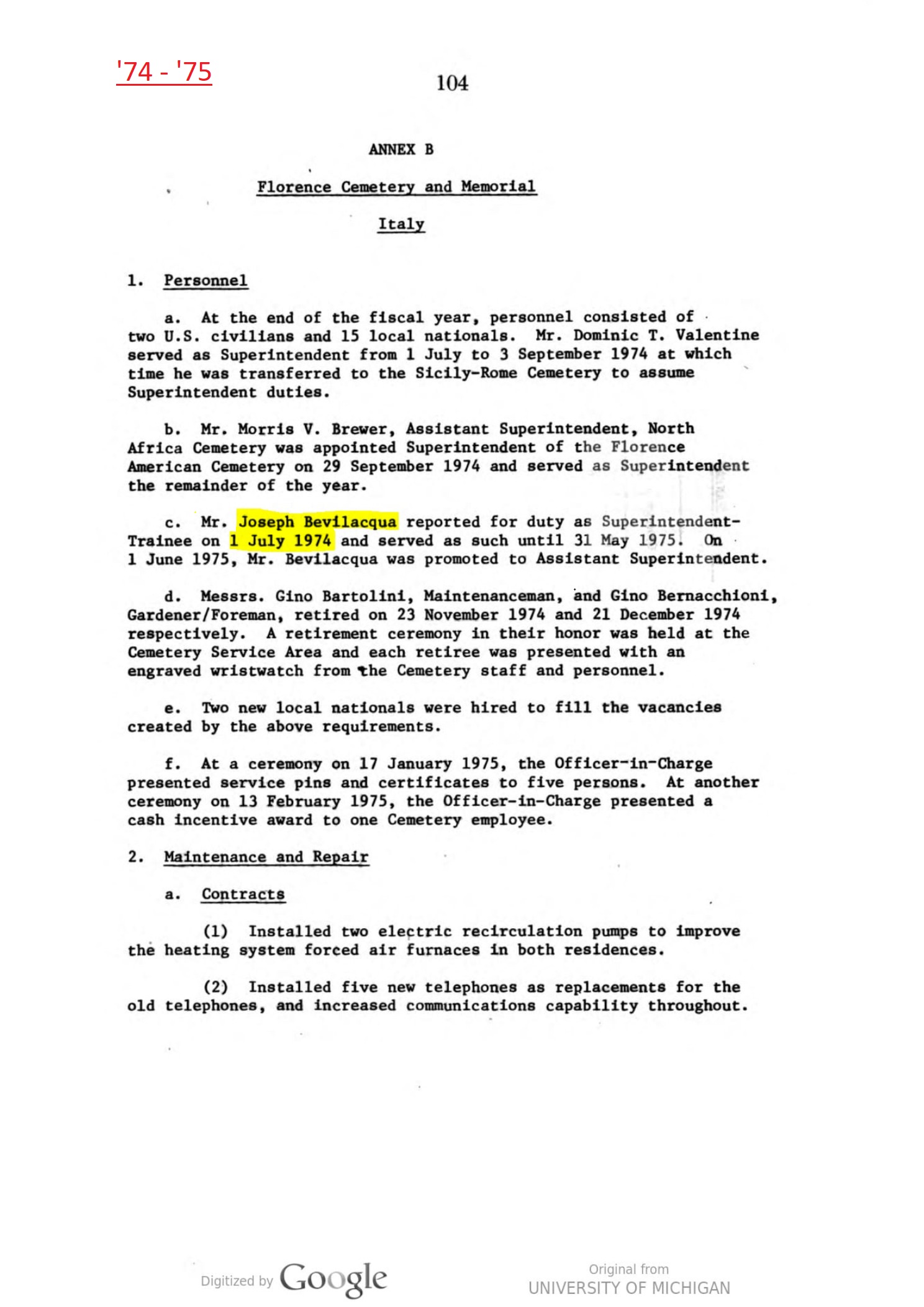
The records on Bevilacqua’s assignments by the ABMC (US Congressional agency that manages monumental war cemeteries) states that the Italian-American began working and residing at the Florence American Cemetery from July 1, 1974, until end of ’88, before being transferred to Nettuno.
According to the ABMC annual reports, at the time of the first three confirmed murders of the Monster (’74, ’81) there would be no other American officers resident in the cemetery apart from Bevilacqua.


6. INVOLVEMENT IN THE MONSTER OF FLORENCE CASE

While Bevilacqua resides in the Tuscan capital, the serial killer of couples labeled “Monster” by the media kills 14 people in the countryside areas surrounding the city. Four out of seven double homicides are committed within a half-hour’s drive of the American cemetery. However, the former CID investigator appeared as a witness at the Pacciani trial on the Monster case, claims that he had not “followed” the story (next video).
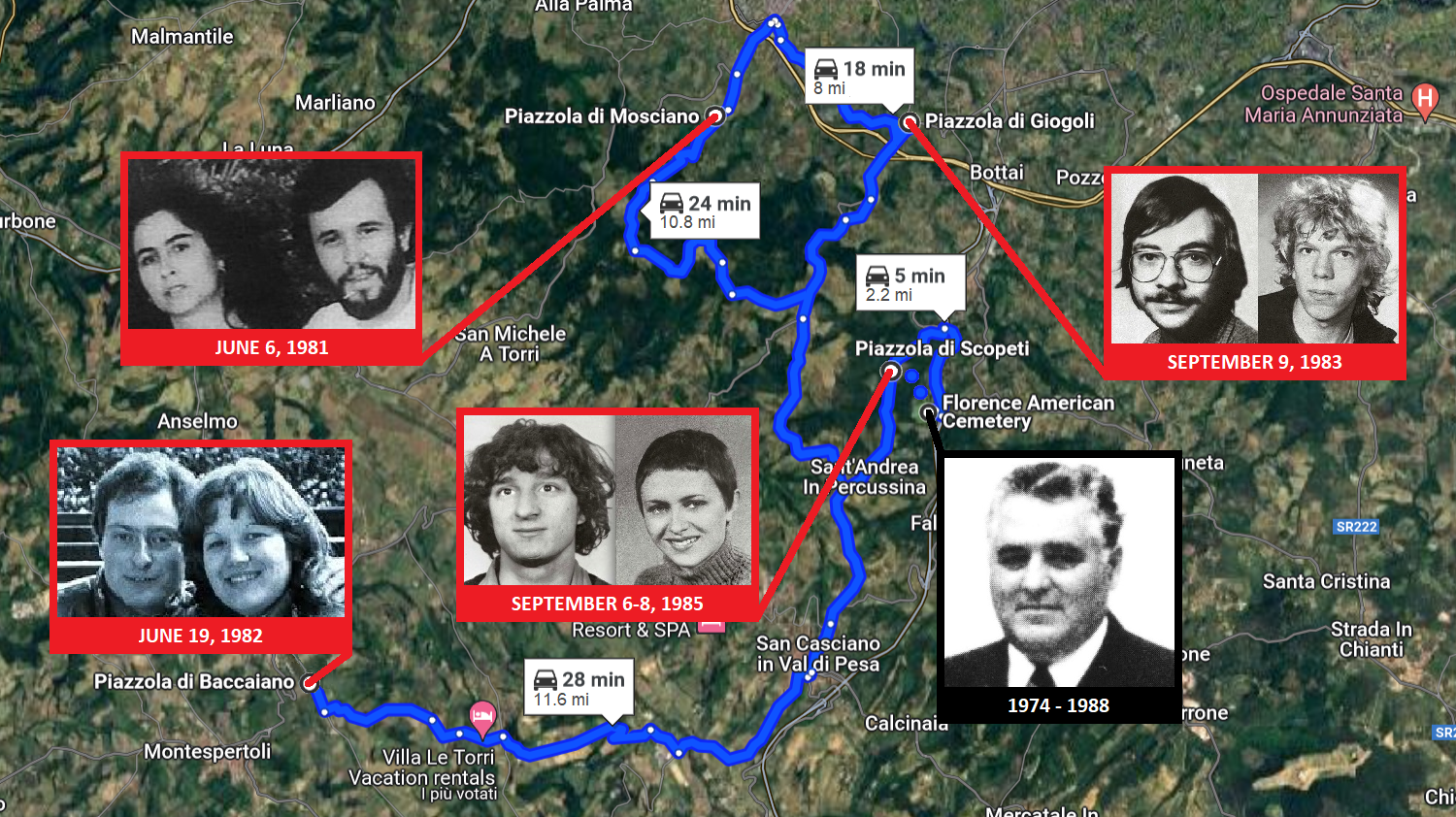

Bevilacqua’s deposition focuses on the Monster’s last double murder, dating back to ’85. The attack occurred about three hundred yards as the crow flies from the cemetery where he lived and worked until ’88, when he was transferred to Nettuno, near Rome.
The Italian-American claims to have spotted the defendant and the victims a few days before their deaths. He makes a serious mistake, claiming to have learned of the murders the morning after the crime, when the news had not yet been disclosed.
In his testimony, Bevilacqua avoids mentioning his military background and, above all, states that he does not know Pacciani.
In 2017, he tells me he knew him and will confirm the same to Carabinieri in 2018.
2017 talks and admission
Between May 26 and August 10, 2017, Bevilacqua and I have seven talks of approximately two to three hours each (verified by the Carabinieri).
On 1 March 2018 I filed a denunciation stating to the Carabinieri that Bevilacqua made an admission of guilt relating to the crimes of the Monster and Zodiac killer during a phone conversation dated September 12, 2017 (at the time I reported “September 11” for a mistake).
I did not secretly record the “admission call”, even though Italian law allowed it. The reason was ethical-professional.
I had given my word to Bevilacqua that I would not disclose information received from him without his consent.
However, the phone records confirm that, soon after that conversation with me, Bevilacqua contacted the criminal lawyer I suggested to him to help him turn himself in, as I states in a interview with the Carabinieri.
After the publication of the first articles of my journalistic investigation on tempi.it and Il Giornale in 2018, Bevilacqua sued me for defamation.
The analysis of the phone records, my statements and many other documents from the investigation resulting from my 2018 denunciation can be found in Italian at this link.
A few translations are here.
In 2021, the Florence DA’s Office obtaines the dismissal of the Bevilacqua case, without contacting the offended parties in violation of the Italian law.
Although the Carabinieri of the ROS of Florence have evidence of my reliability and Bevilacqua’s perjury in ’94 since the day after the actual start of the investigation resulting from my denunciation, they do not search his home nor inform the US Department of Justice. His DNA is not collected. It is acquired by the Siena DA’s Office, prosecutor Nicola Marini, in 2020.
In November 2023, one year after Bevilacqua’s death, I send his genetic profile to the US authorities in charge of the Zodiac case to defend myself from the accusation of having defamed Bevilacqua brought forward by his family and the Florence DA’s Office.
7. RECORDS
PRESS REVIEW (1954 – 2008)
MILITARY RECORDS (1953-1974)
ABMC ASSIGNATIONS (1974-2010)
 Zodiac, Mostro di Firenze

You must be logged in to post a comment.