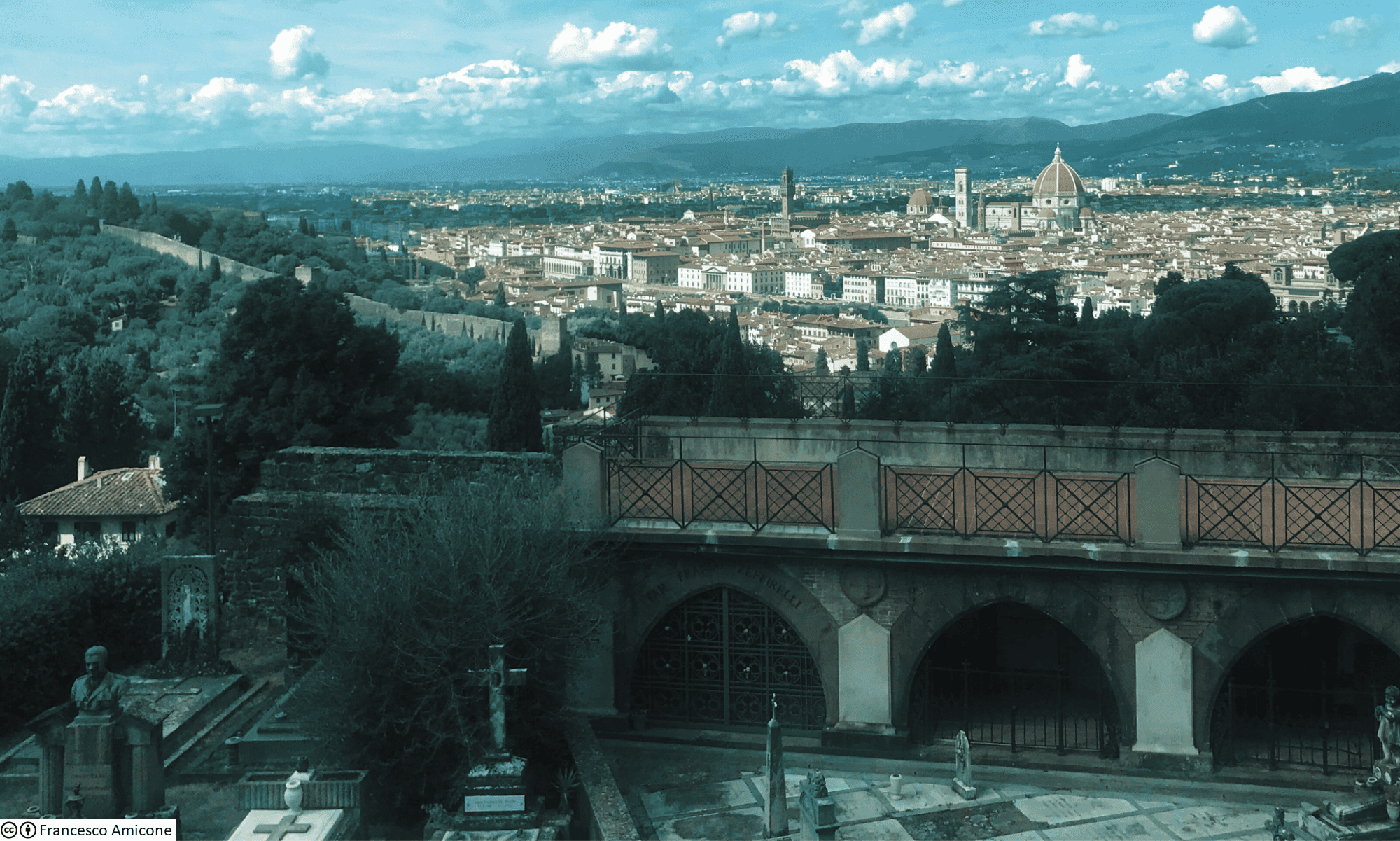

Original post from 2020 (link)
First sketch sent to the Italian police in 2017 (link)

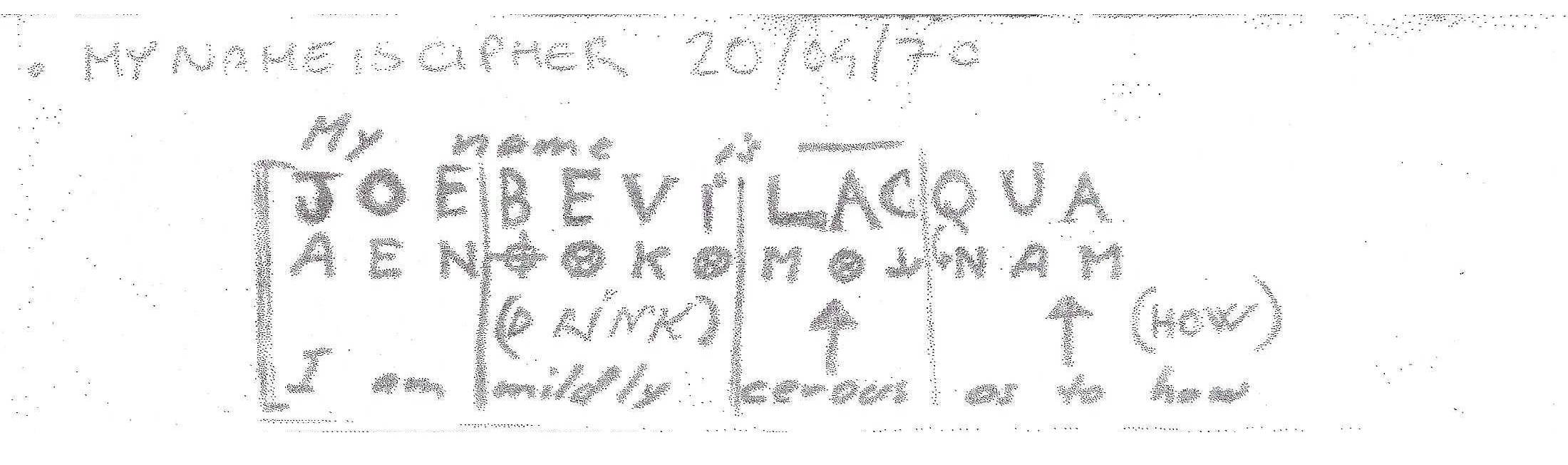
In this post I explain the decryption of the “My name is” cipher, a code of 13 symbols mailed to the San Francisco Chronicle in ’70.
I did not arrive at the solution with a standard method and there is not enough evidence to exclude possible similar results with other names. However, the decryption follows a logical criterion and can lead to a name and surname.
Joe Bevilacqua.
The decryption of Zodiac’s name dates back to 2017, but I had not yet identified the sources of the symbols. I reported it to the Florence law enforcement agencies on September 14, 2017. A few months later also to a blog of a so called “mostrologist”, who removed it later.
On June 6, 2018, I published it on mine.
In 2020, I believe I have come to locate almost all the references of the cipher. It will be seen that, apart from ancient symbols and terms, the sources used to encrypt the name were popular at the time the message was written.
INDEX
Click on the titles to scroll the page to the chapter of interest.
To return here, just click the “back” arrow on your browser.
INTRODUCTION
1. A TIP FROM JOE
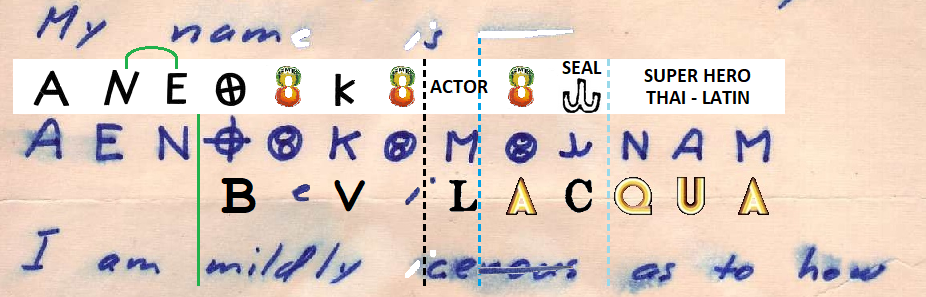
2. THE LETTER
3. “A CID”?
4. ANETHEKE
5. SET UP
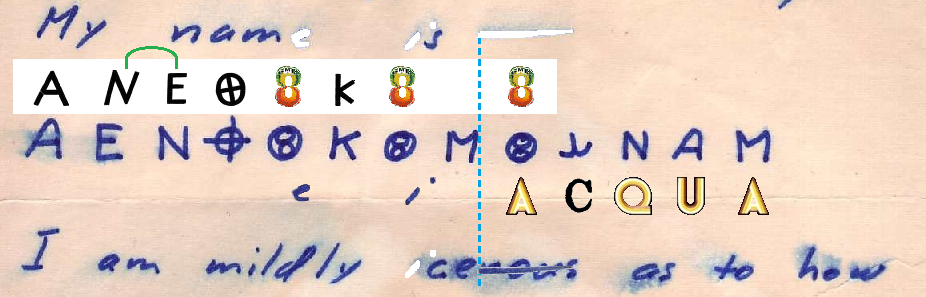
6. LET THE SUNSHINE IN
7. THE MUSICAL
8. AQUARIUS
9. WATER
10. QUA-NAM
11. CEROUS AND LAC
12. BEKIM
13. DON’T DRINK THE WATER
14. TAKE THE MONEY AND RUN
15. JOE
ENDNOTES
Introduction: Zodiac’s identity in his aenigmas
Before delving into decoding the name of the serial killer who nicknamed himself “Zodiac”, it is to be found the right method to do so.
Before that, by the way, it would be better to check for possible clues on his identity in other letters.

Between ’69 and ’74, Zodiac sent circa twenty letters to the press in the San Francisco area, most of them to the Chronicle. Some of them include ciphers and riddles.
There are four “aenigmas” expressly related to the name, identity or real signature of the serial killer.
Here they are in chronological order:
- 1969, July 31. First cipher (Z408)
- 1970, April 20. “My name is” cipher
- 1970, October 27. The Halloween card
- 1974, January 29. The “Mikado” signature (last definite letter)

First cipher anagram: “I bere e tope I’m the hit”
At the end of July 1969, an anonymous writer sent almost identical letters to three newspapers in the San Francisco area.
The alleged “murderer”, as he calls himself, claims responsibility for two fatal attacks near Vallejo, north of the bay.
The letters addressed to the Vallejo Times Herald, the Examiner and the Chronicle from San Francisco are signed with a Celtic cross. Each of them is accompanied by a portion of a a cipher.
In the one to the Chronicle, to which the last part is attached, the writer claims to have encrypted his identity.
The author of the notes, who will be known as “Zodiac” from the following August, threatens to kill again if the cipher is not published. The three newspapers fulfill his request.
The solution was found a few days after by two teachers from Salinas, Donald and Bettye Harden.
"I like killing people because it is so much fun / it is more fun than killing wild game in the forrest because man is the most dangertue anamal of all / to kill something gives me the most thrilling experence / it is even better than getting your rocks off with a girl / the best part of it is thae when I die i will be reborn in paradice and all thei (sic) have killed will become my slaves / I will not give you my name because you will try to sloi down or atop my collectiog of slaves for my afterlife / ebeorietemethhpiti"
There are some spelling errors in the plain text. It is also read “paradice” instead of “paradise”.
The serial killer will use the same word other times, afterwards.
“Paradice” is an obsolete archaic term. It can be a wordplay on “dice” or “ice”.
As for the identity of the author of the message, the Harden’s decryption seems to contradict the claim in the Chronicle letter.
The plaintext says that the serial killer does not want to give his name. However, the last 18 characters of the cipher remained unresolved.
They reads:
"EBEORIETEMETHHPITI"
Were the letters rearranged to form an anagram?
Yes, perhaps. In this case, the solution could regard Zodiac’s “identity”, although his name should not be there.
In June 2022, I manage to decrypt the anagram using the columnar transposition method (Zodiac simplified it by stopping at an intermediate step) and the keyword “paradice”.
The solution is:
"E EREB I TOPE I'M THE HIT"
The first part of the sentence is backwards (like six words, including “paradice”, in the Z340 solution) and contains two words in Italian, the verb “bere”, to drink, in the infinitive and the conjunction “e”, and.
The adjusted and translated text is a mysterious phrase.
"I DRINK AND TOPE I'M THE HIT"
What does it mean?
The answer is in chapter 8.

Halloween card: the Cuckoo’s game
At the end of October 1970, Zodiac send a postcard to Chronicle reporter Paul Avery.
It is a pre-printed Halloween card to which the serial killer has applied some changes.
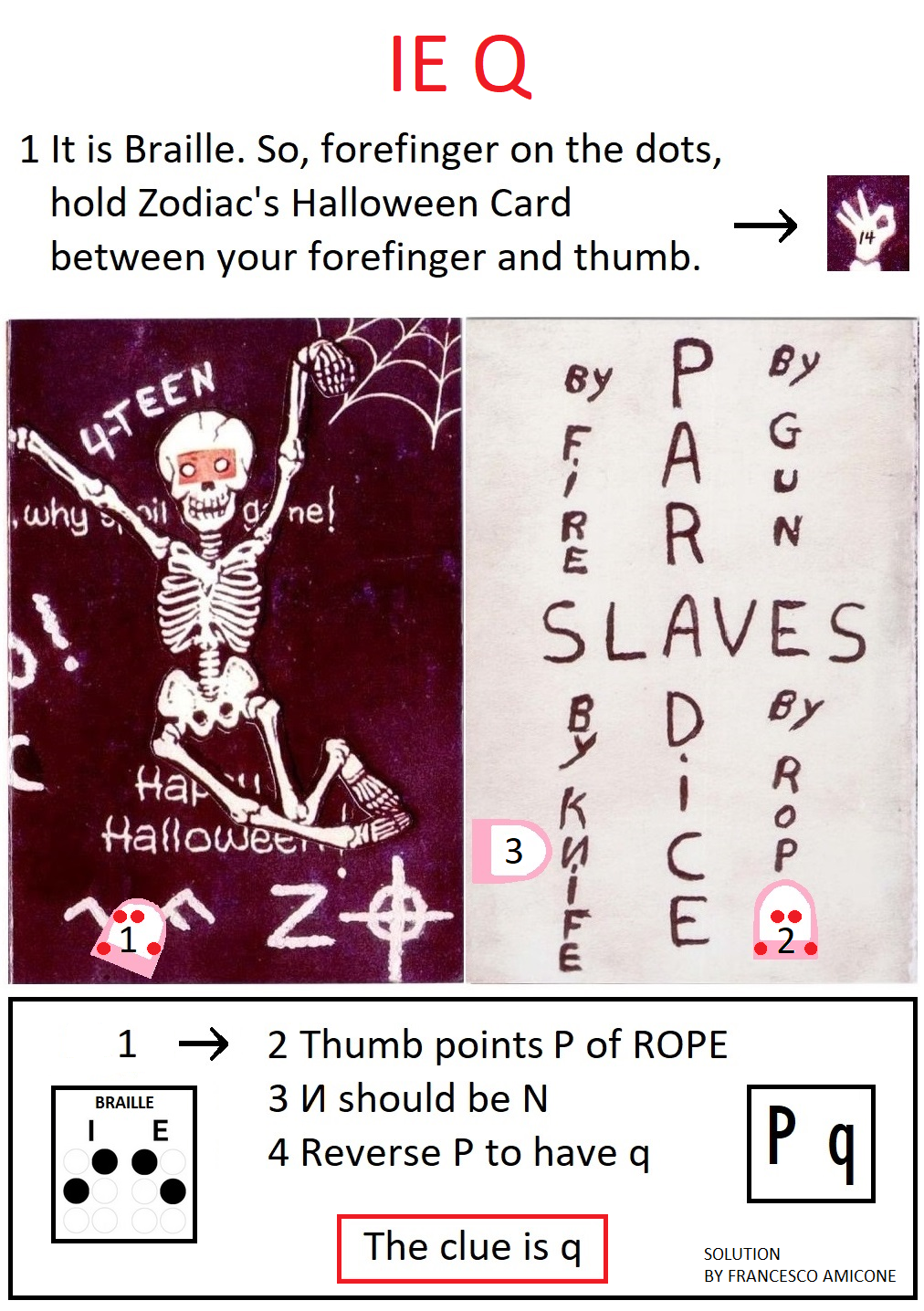
The card reads that the sender wants to give a clue about his name.
To facilitate understanding the solution, I used a reproduction of the postcard from David Fincher’s movie “Zodiac”, not the black and white FBI copies, which are however available in the post dedicated to the solution.
Zodiac has made some changes to the original pre-printed card (the cutout of a pumpkin, a skeleton, drawings, writings, etc.).
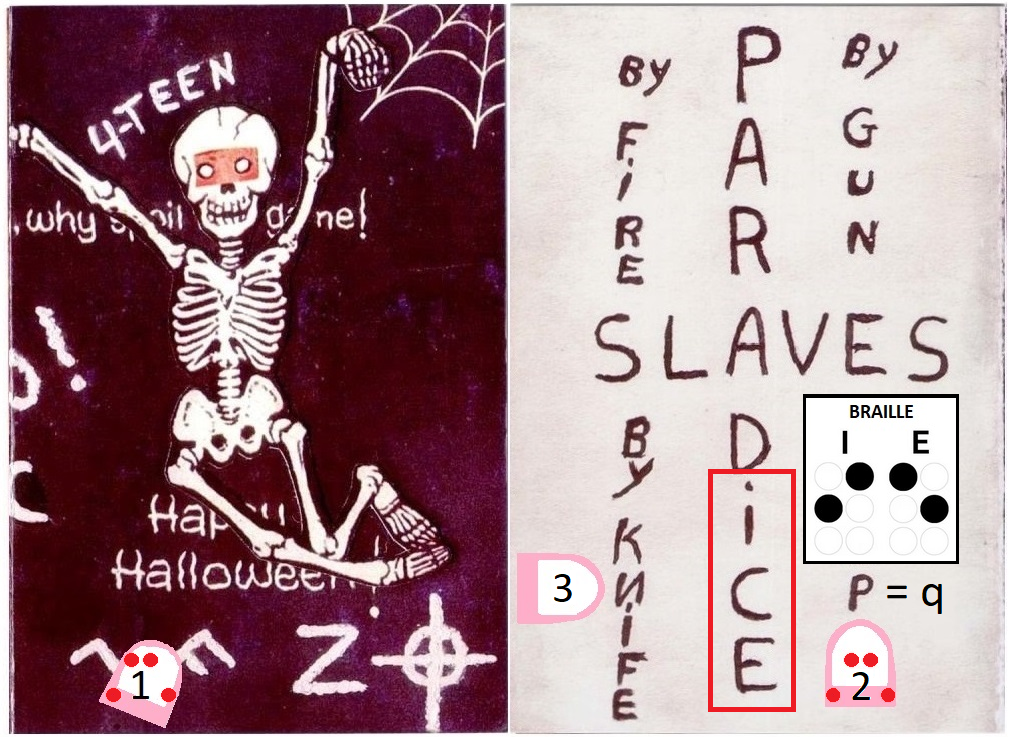
On the first page the card reads:
"I feel it in my bones,
you ache to know my name,
and so I'll clue in..."


I find the possible solution of the riddle in 2017, before the talks with Bevilacqua, to whom I submitted the postcard in August 2017. On that occasion, the Italian-American grins and then, in silence, with only the movements of his fingers, indicates what I already consider to be confirmation of the solution (next images).
The riddle refers to “il gioco del cucù” (the cuckoo’s game), the Italian name for peek-a-boo, and on the pronunciation in Italian of the letter “Q”, which is assonant to “cu” in the word “cucù”.
Therefore, the clue to Zodiac’s name is the letter Q.
Zodiac used the Braille alphabet by inserting “ie” (which means “that is”) and the symbol of Red Ryder‘s ranch, main character of an old western comic, to direct the reader to the confirmation of the solution (bottom right image).
Zodiac’s postcard alludes to a second western comic starring Tim Holt as Redmask (chapter 11).
The names of both characters are accomunated by the word “red” (chapter 13).

Last signature: a stanza on a drowning
Zodiac returns to make itself heard in ’74, after a three-year hiatus. It is unknown what kept him from sending notes and what will happen to him afterwards. The letter postmarked on January 29, 1974, is his last certain written communication. Other not definite but possible letters date back to the immediately following months.
Three years after his last contact in ’71, Zodiac’s handwriting and style have not changed. With the blue felt-tip pen that characterizes most of his correspondence, he threatens to do something “horrible” if he will not see his message in the Chronicle.
This time, the serial killer does not sign himself with the Celtic cross and his nickname.
He prefers to use a stanza from “The Mikado” by Gilbert and Sullivan, an operetta that he had already quoted four years earlier, in ’70.
He writes:
"Signed, yours truley:

He plunged himself into
the billowy wave
and an echo arose from
the sucides grave

titwillo titwillo titwillo"
It is a verse by Ko-Ko, Titipu’s “supreme executioner”, who is recounting the death by drowning of a desperate little bird who cannot find a partner and has decided to commit suicide.
Zodiac’s signature has something to do with this passage, according to a literal interpretation. There should therefore be a correspondence between the solution of the riddle and his name (following video).
It must be said that there is a recurring element in the criminal activity of the serial killer that also returns in this signature. The water (chapter 9).
How to decrypt Zodiac name?
Zodiac’s “my name” cipher is received from the Chronicle towards the end of April, 1970.
It seems like an encrypted text like the previous ones, the Z408 and the Z340, and like the Mt. Diablo code, where one or more symbols uniquely corresponds to a character of the plain text (the solution).
Questioning this hypothesis there are two clues.
- Zodiac is able to construct complex ciphers like the Z340, and he could be trained to do so by US military agencies according to Army experts (chapter 2). He should know that with a 13-symbol cipher you can get many names using different equally valid codes (is it consistent with a narcissistic serial killer?);
- The first part of the cipher is clearly copied from a slightly modified ancient Greek inscription (chapter 4). This discovery, published for the first time by the site zodiackiller.com, casts strong doubt on whether it is a substitution cipher.

The word “anetheke” can be found in many Ancient Greek temples. In this context, the translation is: “set up” (as a votive). It was part of a dedicatory formula for votive gifts to the deities.
The first part of the Zodiac code does not refer generically to the word “anetheke”, but to a specific inscription with an archaic “theta” in the shape of a Celtic cross which can be found in a temple of Poseidon (god of the sea) at Cape Tenaro, in Laconia, and was reproduced in the book “The Alphabet” by type designer Frederic W. Goudy.
It is possible that Zodiac saw the illustration in “The Alphabet” and decided to use the inscription in writing the cipher (several copies of this work are still available at the San Francisco Public Library).
I found confirmation of this criterion with the discovering of the probable reference of the anchor symbol in 2019.
In chapter 11, I explain why “probable” and not just “possible”.

The two new symbols shown above the cipher can be found on the English Wikipedia page on the Brahmi alphabet.
They come from a book containing images of ancient inscriptions (again), “Inscriptions of Asoka” by archaeologist Alexander Cunningham.
They are part of a Brahmi translation of an inscription on a seal from Harappa.
In recent years, several US universities have decided to digitize their collections (for example, the HathiTrust project). The works of Goudy and Cunningham are part of it.
It is possible that Zodiac consulted these two publications in the same history/language area of a library. In or around San Francisco.
It will be seen that other symbols in the “cipher” (M and NAM) also have connections, directly or indirectly, with the antiquity.

1. A tip from Joe: “ceroso“
Summer 2017. For a few months I have been conducting a journalistic investigation on the Monster of Florence. My research led me to Zodiac and a man named Joe Bevilacqua (bio).
Between May 26 and August 10, I have seven talks with Bevilacqua at his home and in Falciani, next to the Tuscan capital American Cemetery. The existence of the meetings will be verified by a ROS Carabinieri’s phone cells analysis.
On September 12, 2017, upon reading part of this decryption over the phone Joe owns up to the crimes committed by the Monster and Zodiac. He will deny the admission of guilt the following year, when investigated by the Florence DA’s Office on the basis of my denunciation (case dismissed in 2021).
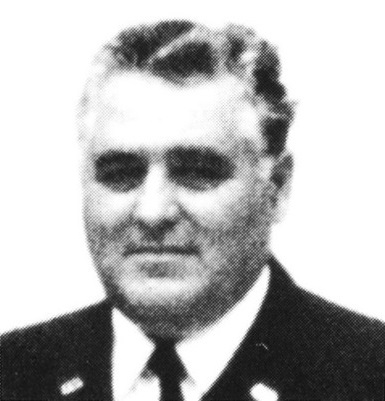
Joe is an 81-year-old Italian-American from New Jersey. During his 20-year career in the United States Army, he served as a chemical instructor and Army CID investigator. In Vietnam he was awarded the Silver Star and other prestigious medals for valor.
In ’94, Joe testified at the Pacciani trial on the “Monster of Florence” case. At the time of the murders, he actually resided in the serial killer’s area of activity. The last certain crime, in ’85, was committed near his home, the Florence American Cemetery where he worked as director.
One afternoon in August, while we are on the balcony of his house, an apartment overlooking the Autostrada del Sole and the Florentine hills, I pass him a copy of the first page of the Zodiac letter with the encrypted name of the serial killer.
Joe takes the paper and begins to read aloud, translating each line into Italian.
When he reaches the thirteen symbols, he smiles and raises a hand:
“Forget it.”

He focuses on the line below.
“Io sono moderatamente ceroso…” (cerous means "waxy" in Italian).
"This sentence is strange," he observes.
"Why did he write 'cerous' instead of 'curious'?"
Joe’s tone is thoughtful. I am about to say something, but he anticipates me.
"Ah, you think it is an error..."
A few weeks later, thinking back to the emphasis put on “cerous”, by the elderly retired sergeant, I wonder if perhaps he wanted to give me a tip.
Is “cerous” an important element in solving the puzzle?
I realized so in the first days of September 2017 by writing the name “Joe Bevilacqua” above the cipher, although I only understood two years later how this word is essential to solve the puzzle (chapter 4 and following).

As I try to figure out how “Zodiac” encrypted his name, I notice another detail.
I have an Oxford Paperback dictionary (1988) on hand. I look for English words that start with AEN, like the Zodiac cipher.
I find “Aeneid” and “Aeneas”.
Virgil’s Latin poem and its legendary protagonist are the only words quoted.1
Could there be some connection between Zodiac’s cipher, the great Mantuan poet and his work?
I will discover that not only is Virgil leads to understanding how the serial killer encrypted a letter of his own name, but also reveals the “disguise” he mentions in the message of 9 November 1969, the motivations underlying the selection of two crime scenes, as well as the reason for the use of the word “lavare”, to wash, in his criminal activity between September and November ’69 (chapter 13).
2. The letter


3. A “cid”?
Premise. You will see that the Zodiac name is not encrypted with a substitution code. The symbols are part of a puzzle game.
The words above and below the symbols are needed to arrive at the solution. For this reason it is necessary to include them in the decryption.
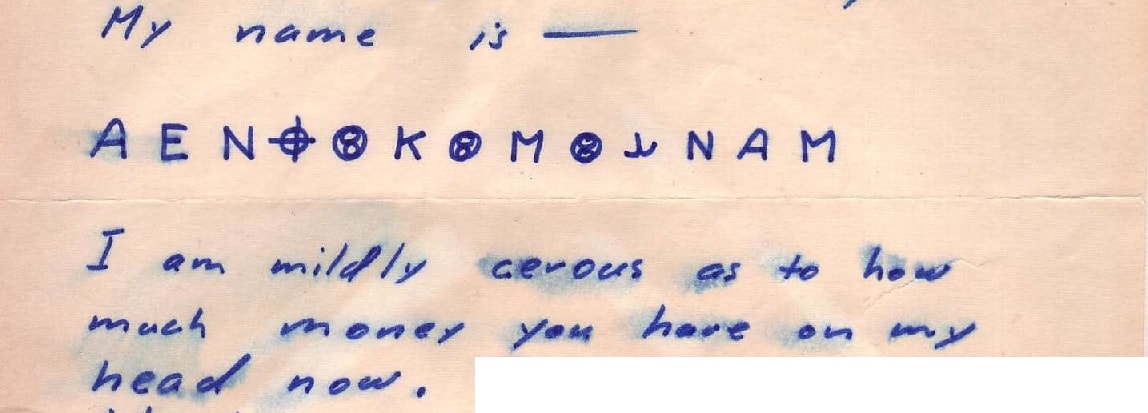
In his letter to the San Francisco Chronicle postmarked “April 20, 1970”, Zodiac claims to have encrypted his name in the line of 13 symbols on the first page.
Immediately after receiving this communication, the San Francisco Police Department (SFPD) asks the FBI to decrypt the cipher. The Bureau’s specialists are not able of doing so.2 The text is too short.
A few months earlier, the military intelligence agency Army Security Agency and the Criminal Investigation detachment (CID) at the Presidio of San Francisco contact SFPD investigators.
An FBI airtel reports:
"ASA and CID at Presidio, San Francisco, of opinion unsub this matter probably trained in crypthography by U.S. military."3

If it were true, the serial killer should know that the 13-symbol message cannot be “cracked” without hints, or clues similar to the one he will insert into his Halloween card in October 1970, according to the solution I proposed.
Is it possible that there are also some in the same letter that contains Zodiac’s encrypted name?
On the first page of the message, the author of the puzzle asks readers if they have found the solution to the previous Z340 cipher.
He says he is “cerous” – instead of curious – to know the amount of the bounty on his head.
He calls the cops “blue meannies (sic)”, like the Beatles’ antagonists in the film “Yellow Submarine”. And he claims to have been “swamped out” by the rain some time before.
What is it referring to?
Zodiac claims not to be the perpetrator of a recent attack on a police station, which will become his target a few months later, according to my decryption of the “Mt. Diablo code”.
In the same sentence he writes that there is “more glory” in killing a policeman rather than “a cid” (instead of “kid”).

The mispelling is likely to be deliberate. In fact, in a previous letter about the Stine murder, Zodiac correctly uses the plural of “kiddie”.
Could “Cid” be an allusion to the military investigators of the Army Criminal Investigation detachments (such as that reporting Zodiac’s possible military background) Bevilacqua tells me he was with between the 60s and 70s?
On the second page, the author of the note sketches a diagram of a bomb he threatens to detonate.
He concludes the description of its functioning with these words:
"...so the bomb wont go off by accid."

Just remove the first C added by Zodiac to “acid” to change the meaning of the sentence to this:
"...so the bomb wont go off by a cid."
If this is the allusion, Zodiac would be identifying himself with “a cid”. The mispelling of “kid” would be a way to highlight the wordplay on the second page.
4. Anetheke
The first block of the code consists of a modification of an ancient Greek word in capital letters, ANETHEKE, set up (or dedicated). The discovery was first published by the website zodiackiller.com.
The Theta of the inscription above the cipher has a particular, uncommon shape, similar to a Celtic cross. An illustration with this type of Theta can be found in the book “The Alphabet” by typo designer Frederic W. Goudy.4
Goudy is well known in the printing community and his book is in the collections of many universities and public libraries, also in San Francisco.5 It is possible that Zodiac leafed through the book at one of these, coming across the illustration.

The inscription is in the Temple of Poseidon, god of the sea, at Cape Taenarum in Lakonia, Greece.
Zodiac makes three changes:
- He inserts his Celtic cross in place of the Theta;
- Replaces the second and third E with a circled 8;
- Switch N and E.

As for the Celtic cross, the similarity with the Theta in the inscription of the temple of Poseidon may explain why the author of the cipher replaced one with the other.
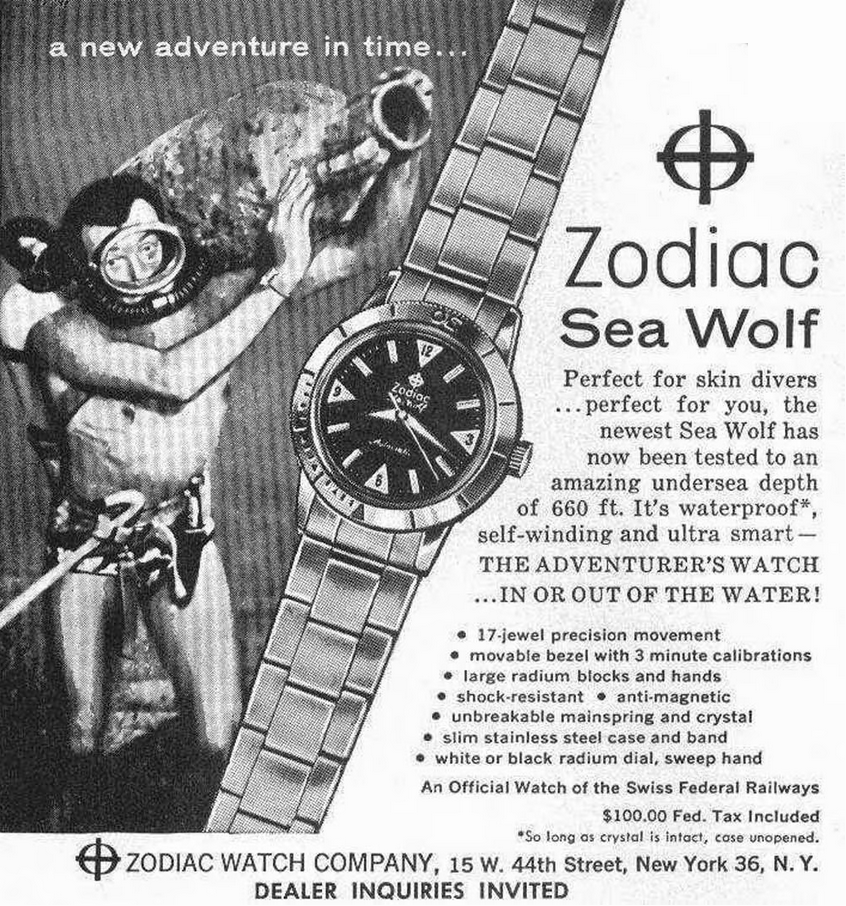
Although Zodiac has never said anything about the origin of its nickname, it is almost certain that it was copied from the “Zodiac” watch brand as well as the symbol accompanying it.

Zodiac’s flagship product between the 50s and 60s is the “Sea Wolf”. The advertaising campaign is focused on the water-proof quality of the watch.
In 1967, the following ad appeared in various newspapers in the US, including the Los Angeles Times.6

The catch-phrase says:
"A skin diver's watch?
The only time
I'm under water is
in the shower."7
5. Set up
As seen in the previous chapter, the inscription from which Zodiac may have been inspired in the choice of symbols in the first part of the cipher comes from a temple dedicated to Poseidon.
ANETHEKE comes from the verb anatithemi (ἀνατίθημι) composed of “ana”, (on/upon), and tithemi (lay, put). According to the Greek-English dictionary Liddell-Scott-Jones, “lay upon” is the first meaning of the verb.8
Italians Rocci9 and Olivetti agree in indicating “put on” (the Olivetti adds “overlap”).
Other meanings follow including “set up”.
Archaeologist James Whitley, Cardiff University, writes:
"In the Archaic period many votives were inscribed. Sometimes the inscription just gives us the name of the deity to whom the object is dedicated. Often, however, a particular formula is followed: the dedicator's name, followed by the verb 'set up' (anetheke), followed by the name of the deity in dative case."10
Whitley explains that “anetheke” refers to a votive object “set up” in a temple for religious reasons.11
The same phrasal verb is used by Zodiac at the beginning of the second page of the letter.

What if it is not a coincidence, but an indication to solve the cipher?
Below the sentence is a diagram that would describe how the bomb works. It consists of a solar disk with two arrow-shaped rays, two parallel lines representing a road, and finally a rectangular bus.
Perhaps what Zodiac wants to suggest is:
“The new bombMy name is - set up like this”
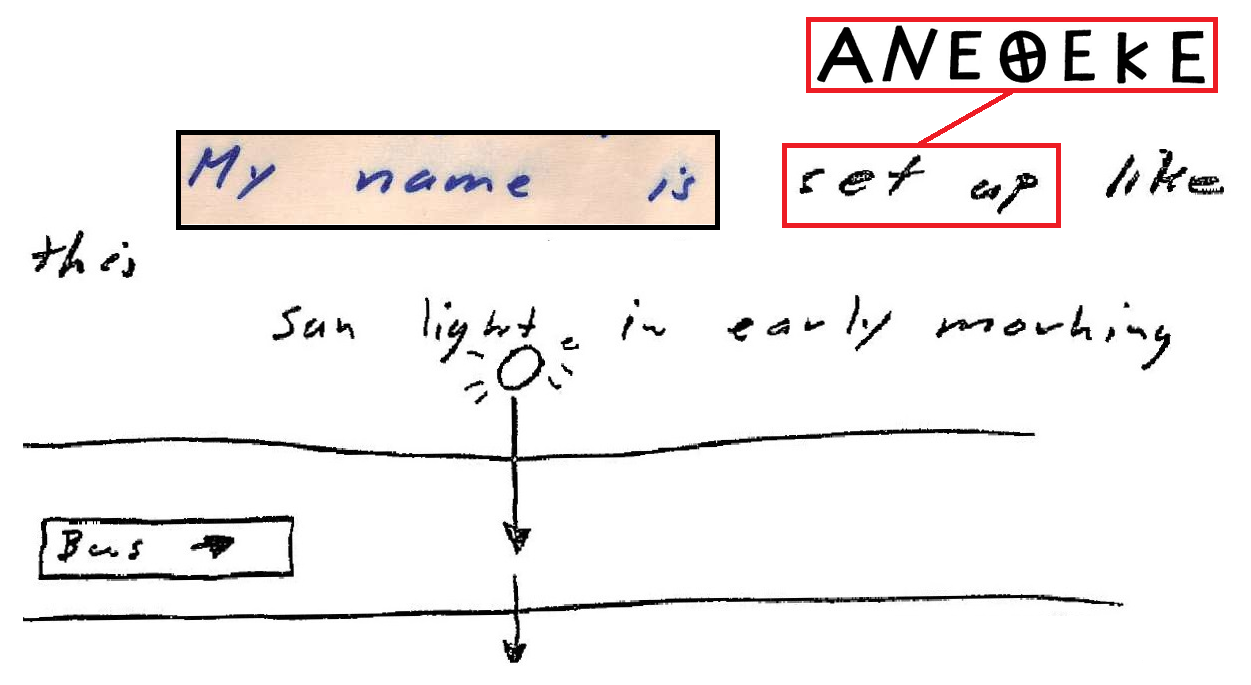
The diagram could be the tool to decrypt the cipher. It remains to understand how to use it.
In 2020, I will be reminded of Bevilacqua‘s words in 2017, when at bar Marconi in Falciani, asking him for “help” on the cipher of 340 symbols of November 1969 (solution found by three researchers in 2020), it tells me generically that there are various ways to decrypt encrypted messages.
“Sometimes, masks are used.”
For “masks”, Bevilacqua means grilles with witch some ciphers have to be overlaid with.
Maybe the diagram of the bomb with the sunbeams is a grille to put over the coded name of Zodiac?
What is certain is that the day before the interview at the Marconi bar, tempi.it published an article of mine on Giampiero Vigilanti, the last suspect in the Mostro case in Florence, and that Bevilacqua continues to call him “Raggianti” (radiant).
The date and area of the talk will be verified by the Carabinieri in 2018.12

6. Let the sunshine in
This chapter explains the method to decode the first letters of the cipher (next video). The next two chapters deal with the source from which Zodiac took inspiration in designing this system.
The method is suggested:
- by the presence in the first part of the cipher of the word ANETHEKE, to which Zodiac has made some changes;
- by the connection with “set up” (which is the translation of ANETHEKE) before the bomb diagram on the second page of the letter;
- by one of the meanings of the verb from which ANETHEKE derives, “anetithemi”, i.e. “put over” (previous chapter).
ANETHEKE indicates that part of Zodiac’s name must be decrypted with the diagram.
How?
By “putting it over” the cipher like a sort of “grille”.
I explain how in the next video.
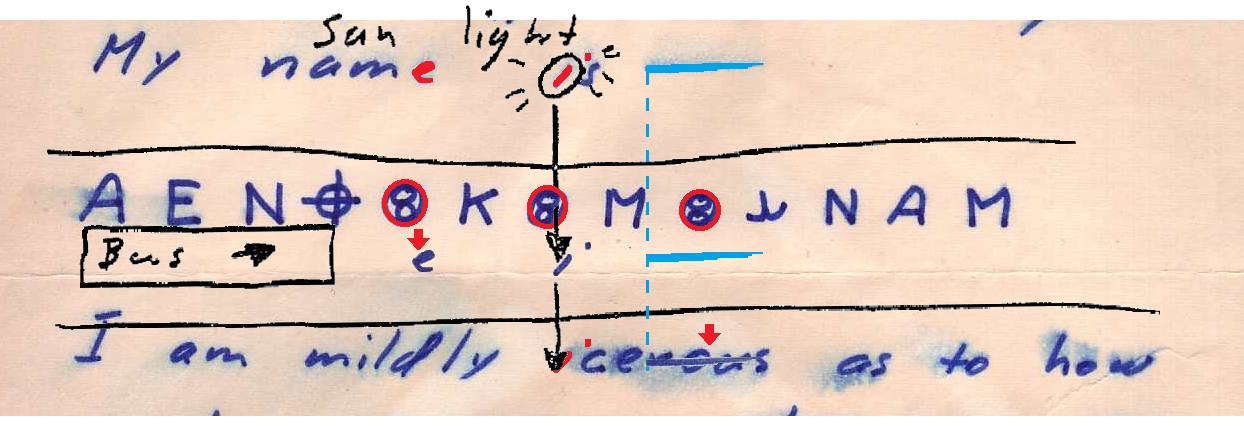
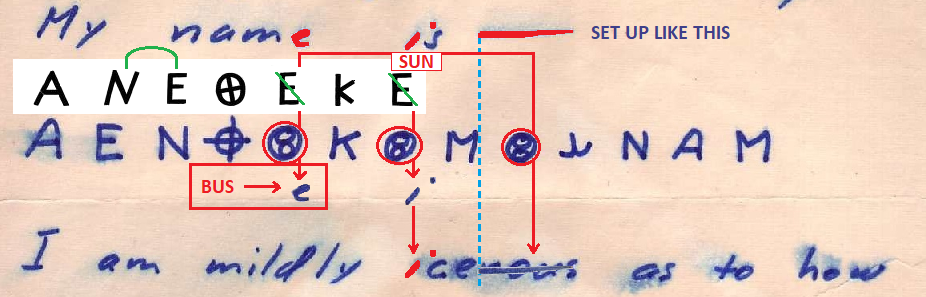
By superimposing the diagram on the first page, the translations indicate by the arrows, corresponding to the circled 8 symbols:
- move the letters E, I under the cipher (first arrow);
- form the word ICE (second arrow).

The method can be verified by downloading the next image at this link. The bomb diagram must be slid onto the letter. The method applies in correspondence with the three circled 8 symbols.
In the ’60s tracing paper could have been used. Today it can be done on the computer with a program like Microsoft Paint (to superimpose, click “selection”, then “transparent selection”).
A clarification: the image of the diagram comes from the black and white photocopy in chapter 2 obtained by the FBI via a FOIA response published on the zodiackiller.com. The two black and white pages were resized because they had the wrong aspect ratio.
In the absence of a color scan of the same quality as the first page of the letter, available here, to resize the second page I took as a reference point the unit of measurement stamp (1 inch) present on both b/w photocopies .
There may be negligible differences from the original, but they will be uninfluential.

If you place the bus exactly at the beginning of the ciphe, under AEN, you notice that:
- the sun is positioned on the I of “is”;
- first arrow points to a blank space under the circled 8 symbol;
- second arrow points to a blank space before “cerous”, with the bus just below/tangent to the cipher.
The arrows could indicate two translations of the I.

The first arrow moves the letter I below the cipher, onto the bus track.
The second “sunbeam” put the I before “cerous”, a mispelled word which now becomes “icerous”.
If you scroll the diagram in correspondence with the last circled 8, the solar disk stops on a dash which indicates a pause of suspension identical to the one on the second page (“the new bomb is set up like this…”) where instead it is missing .
Perhaps the dash here has a utility beyond its apparent purpose?
In fact, combined with that of the I, the translation of the dash on the word “cerous” (which meanwhile became “icerous”) forms the word ICE.
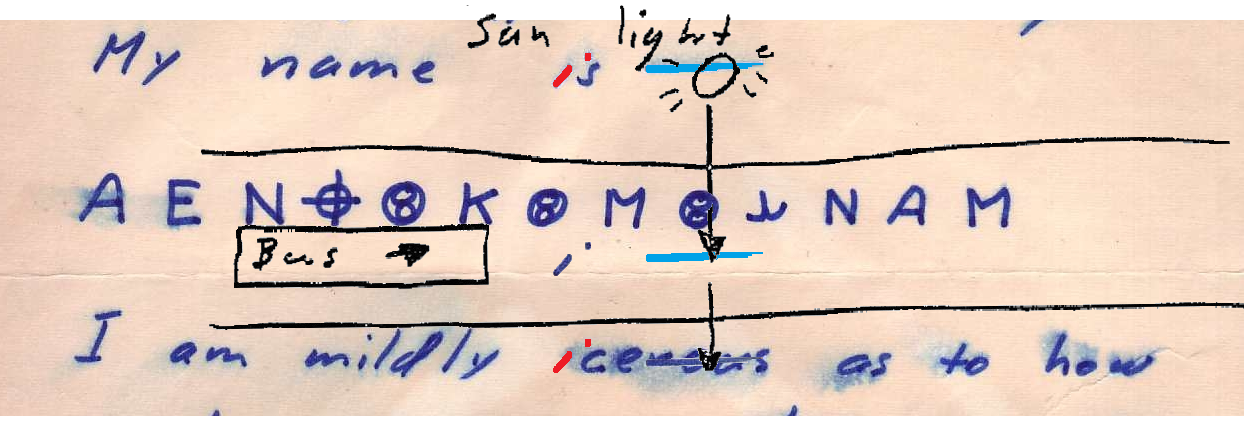
ICE is obtained in correspondence with two circled 8s. It can be deduced that the first of the three must also be translated.
In this case, the system only makes sense with the first arrow, which indicates an empty space on the “roadway” of the bus.
From this method it can deduce that:
- the first arrow may decrypt two letters of Zodiac’s name, E, I, which are placed under the cipher;
- the second arrow forms ICE, a word that can be a suggestion on the letter corresponding to the last circled 8.
By “animating” the bus and moving it along the horizontal axis you can see how it precisely “intercepts” the letters on its track with the first sunbeam entering inside it.

There are several points to believe that this method is correct.
- As mentioned before, it corresponds to the verb anetithemi, “to put over”, from which comes the source of the first part of the Zodiac code, ANETHEKE (chapter 4);
- brings out the meaningful word ICE;
- this word appears thanks to the mispelling of a commonly used term that Zodiac can hardly fail to know, “curious”, which become “cerous”;
- it applies in correspondence with the same 8-shaped symbols (next chapter);
- the accuracy with which the projection of the dash tangent to the M eliminates “rous” is compatible with the use of a ruler;
- the bus “intercepts” the letters with precision.
In addition to what is listed, it is worth noting:
- the continued use of the anomalous “paradice”, instead of “paradise”, the key word of the anagram of the first cipher, which could be a play with the word “ice“, PARAD-ICE;
- the presence of four dots which in Braille mean IE (“that is” in English), the two decrypted letters, in the subsequent Halloween card. The dots are intended to suggest a clue to the name of the author of the riddle, according to the solution I proposed.
Furthermore, the word PARADICE is also present in this postcard. Its final letters, ICE, are next to the area indicated by IE as emerges in my solution (image below). However, in this case, there could be also an allusion to DICE, given that the new victim included in Zodiac’s count could be Donna Lass, a nurse who worked in a casino on Lake Tahoe.13
7. The musical
I come across the possible source of the circled 8 symbol in 2020.
The discovery makes me realize that, in designing the “sunbeam” system, Zodiac was inspired by a song that was popular in ’69 and ’70.
For this reason, in June 2022, when I find the solution of the anagram of the first cipher, I already know the possible meaning of the enigmatic words…
"I [bere e] drink and tope tracanno I'm the hit"
The solution to the riddle, deliberately ambiguous, is a “hit” that refers to the identity of Zodiac, that is, the same piece of music (rearranged) that inspired him in developing the “sunbeam” method.
I will talk about the song (which came second in Billboard Year-End Hot 100 of ’69) in the next chapter.
First, I address the topic of the circled 8 symbol with which Zodiac replaces the two last E of Anetheke.
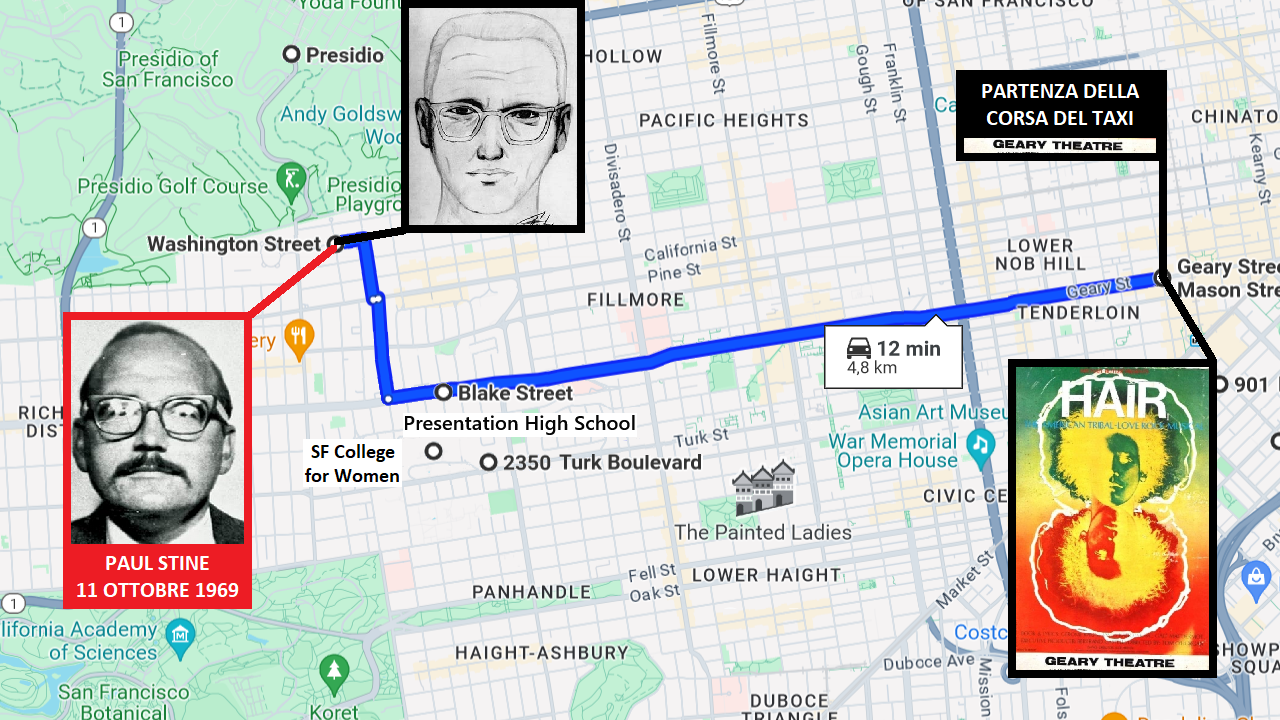
A consult on newspapers.com and a check of open sources brings me to a few steps from the intersection of Mason and Geary Streets where Zodiac gets into Paul Stine’s taxi on the night of the murder, October 11, 1969.14
At Geary Theatre.
That evening, on stage in one of the city’s main theaters is a cornerstone of hippie culture.
The musical “Hair”.15

“Hair”, which was performed at the Orpheum in April 1970,16 has its own symbol.
In the billboard below, you can guess which one.

On the posters of “Hair” the face of a “long-haired” man is depicted, in the style of a symmetrical stain in the shape of an 8, the symbol of infinity which appears in place of the dot above the “i” of “Hair” also in the advertisements of that time.17

Below is the possible route of Stine’s taxi on the evening of October 11, 1969.
It will be seen in chapter 13, that “Hair” is not the only reference of this decipherment that is found “along the way”, so to speak.
There could be two tips on the source of the circled 8 symbol.
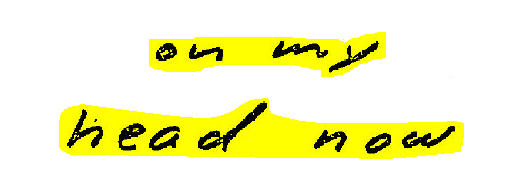
- The first is a possible allusion to “hair” contained in the paragraph below the 13 symbols, when he says he is quite interested in knowing the amount of the size…
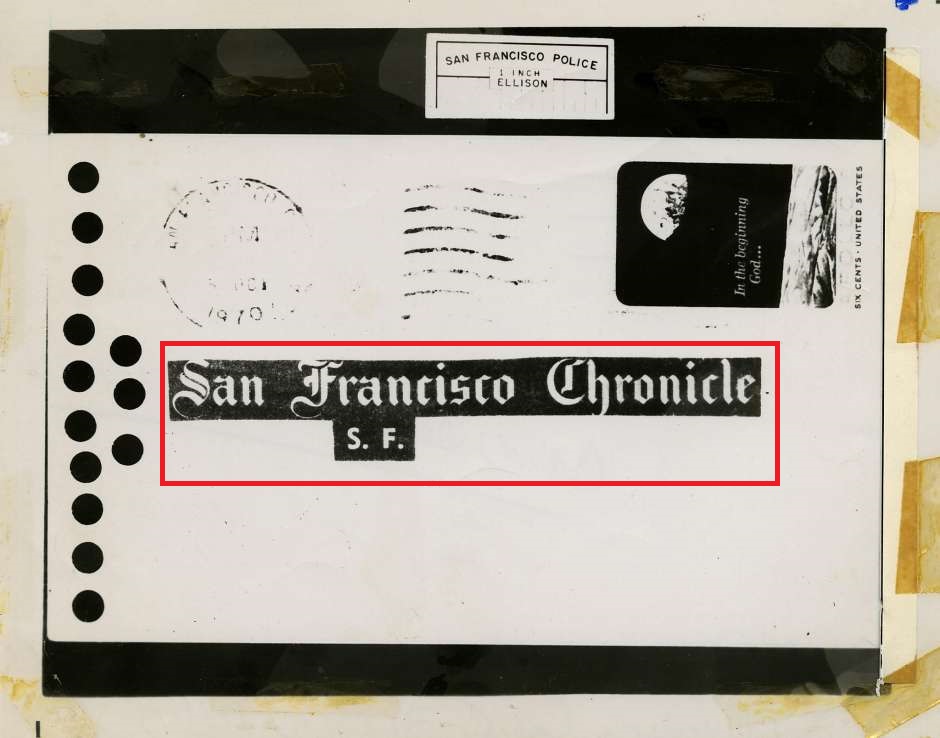
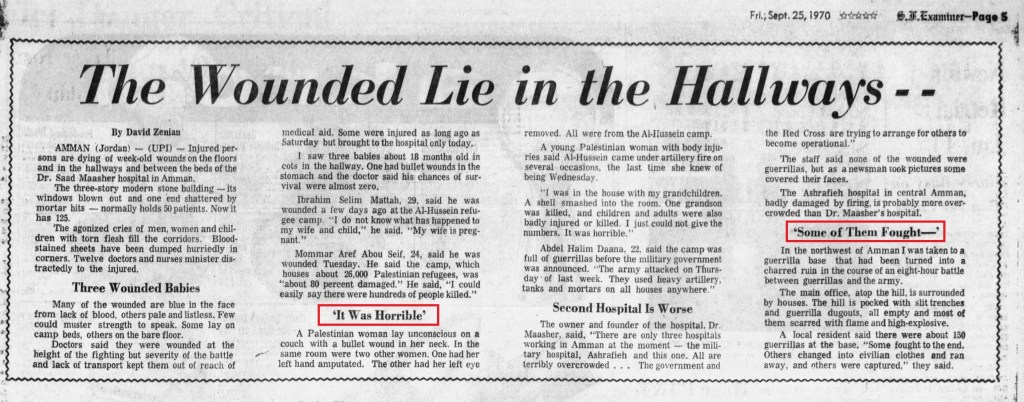
- The second potential tip comes with Zodiac’s “holes” card dated October 5, 1970, made up of newspaper clippings also from the Chronicle and the Examiner (examples at the end of the chapter).
The P.S. bottom left is strangely upside down. How come?
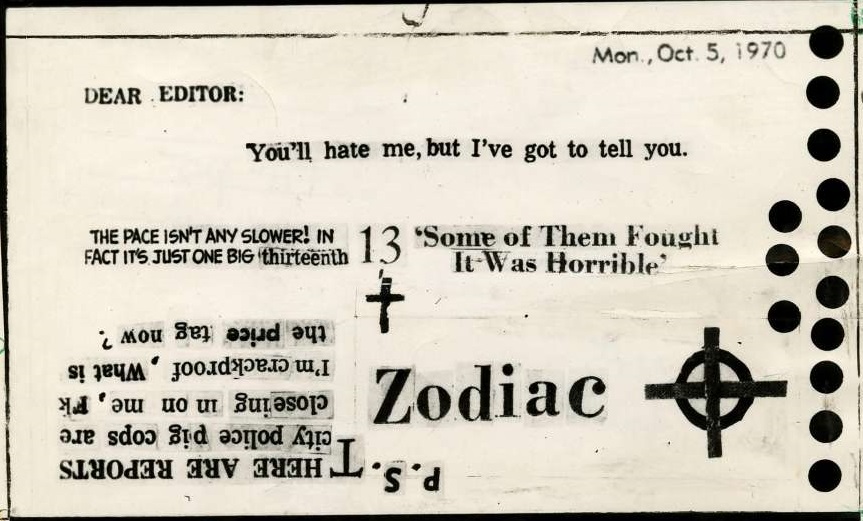
In September and October 1970, before the serial killer sent his postcard, several advertisements for “Hair” were published with the title upside down. Even four days before the disappearance of Donna Lass.18
They read:
"The musical that turned Broadway upsidedown."19
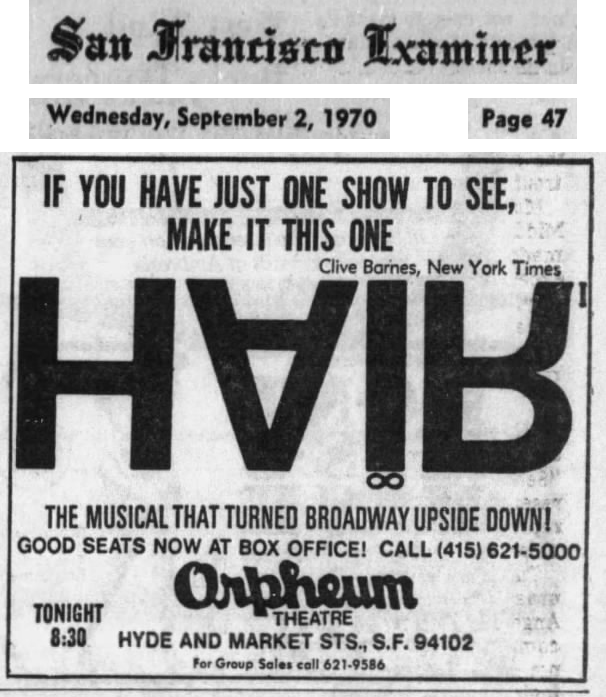
In 2020, I find advertisements for “Hair upside down” in some weekday editions of the San Francisco Examiner published in the weeks preceding the date of the “holes” card, which is made up of clippings also from this newspaper (next gallery).20
The address on the postcard should belong to one of the sections of the single edition with the Chronicle on newsstands on Sunday.21


8. Aquarius
On July 28, 2017, at bar Marconi, when I ask Bevilacqua about Zodiac, the elderly former superintendent of the Florence American Cemetery replies with a half smile:
“In my opinion, he is five people.”
He never says the word “Zodiac”. He just calls him “him.”
But what does “he is five people” mean? Accomplices?
Why five?
I discover that this too is probably an allusion to Zodiac’s name cipher when I locate the source of the encryption method of one part o that, which could also be the hit he refers to in the anagram of the first cipher.
The song from which the “sunshine method” derives is “Aquarius – Let the sunshine in” by 5th Dimension.
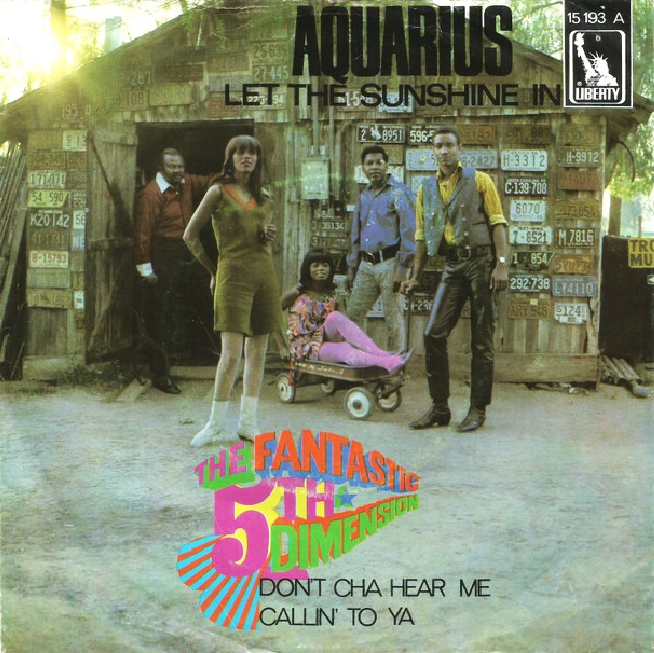
The title of the hit by the 5 singers of the R&B group translates to:
"Aquarius - let the sunshine in"
The song is composed of the two most important lyrics from the musical “Hair”22 rearranged into a single song that ends with a mantra:
"Let the sunshine in"
This is why the grid for decrypting E, I, ICE is only applied at the circled “Hair” symbol, with the tip of the sunbeam translating the letters within it.
E and I are obtained by letting the “sunshine” (virtually) into the school bus (chapter 6).

“Aquarius” is explicitly zodiac-themed, as can also be seen from the cover of the complete album (next image).
While containing some astrological errors, it is a synthesis of the beliefs of the hippie and new age movements of the time.23
The text speaks of the period of peace and love brought about by the advent of…
"The Age of Aquarius"
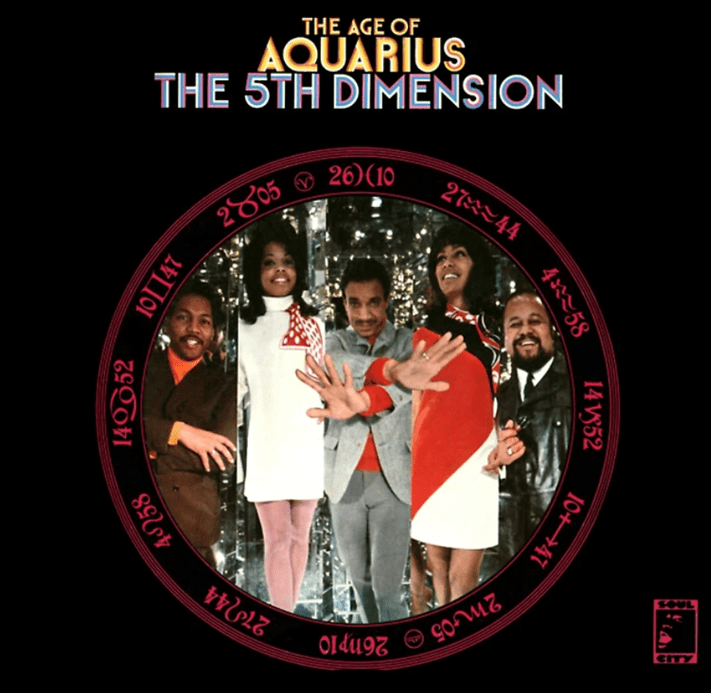
The single “Aquarius-Let the sunshine in” becomes a hit in the spring of ’69.
For six weeks the song remains at the top of the Billboard Hot 100, and would be destined to obtain first place in the annual chart of ’69, if it has not been overtaken in the autumn by Archie’s “Sugar, sugar”, slipping to second place.24
In ’70, on the other hand, the song win the Grammy for “best recording of the year”, leading the 5th Dimension to win a second one for “best vocal group”.25
It should be added that on the album of the musical “Hair”, “Aquarius” is followed by “Donna”, the same name as Donna Lass, whose disappearance seems to be attributed to Zodiac in a card postmarked on March 22, 1971.26
The musical and the song sung by the 5th Dimension are both considered symbols of the “hippie” age.
A recent example of this is the choice to give the title “Aquarius” to the TV series created by John McNamara starring David Duchovny about the well-known Californian criminal contemporary with Zodiac Charles Manson.
Why is Zodiac inspired by the 5th Dimension’s song in ’70?
Probably because it is the hit alluded to in the solved anagram of the first cipher. I bring up the riddle once again:
"I [BERE E] DRINK AND TOPE I'M THE HIT"
Zodiac claims he did not put his name in that cipher. But he also says that his “identity” is there.
A contradiction?
Not if the riddle, as the text suggests, pertains his identity in general, which should be related to “Aquarius-Let the sunshine in”.
An observation support the correctness of the hypothesis of a link between Zodiac’s identity and the song sung by the 5th Dimension.
In classical iconography Aquarius, the water bearer, is depicted with an amphora.
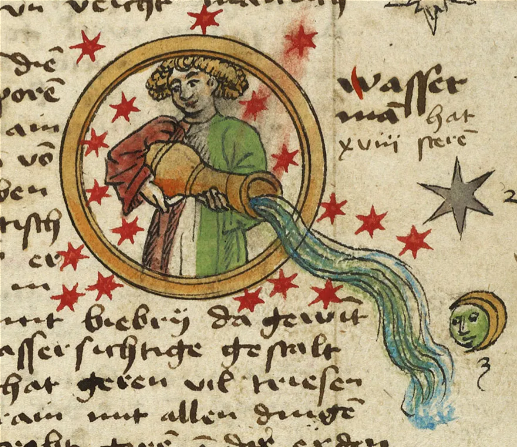

One cannot help but notice the similarity, sought or otherwise by advertisers, with the Zodiac Sea Wolf adverts from a few years earlier which depicted a diver with an amphora on his shoulder.
The timing lead let you think that the serial killer may have decided to appropriate the name and the Celtic cross of the “Zodiac” watch brand precisely because of the reference to Aquarius, to which he refers from the beginning of his correspondence with the press (according to this solution).
9. Water

There are many clues that lead to deem that Zodiac’s name contains a reference to water.
This is not only suggested by the generic references to water in crime scenes (Robert Graysmith, author of “Zodiac”)27 or in his messages written with a blue marker which I list in the post “The water theory”, two also present in this letter:
- The term “blue meanies”, villains of the Beatles in the movie “Yellow Submarine”;
- the sentence: “I was swamped out by the rain we had a while back” (I talk about it in chapter 13).
The most important clue is that in his last certain letter of ’74, Zodiac abandons his nickname and Celtic cross to sign himself with a text about a drowning, possibly correlating his identity with water.
Certain solutions/decryptions I provided are consistent with this hypothesis.
- The solution of the anagram of the first cipher, the riddle “I am the hit”, in light of the decryption “let the sunshine in” could mean: “I am – Aquarius“;
- the “let the sunshine in” method itself leads to ICE, the last three letters of PARADICE, an emblematic word in the Zodiac case, also used as a key word.
Also, the Halloween card contains another possible veiled allusion to water as a signature.
In the next image, it can be observed that in the editing of the last page of the postcard Zodiac partially copies the labels of a wheel of death depicted on the cover of the western comic “Tim Holt” #30 (found out by Tahoe27).28
Inside the wheel, it is possible to glimpse a fifth capital sentence, not mentioned by Zodiac, partially hidden by the head of the protagonist of the comic, Redmask, who the masked skeleton on the third page of the postcard seems allude to (next image).

The phrase hidden back of Redmask’s head is “death by water”, one of the two deaths to which the hero is condemned in the story (next image).29
As you can see, Zodiac does not copy the word “death” in his postcard.
That omitted “by water”, therefore, may be a hidden signature.

There are other clues to consider that can help in identifying the Zodiac’s name other than the aquatic quotes.
- In the solved anagram in the first cipher, there are two Italian words. “E” is the word “drink”;
- If you accept my solution of the Halloween riddle based on a pun in Italian, there should be a letter Q in Zodiac’s name.
In addition to the reference to water and the presence of a Q in Zodiac’s real name, it can be inferred that he has Italian origins and therefore, perhaps, also an Italian surname.
What happens if, based on these clues, you narrow down your searches to surnames that include the term WATER in English and AQUA/ACQUA in Italian?
I carry out a check with the 2010 US census data which shows all the surnames of the US population with occurrences greater than or equal to 100.
The result is that, if Zodiac’s name has not been modified or anagrammed, only 9 of the surnames in this list containing the word WATER and AQUA/ACQUA with the meaning of “water” are compatible with the decipherment obtained.30
On the podium of the most popular, in third place, there is the surname of the person who gave me the indication that led me to this decryption, Bevilacqua.
This surname would come second, but I added Waterman to the final count for a reason that I will explain in the next chapter.
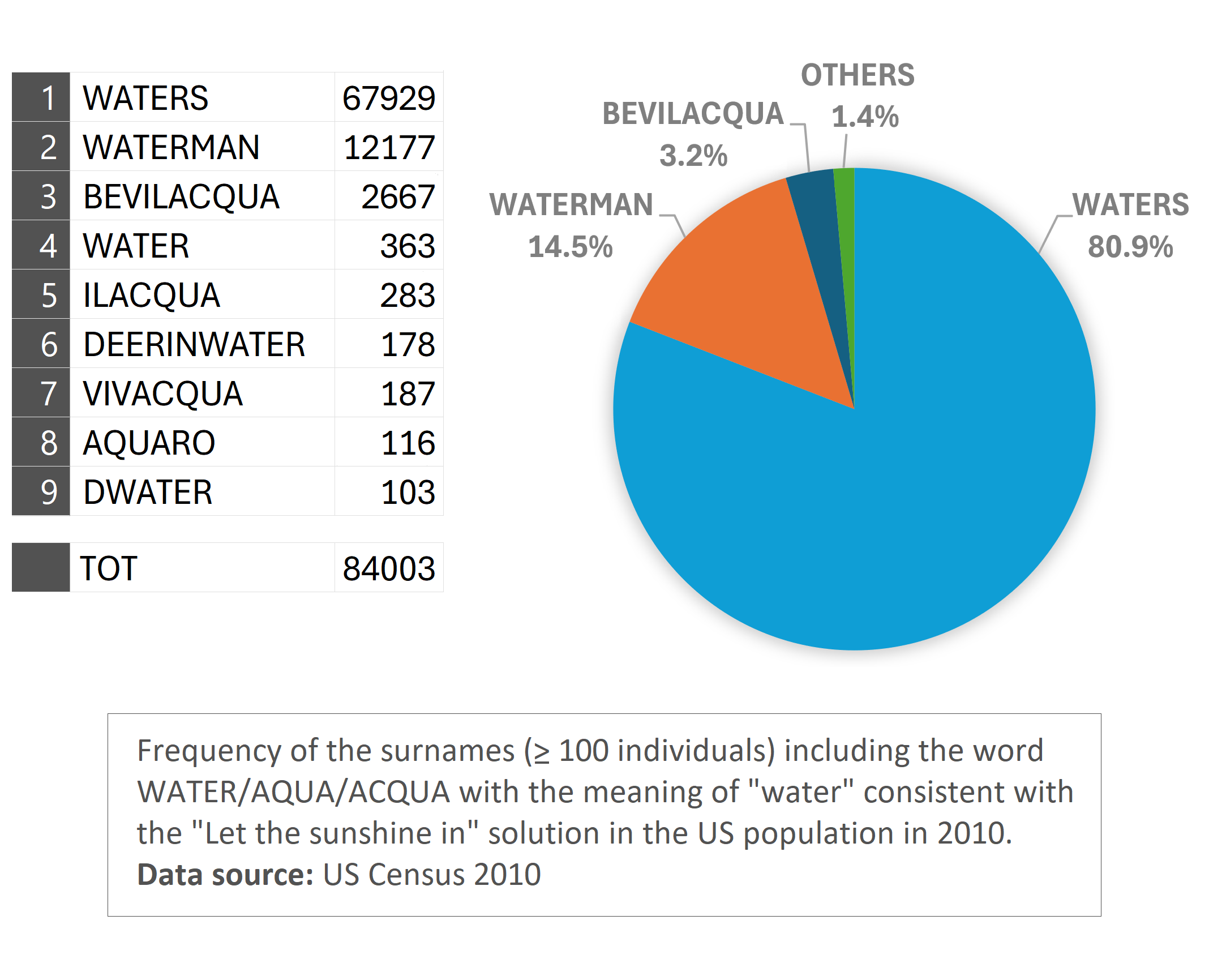
Bevilacqua, which translates to “drink the water” in English, is the most common Italian surname containing the word AQUA/ACQUA in the United States, and it is one of only two surnames containing the word “acqua” in English and Italian that are fully compatible with the letters E and I.31
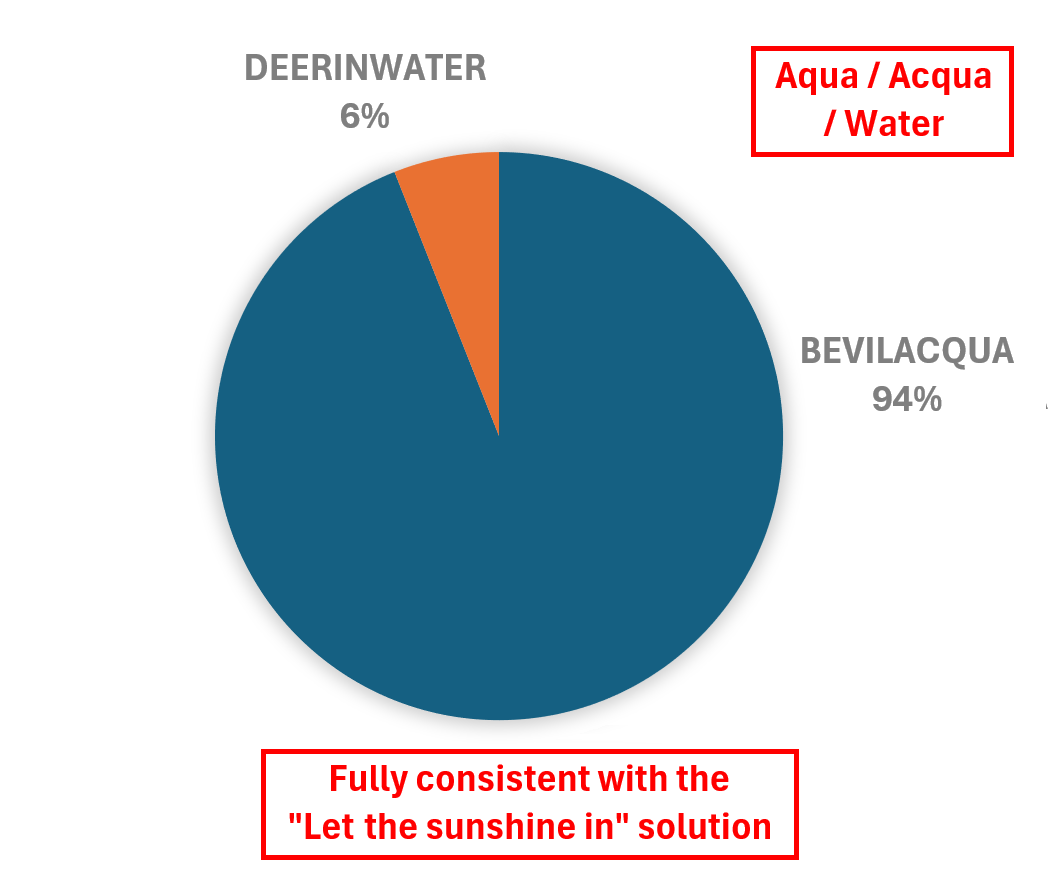
Bevilacqua is the only one among the nine surnames considered to include the verb “bere” in Italian, present in the solution of the anagram of the first cipher.

Of all the group’s surnames, Bevilacqua is also the most compatible with the last known Zodiac’s signature, the stanza about a drowning from the “Mikado”, as can be appreciated in the recitation of the lyrics by actor Mitchell Butel in the next video.
10. Qua-nam
The last three letters of Zodiac’s cipher name have some meaning in many languages.
What meaning do they have for the serial killer? Why did you include them?
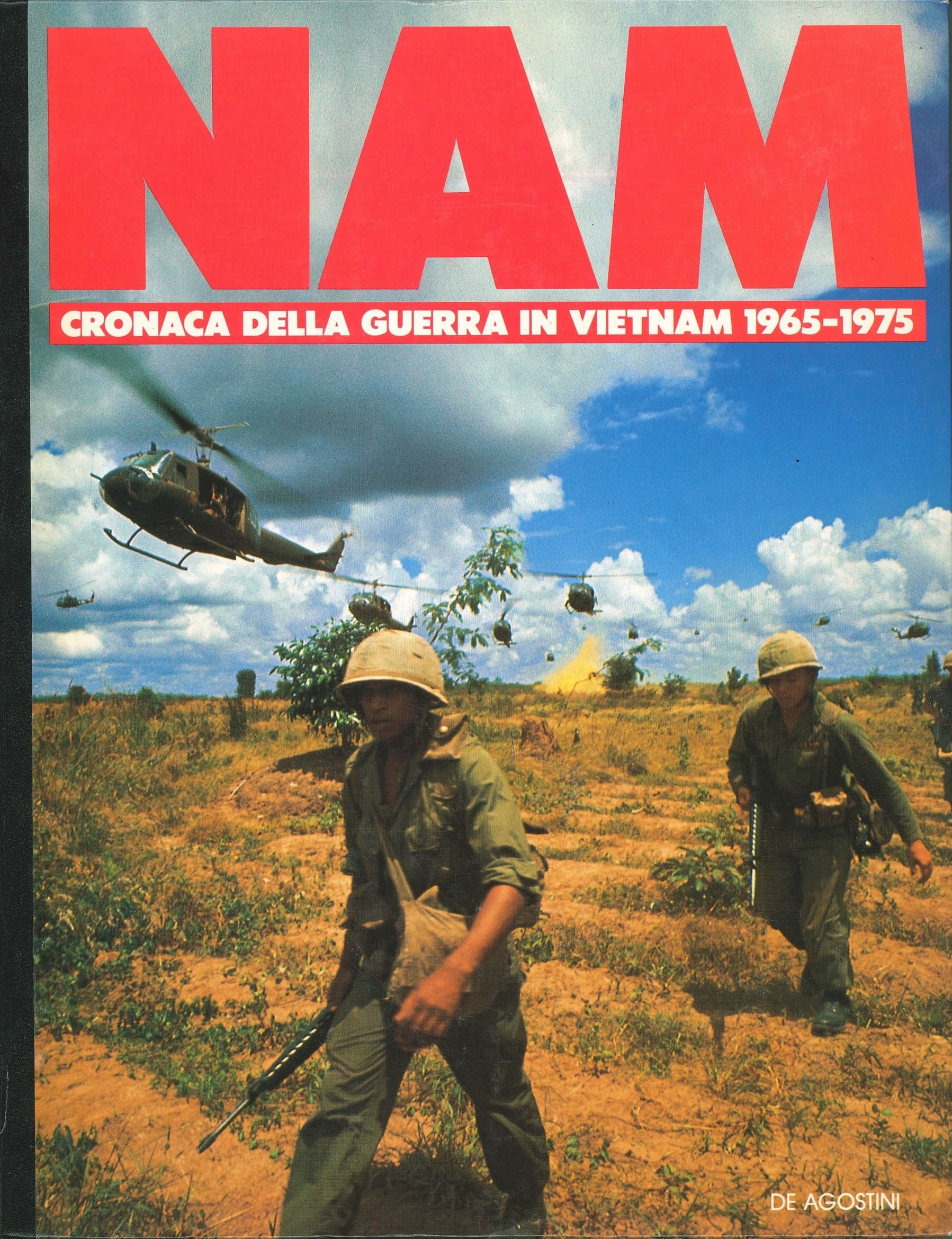
In the Zodiac era, “Nam” was a familiar term for the approximately 2.7 million US soldiers, including Joe Bevilacqua, who served in “Vietnam” in the ’60s and ’70s. The abbreviation of the country of Indochina to “Nam” also gives the title to the book that I will bring to meetings with Bevilacqua to talk about his experience in the war.32
“Nam” in Vietnamese means “south”, but the same pronunciation refers to something else in neighboring Laos or neighboring Thailand.
A reader of this blog, Fabio, will point it out to me.
In the Thai language, the last three letters of Zodiac’s name cipher means “water/acqua”.
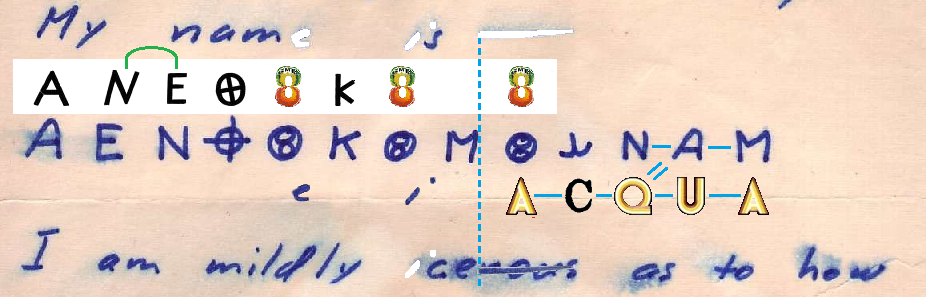
Given the historical period in which Zodiac sends his encrypted name, it is possible that he knows the meaning of a commonly used Thai word such as “nam”.
During the war in Vietnam, Thailand was a close ally of the US Government, being in a strategic zone adjacent to the area of war operations.
The Thai government provides about 40 thousand men in the war against Hanoi and decides to host six main US air bases on its territory between ’60 and ’75. And, above all, the capital Bangkok is one of the most popular destinations for the leaves “Rest and Relaxation” granted to US troops.33
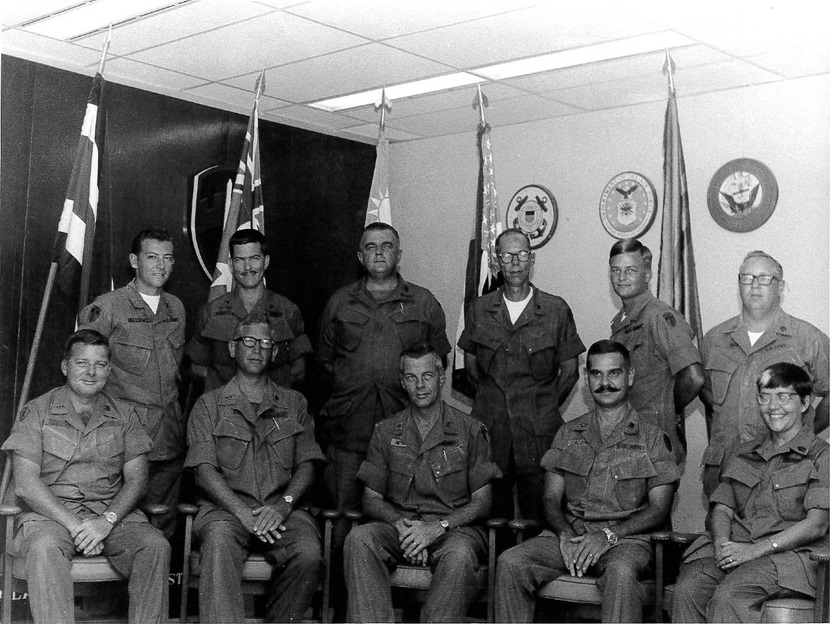
Also two Bevilacqua‘s CID colleagues, Raymond D’Addario, his supervisor in the CID unit at the 25th Infantry Division, and his former chief at the 5th CID in Livorno, Robert Colombo, also travel to Thailand after being assigned to the military command in Vietnam between ’68 and ’69.
But why, among so many possibilities, would Zodiac choose NAM to indicate the term “water”?
Perhaps to overcome a space problem, perhaps to form a play on words. Or both.
Waterman is the second most common surname in the United States containing the word “water”. Because of is lenght, it represents an exception compared to the remaining eight compatible with the solution E and I, which include the word “water” in English or Italian.
The presence of NAM could be explained as a ploy with which the author of the puzzle shortened his surname, inserting MAN backwards.
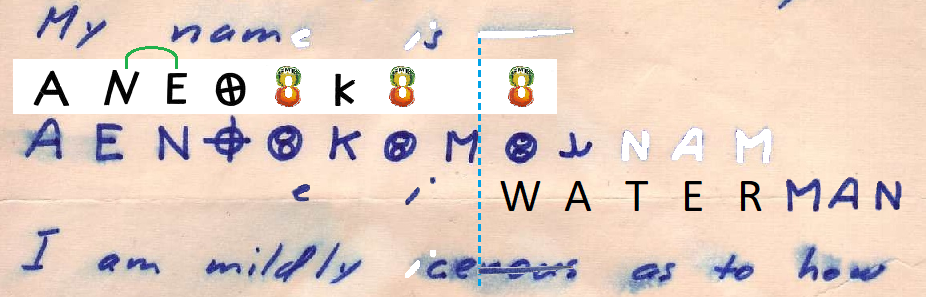
The same trick cannot be applied to Waters.
On the contrary, it would work by taking on another meaning for a comic connoisseur with a surname ending in AQUA/ACQUA.
It could in fact allude to the well-known Marvel hero Aquaman.
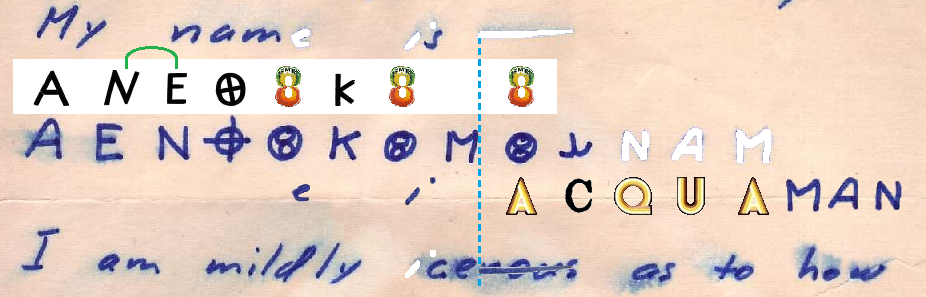
On the other hand, leafing through a Latin dictionary, the language from which the Italian word ACQUA derives, one discovers the existence of the entry QUA-NAM,34 which would correspond to the union of the last part of the cipher and the last three letters of a surname ending in AQUA/ACQUA.
Many dictionaries that report this term cite as a reference a phrase from Pliny the Elder‘s “Naturalis Historia”.
“...how dolphins can hear, it is a mystery...”35
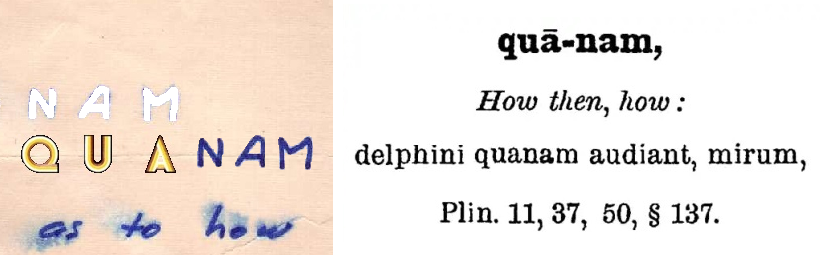
QUA-NAM means “in what way”, “how”, the last word of the sentence underlying the cipher.
It has been already seen with ICE how Zodiac may have exploited a word under the symbols (“cerous”) for encryption purposes.
The scheme could also be the same in this part of the cipher.

QUA-NAM is a pleasant reference, but one should not forget that one of the sources of the cipher is the ancient Greek word ANETHEKE. Zodiac would have easily found a Latin dictionary in the same history/ancient languages sector where he might have found Goudy’s book. And where he could also have drawn the reference I talk about in the next chapter.
The QUA-NAM connection leads to the surnames examined in the previous chapter that end with the Italian word AQUA/ACQUA.
In this case, it is likely that NAM was initially intended for a more direct meaning, such as one or both of the previously cited references:
- The super hero Aquaman;
- the word “nam”, ie “water” in Thai.

11. Cerous and lac
When I try to complete the decryption in the years 2018-2021, some details of the talks will come back to the surface. In addition to the allusion to the 5th Dimension and the reference to “masks” (chapter 4), there is a third one.
July 28, 2017, bar Marconi, Falciani.
Bevilacqua takes the sheet with the copy of the Z340 cipher, looks it up and turns it over. He tells me that in his opinion the encryption does not follow the normal progression of the lines and that it should be spiral. Indeed there has been a transposition, even if the encryption system, quite complex, is not spiral but similar to a repetition of the movement of the knight in chess. Maybe he does not remember?
Then he talks about “masks”, and adds:
"Sometimes there are Indian symbols. But I don't see them here."
About three years later, I will realize that this phrase is an allusion to the anchor symbol in Zodiac’s cipher name.
The anchor symbol is a letter of the Brahmi alphabet. It is found next to a character similar to an incomplete 8 in a Wikipedia image from the book “Inscriptions of Asoka” by British archaeologist Alexander Cunningham.36

The main theme of Cunningham’s book, dating back to 1800, are the inscriptions in an undeciphered language of ancient civilizations that lived in the Indus Valley, in today’s Pakistan. Some of these inscriptions are found on seals such as the one from Harappa with the characters that Cunningham attempted to translate into Brahmi.
Cunningham describes the manufact this way:
"This monument is a seal of smooth black stone, which was found by Major Clark in the ruins of Harapâ in the Panjab. On it is engraved very deeply the figure of a bull without hump, looking to the right, with a symbol on its shoulder and a second symbol and a star under its neck. Above the bull there is an inscription of six unknown characters [...] the sixth may be an old form of y. The whole word thus read Lachhmiya."37
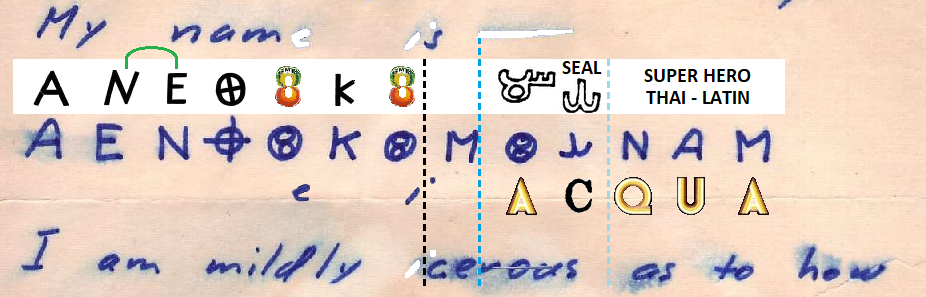
There is possible confirmation that Cunningham’s Brahmi translation is the source of Zodiac in the Halloween card.
To construct his riddle, Zodiac will decide to use braille, transforming IE (“in fact”) into four dots (chapter 6).
The dots are inside a VF-shaped symbol.
Graysmith points out that the VF refers to the western comic Red Ryder, as it is the main character cowboy’s cattle brand, visible in particular on the cover of issue #15. 38
Regardless of my interpretation (in issue #14, Red Ryder is temporarily blind),39 what can be seen from the comparison between the cover and the Harappa seal is that both the brand and the corresponding symbol of the YA inserted by Zodiac in its cipher are depicted on a bull.

Although from different angles, “The Alphabet” by Goudy with the inscription ANETHEKE, the Latin dictionary with “quanam” and the book “The inscriptions of Asoka” have two main themes in common: words and civilizations of the past. It is this fact that leads me to think that Zodiac may have found them in the same sector of a library.
Why did he decide to include the “ya” Brahmi?
Perhaps for the same reason he decided to mangle “curious” into “cerous” despite the many words with which he could have formed the word ICE.
In English “cerous” is related to the metal “cerium”,40 but it is another one the most common meaning the same word translated in Italian has (“ceroso”), “waxy”.
Keeping in mind the ranking of the most common surnames with “acqua”, an Italian can easily identify a possible connection with sealing wax, which is called “ceralacca” in Italian.
For centuries, the main component of sealing wax/ceralacca has been “Lac”, ie “shellac” in its natural state, a resinous substance that is secreted by the cochineal Kerria Lacca from Southeast Asia.41
In the past, a seal (like that of Harappa) was pressed on the sealing wax to seal letters and certify documents. It is still used today to embellish wedding invitation letters or wine bottles.
“Cerous”, ie “ceroso” (waxy), is linked to the word LAC the “Indian” seal with his symbol YA refers to.
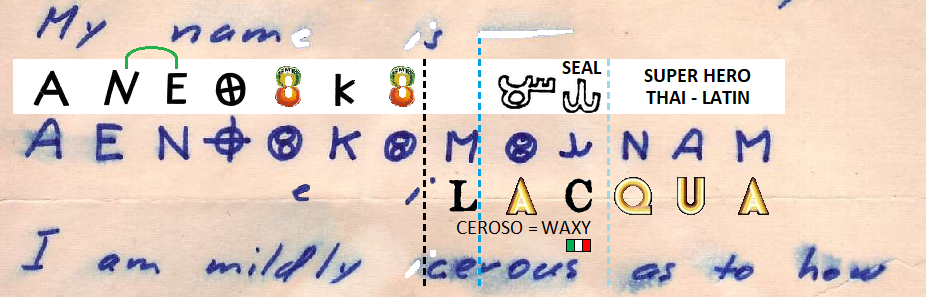
The choice to insert the symbol of this seal may have been dictated by the co-presence of a character similar to the 8 of Hair and/or the meaning of Cunningham’s translation, Lacchmiya, which contains the letters LAC.
12. Bekim
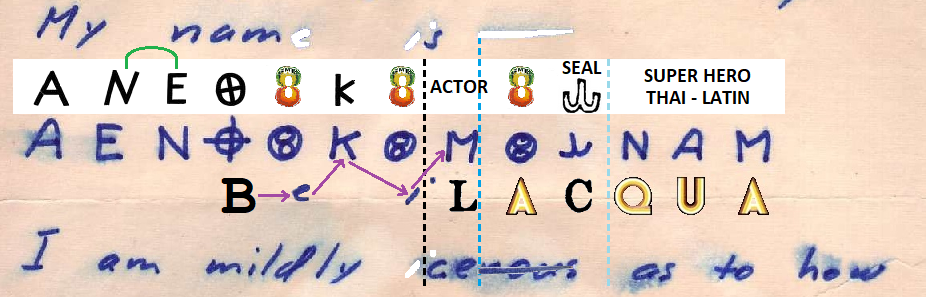
At this point in the decryption, the only symbol left without a source is the letter M. Why did Zodiac put it immediately after ANETHEKE?
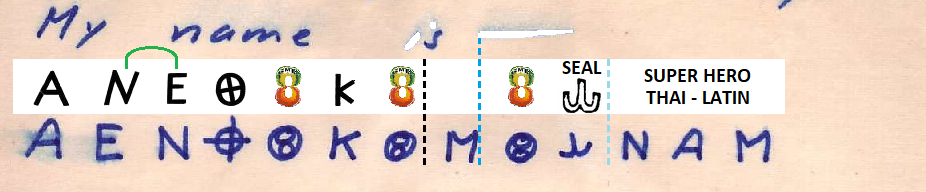
The purpose of the M may be to encrypt another letter of his name. Which one?
In choosing the symbols, Zodiac seems to have taken inspiration from references from two macro categories. Books with ancient words and popular culture of the time. I expect the M to also be part of one of these two sets.
Not being able to find a possible immediate connection between the M and the sentence below, I do a test and replace the symbols in the cipherwith the EI solution (next image).
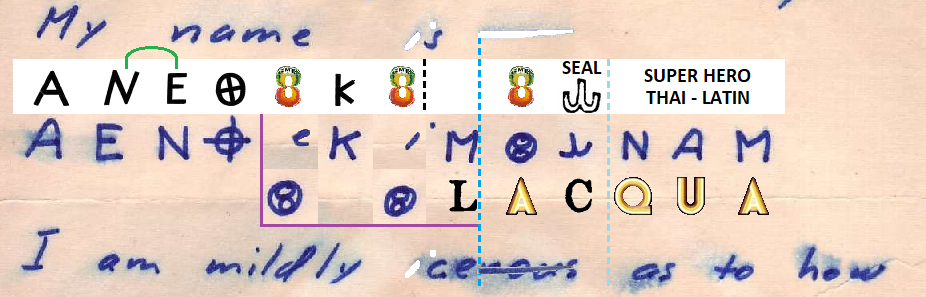
Kim is a name. Could Ekim mean something?
In 2020, a search for the term “ekim” in newspaper editions from ’70 on the website newspapers.com gives me as a recurring result the name “Bekim” of the Serbian-Albanian actor Bekim Fehmiu.42

Replacing the search key with the term “bekim”. it almost exclusively results in mentions of Fehmiu’s name (next image).43
In ’70, Fehmiu appeared in the expensive Hollywood film “The Adventurers” (directed by Lewis Gilbert) in the lead role of Dax Xenos, being joined by actors much more famous than him in the United States, such as Candice Bergen, who played as his heiress wife44 and Charles Aznavour.
The film tells the story of a Latin lover who intends to take revenge against a South American dictator.

On April 20, 1970, the day when the letter with the name of Zodiac was postmarked, “The Adventurers” was shown at Alexandria Theatre and in various other cinemas/drive-ins in San Francisco and the Bay Area (next image).45 It has been for a few weeks already46 and will continue to be shown for a short time.47

The list of theaters includes the cinema at the Hillsdale shopping center, where the restaurant “Italiano” owned by the San Remo Italian Food Company is set.48
That is one of the firms involved in the “Khaki Mafia” case in which Bevilacqua tells me he participated in as a CID detective (I talk about that story here).49
The investigative activity of the CID departments on the Khaki Mafia case in the San Francisco area took place in conjunction with the criminal activity of Zodiac.50
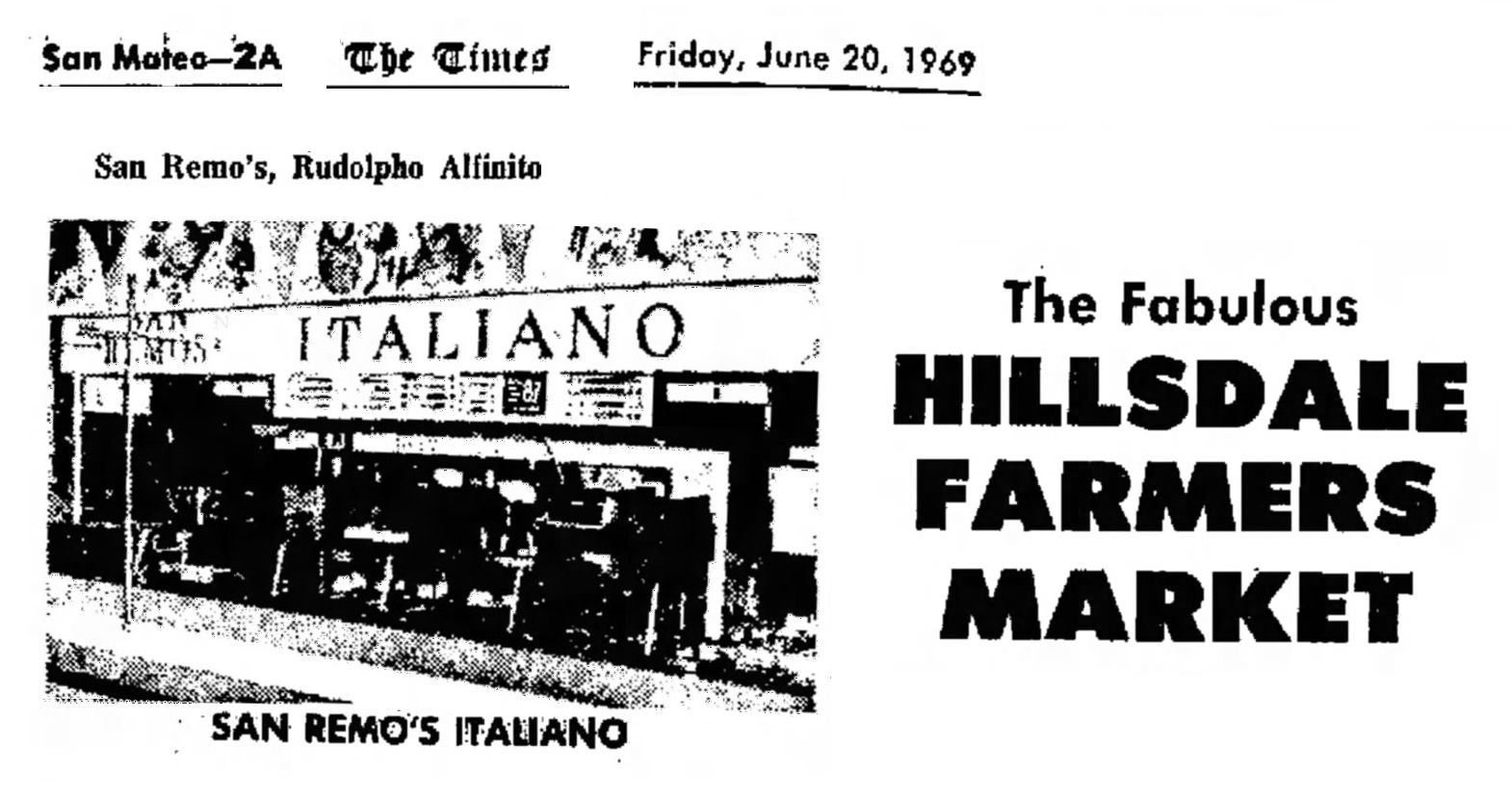
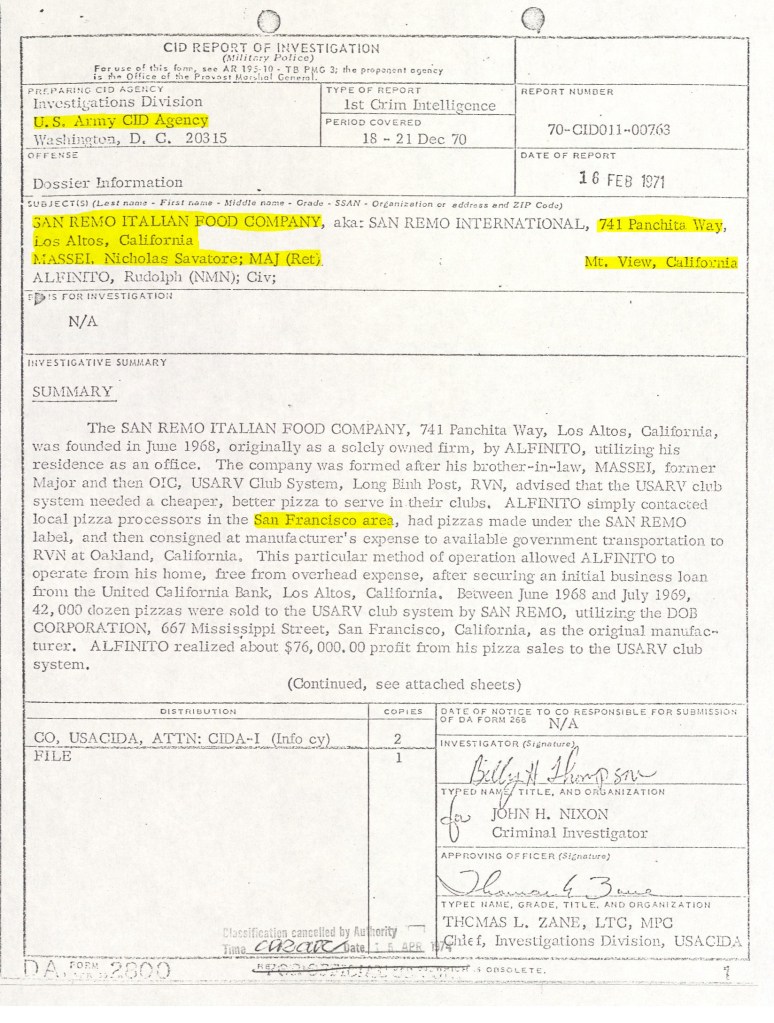
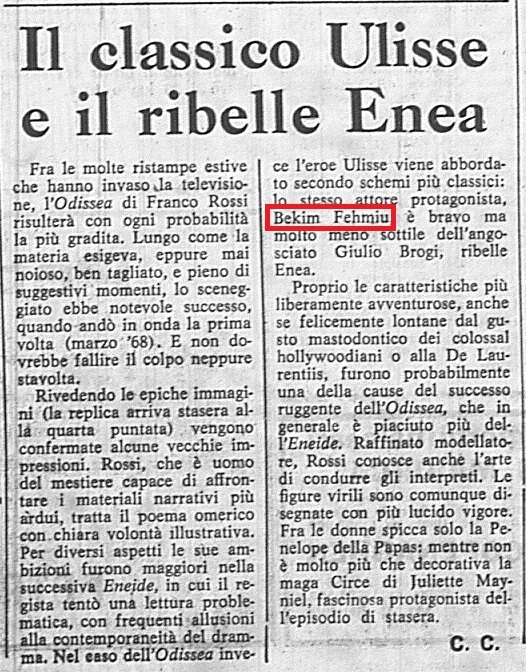
Fehmiu became a well-known face in some European countries for his portrayal of Ulysses in the Italian TV series “Odyssey”, which aired for the first time on the Italian RAI in ’68.51
This is a possible connection with the Monster of Florence case which, in 1994, saw Bevilacqua as a witness in the trial of Pietro Pacciani, the main suspect of the Florence District Attorney’s Office until 2024.
In a 2003 prison conversation intercepted by the police, Mario Vanni, one of Pacciani’s supposed accomplices (for the Italian justice), claims that the real Monster was an American, a “black” whom Pacciani met in the woods (for further information, click here).52
Vanni does not know who he is, but he would have told Pacciani his name.
"Ulisse, he was called."53

One of the reruns of “Odyssey” on Italian broadcaster RAI dates back to July 1974 (schedule in the next image),54 when Bevilacqua moves to the American cemetery in Florence, two months before the Monster’s series of definite murders begin.

Returning to “The adventurers”, I note that the third result for the search term “Bekim” in the ’70 newspaper editions on newspapers.com55 is an article by Vernon Scott on page 10 of the Examiner dating back three and a half months before sending the “my name is” cipher.56
The title is:
"10 Million risked on an unknown"57
Below there is a picture of Fehmiu. The didascaly reads:
"Yugoslavian actor Bekim Fehmiu in 'The Adventurers'
He plays a South American playboy in film of Harold Robbins novel"58
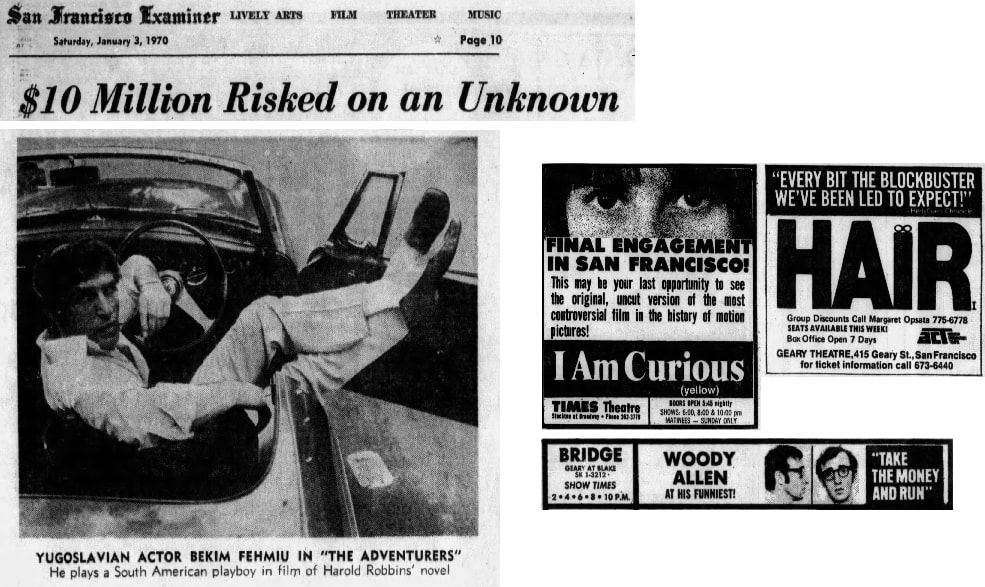
On the same page of the article (clippings on the right), in addition to the ad for “Hair”, there are ads for two films such as “I am curious” and “Take the money and run” that one often come across with when browsing through the editions of the Examiner between October 1969 and April 1970 (next chapter).59
Their titles seem to recall (oddly?) the sentence under the cipher.

The inclusion of the M in the cipher can be explained by Zodiac’s need to encrypt the letter B while preserving the similarity to ANETHEKE and the symbol similar to a Celtic cross.
If this hypothesis is true, the name “Bekim” would suite the purpose.
13. Don’t drink the water
If you insert a V between “Be” and “ilacqua”, Bevilacqua shows, which is the third most common surname in the United States in 2010 containing the words WATER/AQUA/ACQUA with the meaning of “water” (chapter 9).
The decryption combined with the underlying phrase generates “bevi mildly”. In Italian “mildly” can be translated as “moderatamente”.
The connection that confirms the decryption of the V can be the phrase “drink moderately”.
It is sarcasm.

Joe’s surname is formed by the Italian verb “bere/to drink”, like my solution of the Z408 anagram.
There is another possible occurences of this word in the early phase of Zodiac case, associated also with the word water.
After the attack at Lake Berryessa, on September 27, 1969, at 7.40 pm, Zodiac calls the police from a phone booth in front of the Napa Car Wash at the intersection of Clinton and Main Street in Napa.60
A 2-minute walk from there, around the corner of Main and Pearl Streets, is the Pretenders amateur company’s playhouse61 (google maps).
At 8.30 pm that same day, less than an hour after Zodiac’s phone call to the police, the Pretenders will stage a comedy62 by Woody Allen adapted that year for cinema.63
The title is:
"Don't drink the water"

Leaving his signature and mocking the police could be the main reasons that push Zodiac to Napa and break the pattern by striking at Lake Berryessa before dark.
If so, the serial killer predicts that when the police arrive at the phone booth to take fingerprints, the curtain will rise in the nearby theater on “Don’t drink the water“.

14. Take the money and run
The first three letters of the name are to be discovered.
To do this, I start from a question: why did Zodiac transpose the N and the first E of the word ANETHEKE?

Consulting an Oxford Dictionary (paperback, 1988) I find only two words that begin with AEN, like the Zodiac cipher. “Aeneid”, work of the Latin poet Virgil, and its protagonist “Aeneas”, mythological progenitor of the Roman people.64

Virgil is also the name of the protagonist of a well-known movie (at the time) that debuts in New York in August65 and opens in San Francisco on October 8, 1969, three days before the Stine murder.66
The film is “Take the money and run”.
It tells the adventures of Virgil Starkwell, a clumsy robber played by director Woody Allen, who falls in love with a beautiful laundress named Louise (Janet Margolin).67
In the edition of the S. F. Sunday Examiner & Chronicle of October 5, 1969, a didascaly below an image of Virgil reads:
"Woody Allen becomes link in a chain in his new comedy 'Drink the Money and Run,' opening next at the Bridge. Much of the film was made in the Bay Area."68

In a letter delivered to the Chronicle a month after the San Francisco crime, Zodiac comments the description and the sketch of him of October 18, 1969, claiming to be disguising himself.
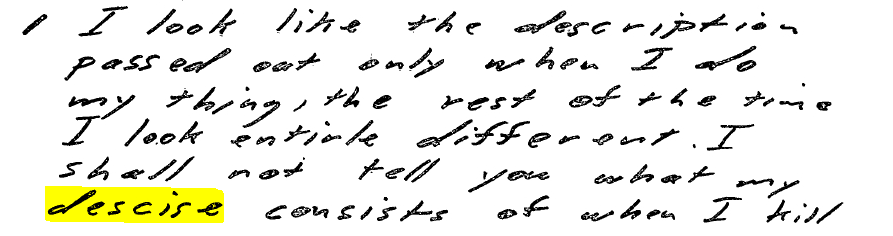
The biggest discrepancies about Zodiac’s appearance in eyewitness descriptions concern hair color. In Blue Rock Springs it is light brown, almost blond; at Lake Berryessa, dark brown; at the Washington Street crime scene they instead turn reddish in color…70

The protagonist of “Take the Money and Run” is not only bespectacled and red like the stocky man described by the three teenagers who witness Stine’s murder in San Francisco, but he also is a robber on the run, and so Zodiac introduces himself, with a staging, to the couple attacked at Lake Berryessa (next video).71
There is another clue to support the hypothesis that Zodiac impersonated Virgil Starkwell.
At the bottom of the first page of the letter on the encrypted name, the serial killer writes that his previous bomb was a dod and he comments:

A review of “Take the money and run” by Stanley Eichelbaum in the Examiner of October 8, 1969, reads:
"Virgil is ultimately sent to jail, where he's crafty enough to carve himself a convicing-looking pistol out of a cake of soap. Then, on the day he decides to break out, he's caught in a drenching downpour."72
The soap gun melts in the rain and Virgil is led back to his cell.
This scene is recalled at the end of the movie (spoiler), when Virgil, once again captured by the police, says to the documentary maker who is interviewing him:
"I'm very skilled with my hands... do you know if it's raining out?"73
For those familiar with the Mostro case, the conclusion may vaguely remind Joe Bevilacqua‘s “joke” about the guns in use when he was in the “criminal police” (CID) during the Pacciani trial.74
Attorney Bevacqua: "Do you also have guns?"
Bevilacqua: "No."
"Criminal police doesn't have guns?"
"Just the hands."75
The young Woody Allen is already at the peak of his career in the late summer of ’69.
On September 21, a week before the attack on Lake Berryessa, he debutes with a show that bears his name on CBS (video) and features Candice Bergen, Bekim Fehmiu‘s wife in “The Adventurers”, and the 5th Dimension.76
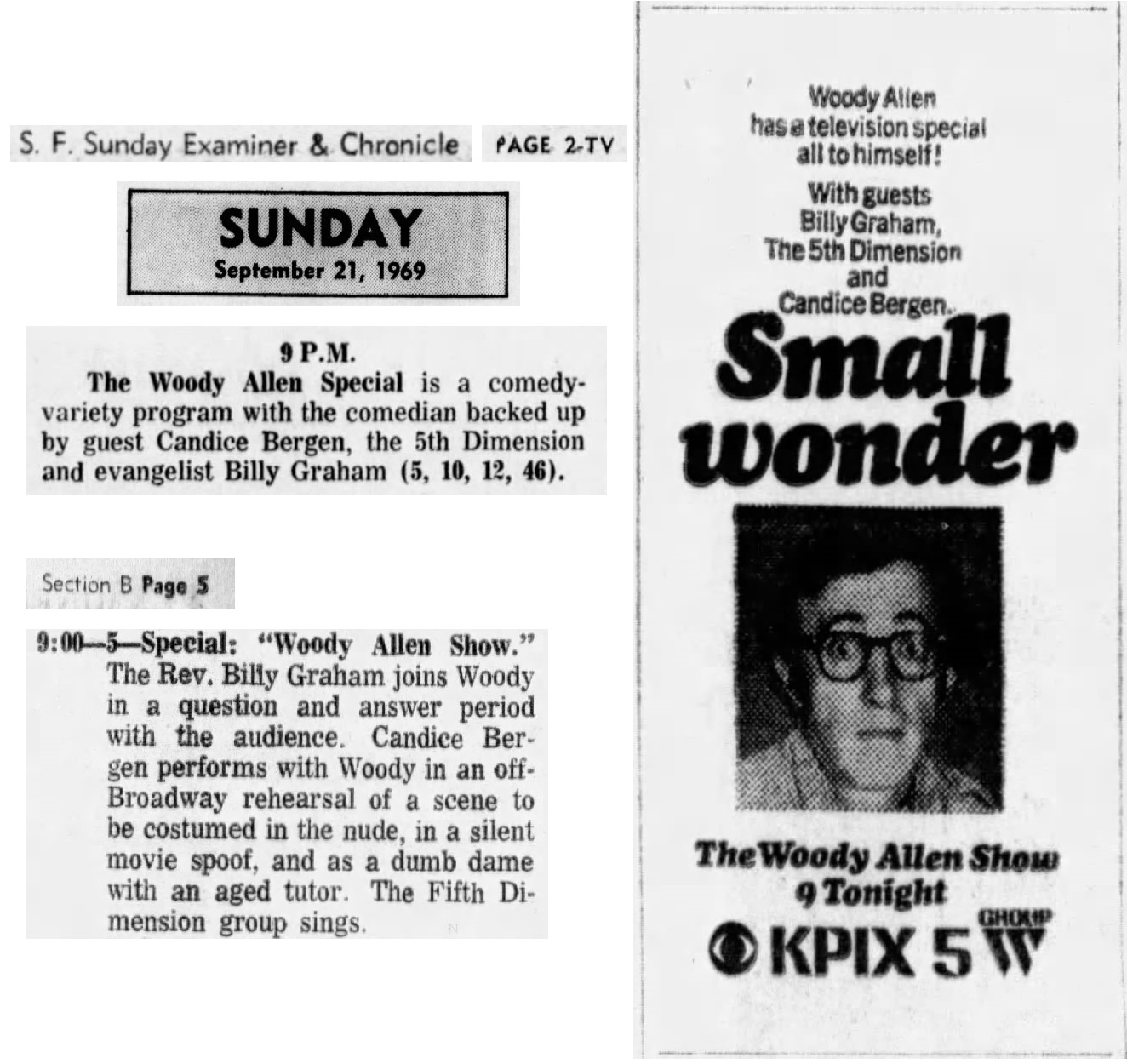
There are many coincidences in this story, but not all of them really are.
Fashionable glasses and red hair color in San Francisco, divergent from previous testimonies, the staging of the robbery at Lake Berryessa, are not the only elements that lead to Virgil Starkwell.
Witnesses to the Stine murder describe Zodiac clothes resembling77 (identical, in case he was actually seen by officer Donald Fouke)78 a match that the main character of “Take the Money and Run” wears in various scenes, as can be seen in the next video. A navy blue jacket and brown trousers.
The dialogue between Virgil and the woman who will marry him follows.
Virgil: "Are you an artist?"
Louise: "No, no, of course not. I'm not an artist."
Virgil: "No? What... what do you do?"
Louise: "I am a laundress."
Virgil: "Laundress? Laundry?"
Louise: "Yeah, I wash clothes in Maryland."79
There is no shortage of indirect references to “wash” in the fatal attack of September 27, 1969, at Lake Berryessa.
- The victims are tied up with strips of washing line;80
- For his claim, Zodiac chooses a telephone booth near the theater where Allen’s play “Don’t drink the water“ (chapter 13) is on, located in front of the Napa Car Wash which is adjacent to the Sam Kee Laundry, as zodiacciphers.com reports.81

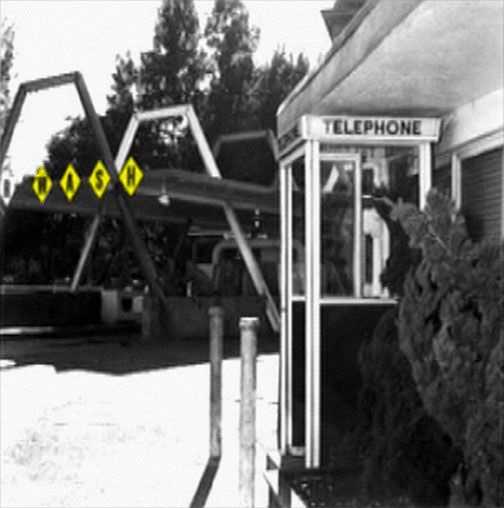
The possible connection with “Take the money and run” transforms the weak link of the “water theory“ mentioned by Graysmith in “Zodiac” into a strong point (I talk about it here):
"I thought it was strange that the killings so far had taken place in locations that had a form of water in their name..."82
Regularity is also found in the most well-known crimes of uncertain attribution: Oceanside, Riverside, South Lake Tahoe.
It would almost seem that Washington Street breaks the pattern, after Lake Herman Road, Blue Rock Springs, Lake Berryessa, yet, unlike the other references to water, the word “wash” is specifically mentioned in a postcard that Zodiac sends a month after the Stine murder (next image on the right).
"Sorry I haven't written,
but I just
washed
my pen..."

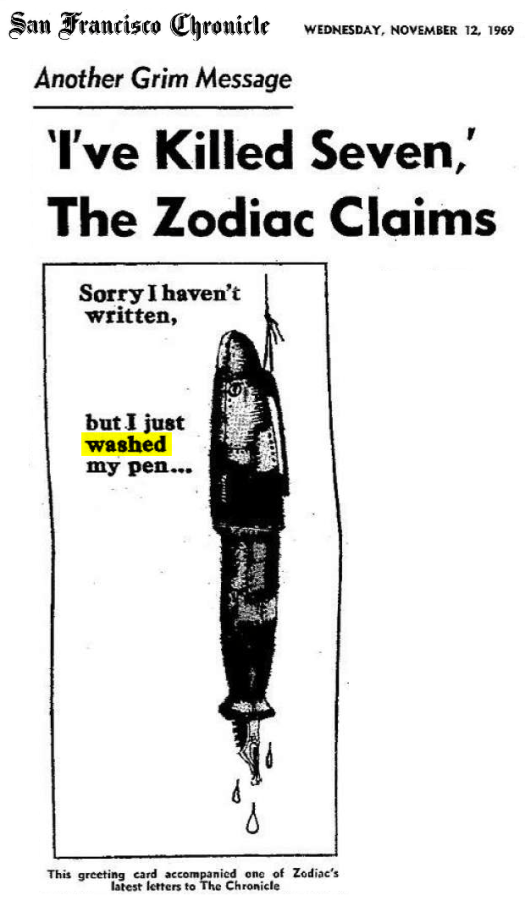
There is a possible “halfway” quote of “wash” the following year.
On the envelope containing the Halloween card, Zodiac strangely underlines the letters LAV of Paul Avery‘s name (mangled) .
According to the solution I proposed, the card riddle centers on a play on words in Italian.
Consulting a ’91 Collins English-Italian dictionary that I have at home, I note that most of the common Italian words that begin with LAV are derivatives of “lavare”, “to wash”.83
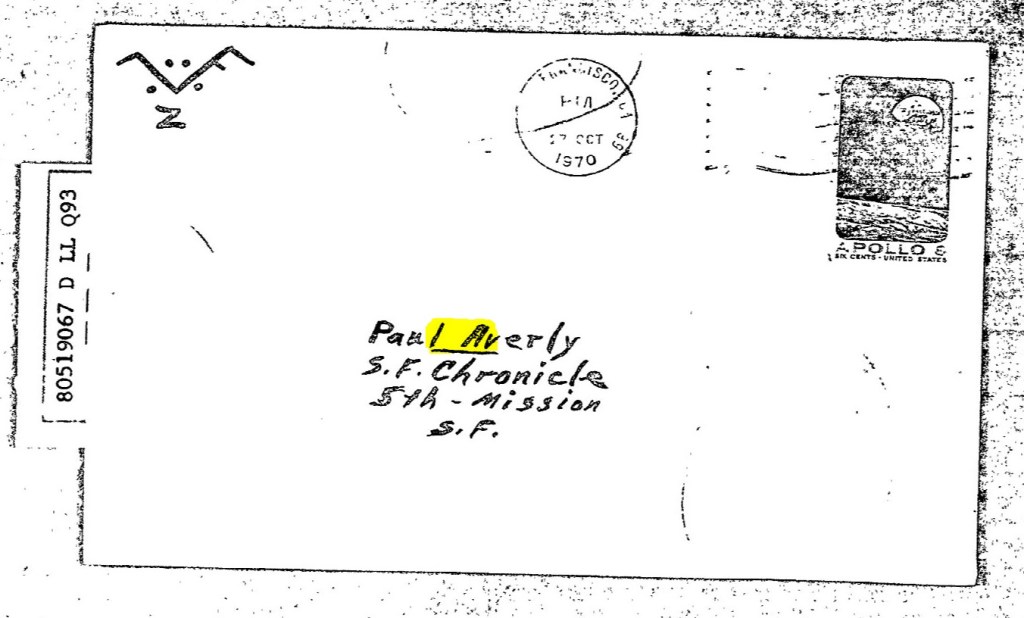
There may be more than one coincidence that pushed Zodiac to impersonate Virgil Starkwell. However, many people might find something in common with the robber protagonist of “Take the money and run”.
For example, Joe Bevilacqua.
The incipit of the film informs us that, just like Joe, Virgil was also born in New Jersey in December 1935.
A coincidence like this and the fact that Allen is the author of a play entitled “Don’t drink the water” which is staged in a theater in a city within Zodiac’s range of action could have influenced his decisions on where to strike and on timing.
My reconstruction of the facts is this.
The serial killer sees “Take the Money and Run” in Los Angeles84 or outside of California85 in the days before the Lake Berryessa attack.
From a local news or newspaper, he learns that Woody Allen’s play “Don’t drink the water” will be performed in Napa in September.
Struck by the coincidences that he can exploit to leave a signature…From a local news or newspaper, he learns that Woody Allen’s play “Don’t drink the water“ will be performed in Napa in September.
Struck by the coincidences that he can exploit to leave a signature…
- decides to claim responsibility for an attack from a telephone booth near the theater;
- finds one between a car wash and a laundry, an aquatic reference that allows him to make a reference to a scene from Allen’s film;
- locates a suitable area for an attack on a couple in the Napa area;
- chooses to act in the afternoon hours of a date on which “Don’t drink the water“ will be performed, Sunday 27 September, in order to claim responsibility for the attack before the curtain rises;
- again to recall “Take the money and run”, he presents himself to the victims as a robber on the run, tying them up with clothesline for the reference to “wash”;
- he phones the police as soon as he returns from the attack to make sure they will be at the phone booth when “Don’t drink the water“ is playing in the theater nearby.
After the attack on Lake Berryessa, Zodiac learns that “Take the Money and Run” will open in San Francisco on October 8. Probably driven by the desire for fame, as criminologist Sharon Pagaling Hagan claims, he dares to strike in the city disguised as Virgil following a plot similar to that of Napa.
He is forced once again to break the pattern of murders claimed as Zodiac and to change the type of victim, a taxi driver.
He decides to call “wash” again and kill Stine on Washington Street.
The cinema where “Take the Money and Run” is shown, the Bridge, is located along the direct route (hypothetical) from the Geary Theater to the crime scene.
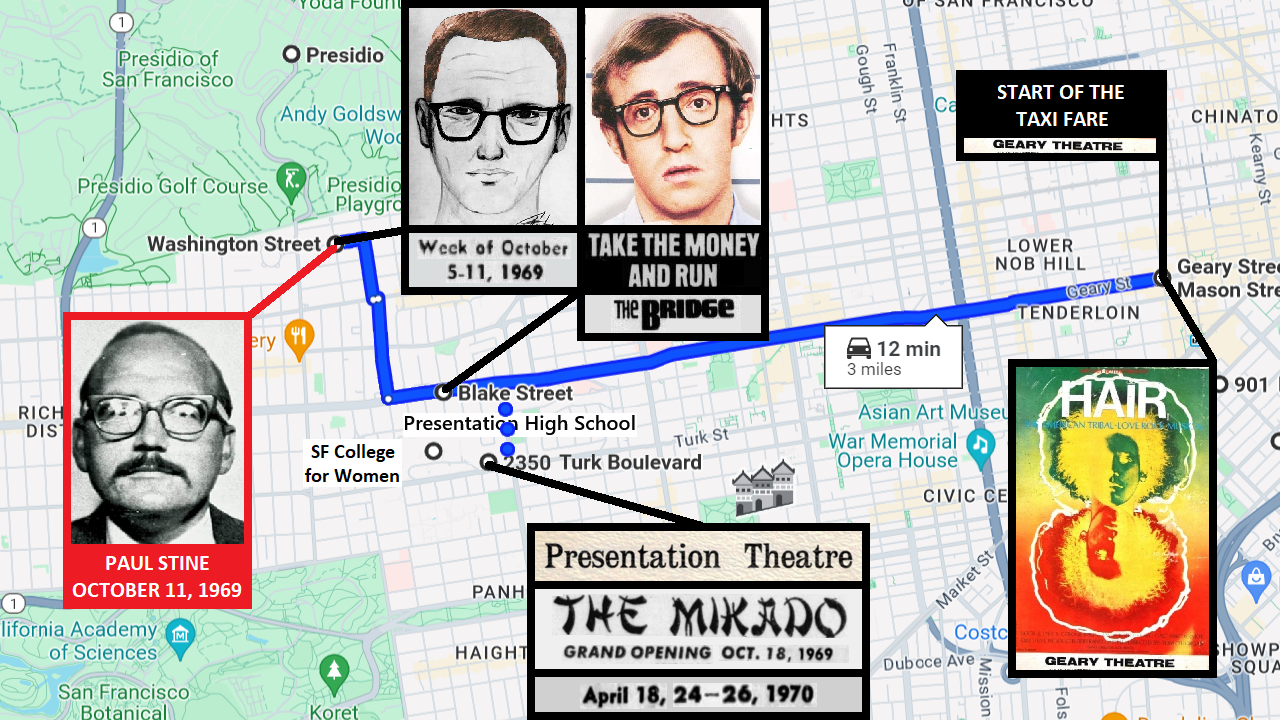
There are other facts to highlight.
- Near the Bridge, there is a school district of the Sisters of the Presentation where the mother of Joe Bevilacqua‘s son-in-law graduated in the mid-’60s.
- The facility is home to the Presentation Theatre. Here, starting from a week after the homicide of Stine,86 the Lamplighters company, known in San Francisco for its performances of the works of Gilbert & Sullivan, will stage the “Mikado” which Zodiac will mention twice in his letters.87 The first in a ’70 letter. The last one signing himself with a stanza about a drowning.
- The “Mikado” returns to the Presentation between April 18 and 26, 1970, at the time of the letter on Zodiac’s name cipher.88
- In the same period, in the Lone Mountain women’s college next to the Presentations, the drama “Dido and Aeneas” by Henry Purcell inspired by a famous part of Virgil’s poem was performed.89
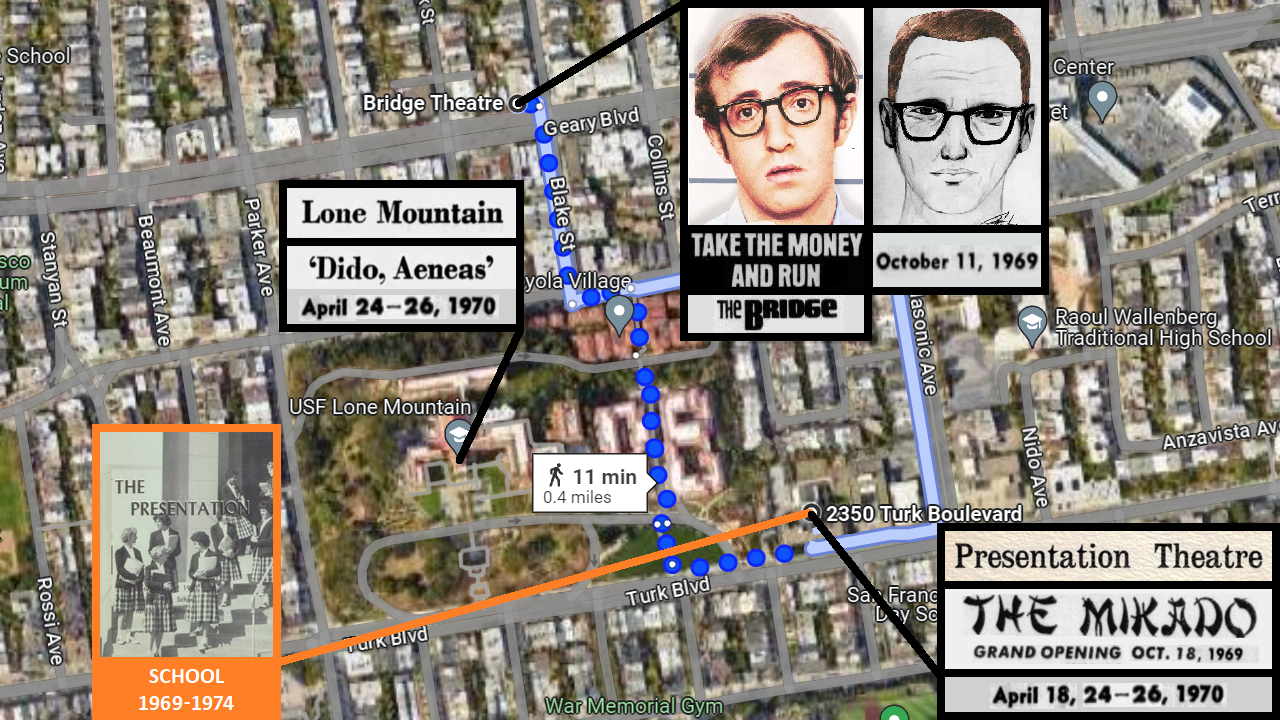
Could it have been an advertisement for “Dido and Aeneas” that suggested Zodiac refer to the name Virgil by replacing ANE with AEN from “Aeneas”?
A clue in this direction would appear to be the postcard delivered to the Chronicle a week later, and stamped the day after Bevilacqua’s assignment to a command in Germany (biographical details here).
The postcard portrays Don Quixote riding a dragon and his squire Sancho Panza.
There does not seem to be anything strange about it, apart from the fact that, in the Examiner of April 21, 1970, there is an announcement for the show “Dido and Aeneas” adjacent to an insert of “The Adventurers” (true coincidence) and next to a drawing depicting Don Quixote.90

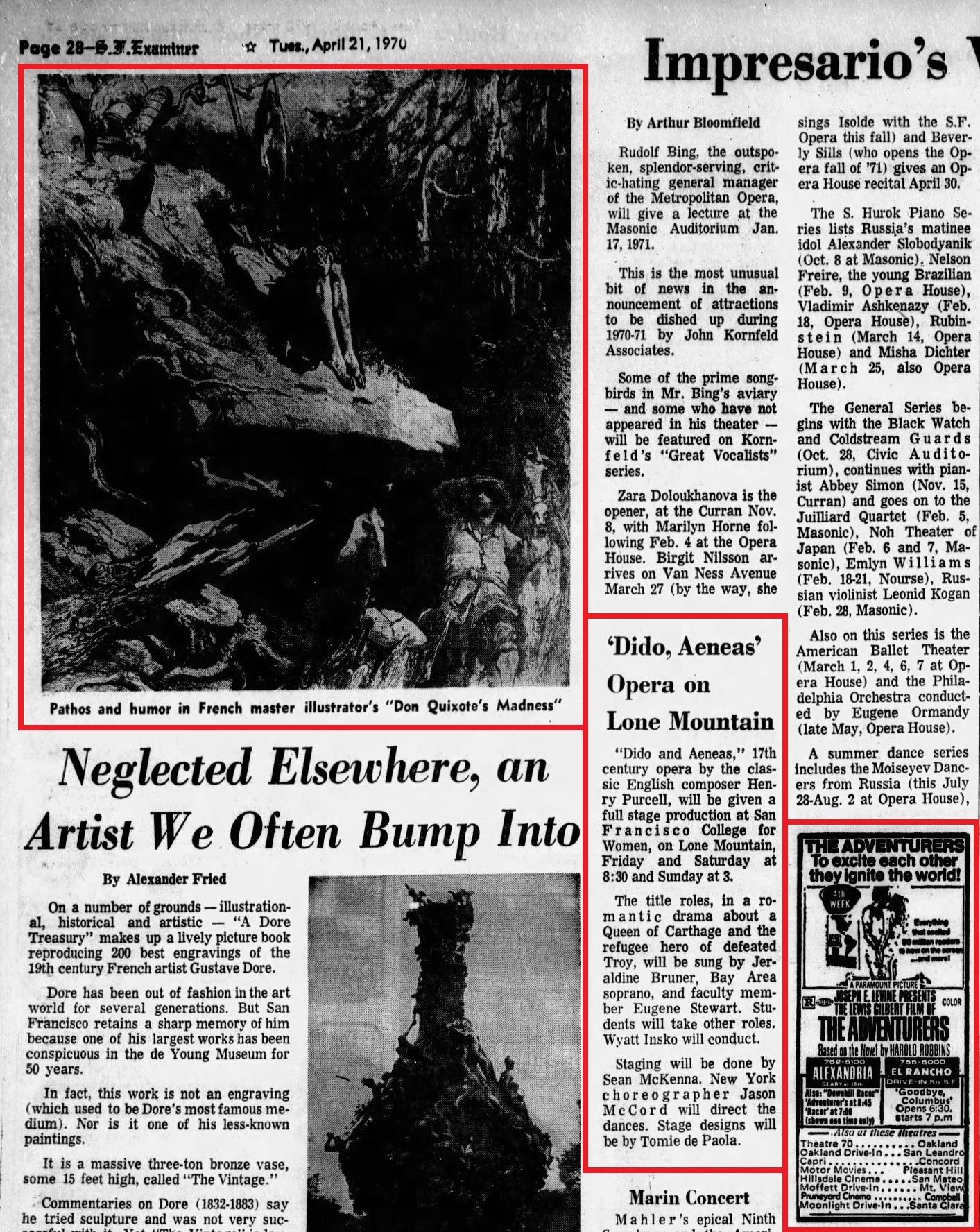
Zodiac’s choice of the postcard may have been due to the coincidence of finding two references to its cipher side by side in a San Francisco newspaper shortly after sending it.
The correctness of this hypothesis would indicate that the serial killer frequents the area south of the Bridge, at least sporadically. Perhaps, he plans an attack.
It would be a choice consistent with his criminal activity in the past, if he were the perpetrator of the murder of Cheri Jo Bates, killed not far from Riverside college in ’66.
It is possible that, after realizing the presence of a women’s college and high school near the cinema where “Take the Money and Run” is being shown, Zodiac carryies out “reconnaissance” activities and comes to know about “Dido and Aeneas” from a poster or a promotional flyer.

The “Virgil/Don’t drink the water” connection is a fundamental piece to understand the motivations underlying some planned choices of the serial killer who calls himself Zodiac.
That does not excluded that alongside the need to sign himself there were calculations of opportunity.
Regarding the crime scene on Washington Street, it is true that the cab’s route would allow it to pass in front of the Bridge, but it is also true that it stops, not at any point, but near the main entrance of the Presidio, the Army base where Zodiac is seen walking after killing Stine.
In the same period as the murder, the Presidio was the site of a lead into the so called “Khaki Mafia” case, a complex CID investigation in which Joe Bevilacqua told me he participated.91
Furthermore, a witness suspected of unlawful activities along with some members of the “Khaki Mafia”, Colonel Jack Ice, is stationed at the Presidio.92
Another company under scrutiny in this investigation at the time, Great West Food Packers (exonerated), is headquartered an office a 15-minute walk from the Geary Theatre, where Zodiac got into Stine’s cab.93
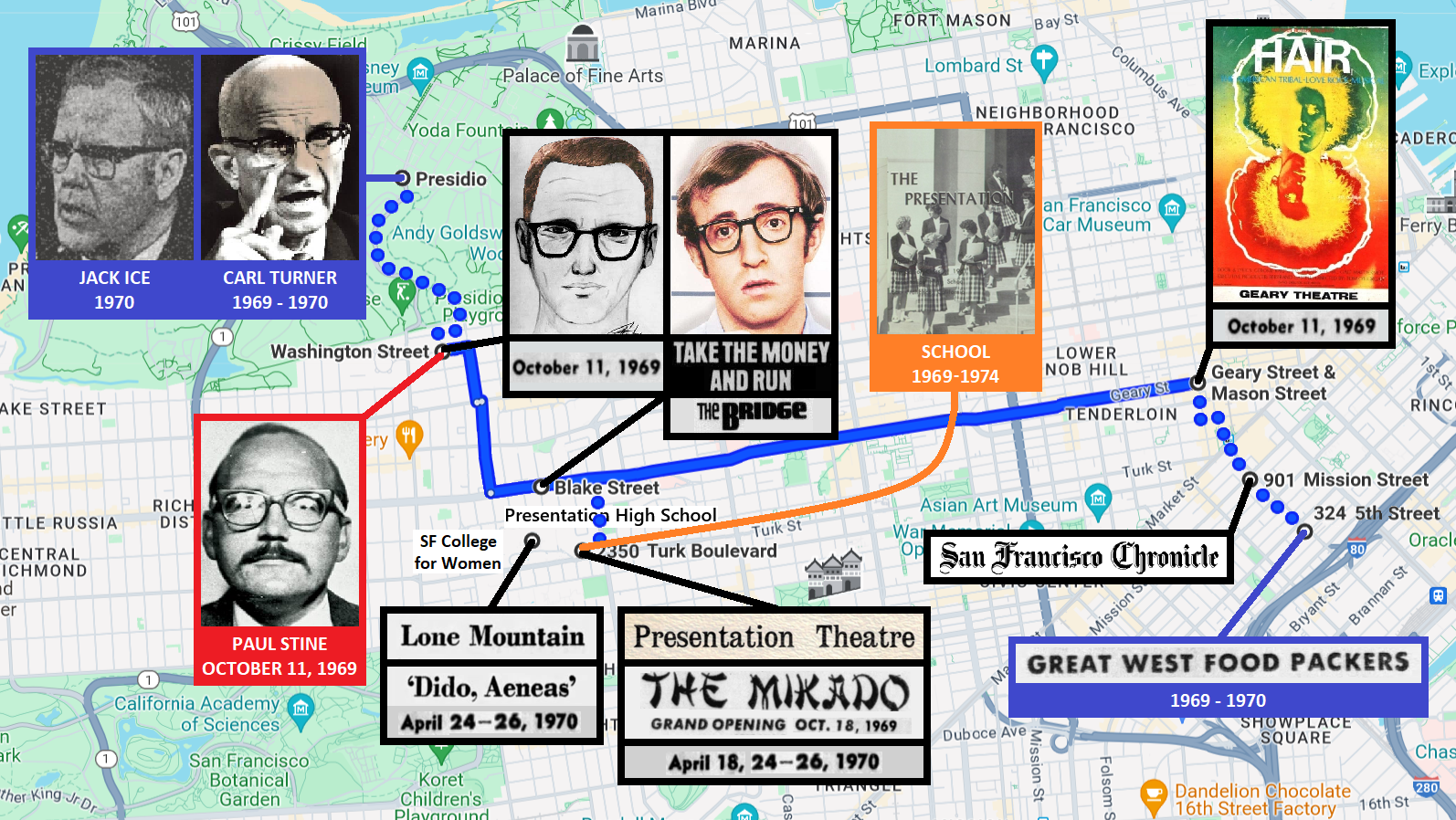
15. Joe
AEN could be completed in AEN-EID or AEN-EAS, but it would make little sense.
“Sae” is a Japanese female name and “die” is just not a name.
At Lake Berryessa, Zodiac chooses the phone booth with the purpose to leave his signature.
Maybe he did the same with the previous phone call too?
Here is what the Blue Rock Springs homicide report says about the booth place:
"...The above call was traced to a pay phone booth at Joe's Union at the intersection of Tuolumne and Springs Road."94
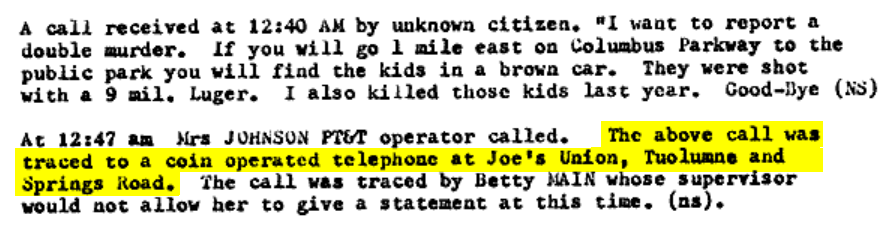
Joe’s Union (even if in the telephone directory of the time it appears with another name)95 is a gas station.
Is “Joe” from “Joe Bevilacqua” Zodiac’s name?
The serial killer may have decided to switch the N and the first E of ANETHEKE to obtain not “Aeneas”, but its Italian translation, “Enea”.96

Putting the E of Joe under the N gives “Enea” following a similar path to the one that could form “A[c]quaman“.
The phrase underlying this part of the encrypted message “I am”, coupled with AEN and the deciphered E forms the horseshoe phrase: “I am Enea.”

You can get an idea of the most common names with three letters ending in E by browsing the websites.
Consulting the lists of a site of English names, nameberry.com, I find the following.97

You could also include “Lee” or “Ste” in the list.
In any case, according to official data from the Social Security Administration, “Joseph”, from which the diminutive “Joe” derives, is in 10th place among the names given to US newborns in the ’30s, the era to which the birth can be traced back of “Zodiac” based on the eyewitness descriptions cited in the previous chapter.98

The final part of the decryption could be suggested by Zodiac at the end of the second page of the letter where he positioned the word “I” above the equal sign, the figure “10” and the Celtic cross.

The 10 drawn like “IO” can also represents the Italian word “Io”, translation of “I”, which Zodiac in this circumstance writes similarly to a J.

After replacing ANE with AEN to get the third letter of its name, Zodiac’s chances of producing combinations that make sense with the first two letters are very limited.
This would explain the use of a trick.
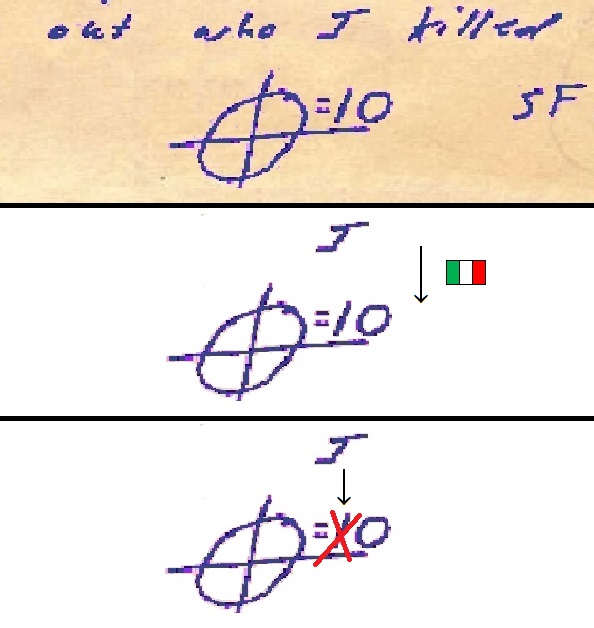
- I = IO (Italian translation);
- if J = I (as Zodiac draws it),
- then: I = IO = JO.
It follows that the word “I” in the sentence below the cipher can correspond to JO.
From this brain teaser Zodiac’s name results JOE.

The solution seems to be hinted at by the J/O and O/I replacements that appear in my decryption of the Mt. Diablo cipher, a cipher sent two months later than that of the Zodiac name.
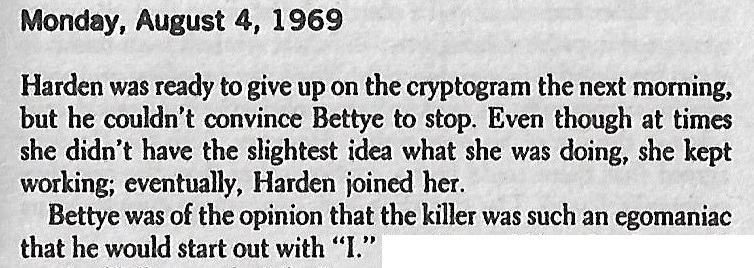
Finally, should be remembered that “I” is the incipit of the first Zodiac cipher,99 the first word to be decrypted thanks to an intuition of Bettye Harden, Donald’s wife, told by Graysmith in “Zodiac”.100
"Bettye was of the opinion that the killer was such an egomaniac that he would start out with 'I.'"101
“My name is Joe Bevilacqua“
The stylized list of Zodiac references follows.
Facts supporting the decryption of Zodiac’s name from solutions of other ciphers/riddles are cited in the introduction.
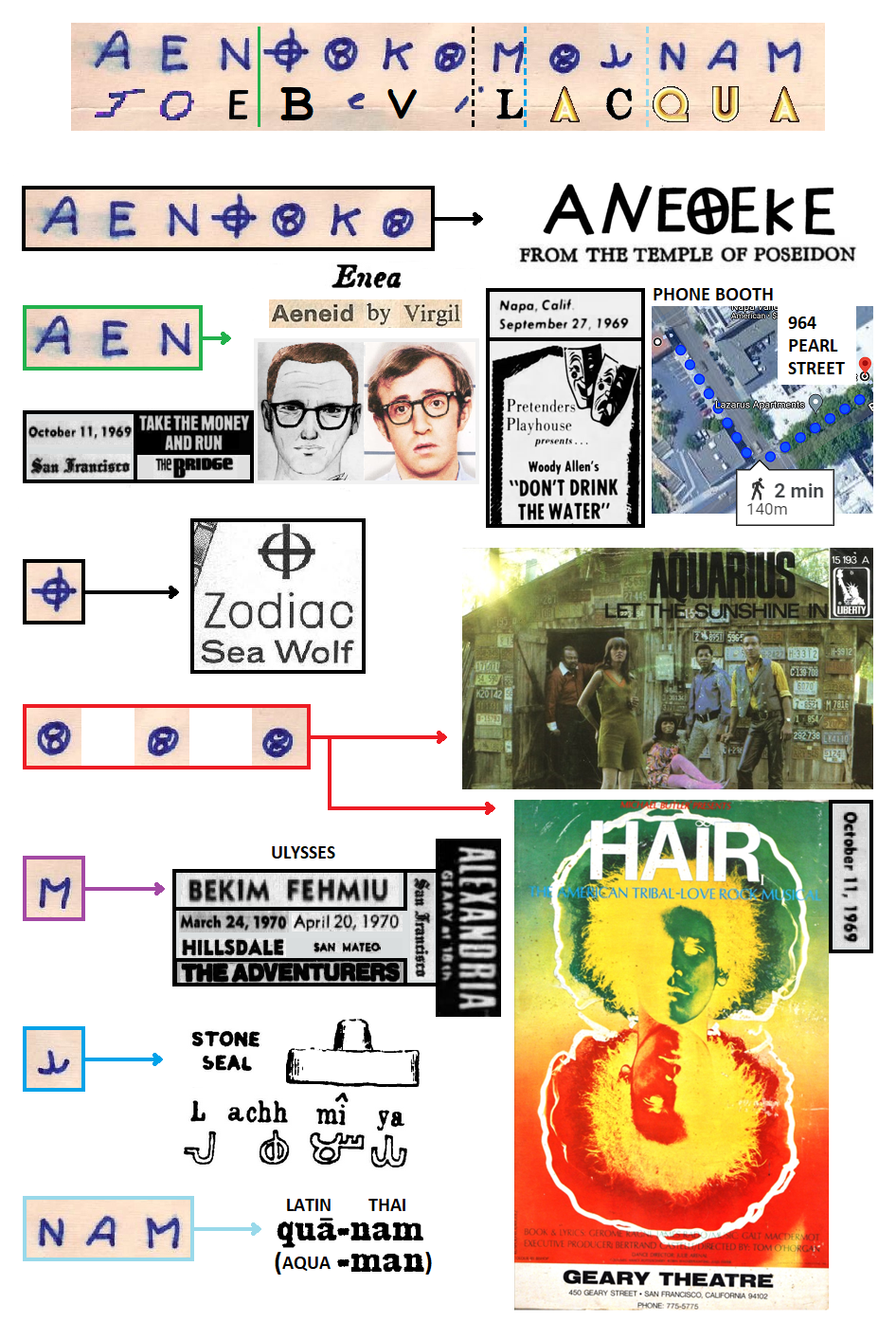
Endnotes
- John M. Hawkins, “The Oxford paperback dictionary”, Oxford University Press, 1988, p. 12, see chapter “Take the money and run”. ↩︎
- FBI Laboratory, Report on specimens Qc45, Qc46, Qc47, FBI File n. 9-49911, April 28, 1970. ↩︎
- FBI San Francisco, Airtel, file 9-49911, January 22, 1970. ↩︎
- Frederic W. Goudy, “The Alphabet”, 1922, p. 11. ↩︎
- https://search.worldcat.org/it/title/The-alphabet-and-elements-of-lettering/oclc/522022 ↩︎
- Sunday S.F. Examiner and Chronicle, California Living, week of November 12, 1967, p. 54. Numberous advertisements for Zodiac Sea Wolf like this one were published in US newspapers in 1967. ↩︎
- Ibidem. ↩︎
- Liddell, Scott, Jones, “A Greek-English Lexicon”, 1940. ↩︎
- Lorenzo Rocci, “Vocabolario Greco Italiano”, Società Editrice Dante Alighieri, 1943. ↩︎
- James Whitley, “The archaeology of Ancient Greece”, Cambridge University Press, pp. 140. ↩︎
- Ivi, pp. 140-141. ↩︎
- ROS, Carabinieri di Firenze, Annotation on phone records analysis, case n. RGNR 879/18, Procura della Repubblica di Firenze, June 12, 2018, p. 6. ↩︎
- “Hunt for nurse at dead end”, San Francisco Examiner, September 26, 1970, p. 4. ↩︎
- California Department of Justice, Zodiac Homicides, special report, 1971. ↩︎
- San Francisco Examiner, October 11, 1969, p. 10. ↩︎
- San Francisco Examiner, March 24, 1970, p. 24. ↩︎
- Hair, poster, A.C.T.’s Geary Theatre, San Francisco, 1969/1970. For advertisements see notes 15 and 16. ↩︎
- San Francisco Examiner, September 2, 1970, p. 47. ↩︎
- Ibidem. ↩︎
- David Zenian (UPI), “The wounded lie in the hallways”, San Francisco Examiner, September 25, 1970, p. 5. ↩︎
- S.F. Sunday Examiner and Chronicle, Datebook, October 4-10, 1970, p. 1. ↩︎
- Mary Campbell (AP), “It’s a ripe age for the 5th Dimension”, San Francisco Examiner, June 6, 1969, p. 26. ↩︎
- Scott Tady, “Age of Aquarius: What does it mean?”, Beaver County Times, July 9, 2017. ↩︎
- “Top records of 1969”, Billboard, December 27, 1969, p. 16. ↩︎
- “5th Dimension gets Grammy”, San Francisco Examiner, May 8, 1970, p. 34. ↩︎
- MClatchy Newspapers Service AP and UPI, “Zodiac’s postcard”, The Sacramento Bee, March 27, 1971, p. D2. ↩︎
- Robert Graysmith, “Zodiac”, Berkley Publishing Group, 1986 (2007 edition), p. 146. ↩︎
- Tim Holt #30, Magazine Enterprises, June 1932. ↩︎
- Ivi, p. 7. ↩︎
- U.S. Census Bureau, Census 2010, surnames occurring at least 100 times, FILE B. ↩︎
- Ibidem. ↩︎
- “NAM. Cronaca della guerra in Vietnam 1965 – 1975”, De Agostini, 1988. Original title: “NAM. The Vietnam experience 1965 – 1975”, Orbis Publishing Ltd., 1987. ↩︎
- Richard A. Ruth, “Why takes pride in the Vietnam War”, New York Times, November 7, 2017. ↩︎
- Charlon T. Lewis, Charles Short, “Latin dictionary founded on the translation of Freund’s Latin-German lexicon”, American Book Company, p. 1505. ↩︎
- Pliny the Elder, “Naturalis Historia”, liber XI, 137. ↩︎
- Alexander Cunningham, “Inscriptions of Asoka”, Volume I, plate XXVIII. ↩︎
- Ivi, p. 61. ↩︎
- Red Ryder #15, K. K. Publications, September-October 1943. ↩︎
- Confrontation between excerpts from the Halloween card and Red Ryder #14, K. K. Publications, July-Agust 1943. ↩︎
- “The Century Dictionary and Cyclopedia”, Volume XI, The Century Co., p. 224. ↩︎
- Andrew Ure et al., “Dictionary of Chemistry”, Volume II, Robert Desilver, 1821, “Lac”. ↩︎
- newspapers.com/search/#query=EKIM&dr_year=1970-1970. ↩︎
- newspapers.com/search/#query=BEKIM&dr_year=1970-1970. ↩︎
- “Three films open this week”, San Francisco Examiner, March 23, 1970, p. 40. ↩︎
- San Francisco Examiner, April 20, 1970, p. 32. ↩︎
- San Francisco Examiner, March 24, 1970, p. 24. ↩︎
- San Francisco Examiner, April 21, 1970, p. 28. ↩︎
- Lloyd Johnson, “Farmer’s market is restaurant complex”, San Mateo Times, July 20, 1969, p. 2A. ↩︎
- CID Agency, Report of investigation n. 70-CID011-00763, February 16, 1971. ↩︎
- Ibidem. See also notes 91-93. ↩︎
- https://www.raiplay.it/programmi/odissea. ↩︎
- GIDES, Transcript of the 30 June 2003 conversation between Lorenzo Nesi and Mario Vanni, July 4, 2003. ↩︎
- Ibidem. ↩︎
- C. C., “Il classico Ulisse e il ribelle Enea”, La Nazione, July 18, 1974, p. 9. ↩︎
- newspapers.com/search/#query=BEKIM&dr_year=1970-1970. ↩︎
- Vernon Scott, “10 Million risked on an unknown”, San Francisco Examiner, January 3, 1970, p. 10. ↩︎
- Ibidem. ↩︎
- Ibidem. ↩︎
- San Francisco Examiner, 3 gennaio 1970, p. 10. ↩︎
- Napa County Sheriff’s Department, Report on the attack at Lake Berryessa, October 5, 1969, p. 1. ↩︎
- “Woody Allen play open friday”, The Napa Register, September 10, 1969, p. 14A. ↩︎
- The Napa Register, September 27, 1969, p. 5D. ↩︎
- Stanley Eichelbaum, “Screen renders ‘water’ non-potable”, San Francisco Examiner, November 20, 1969. ↩︎
- John M. Hawkins, “The Oxford paperback dictionary”, Oxford University Press, 1988, p. 12. ↩︎
- Daily News, August 18, 1969, p. 57. ↩︎
- S.F. Sunday Examiner and Chronicle, Datebook, October 5-11, 1969, pp. 1 e 13. ↩︎
- Stanley Eichelbaum, “Woody the failure is a film success”, San Francisco Examiner, 8 ottobre 1969, p. 69. ↩︎
- S.F. Sunday Examiner and Chronicle, Datebook, October 5-11, 1969, pp. 1 e 13. ↩︎
- San Francisco Examiner, October 6, 1969, p. 30. ↩︎
- According to Michael Mageau, who survived the Blue Rock Springs attack, they are light brown, almost blonde (Vallejo Police Deparment, Interview to Michael Mageau, 6 luglio 1969, p. 4). Instead they are dark brown, according to Bryan Hartnell, survivor of the Lake Berryessa stabbing, who can glimpse them between the glasses and the hood worn by the attacker (Napa County Sheriff’s Department, Interview to Bryan Hartnell, September 28, 1969, p. 14).
In San Francisco, istead, Zodiac’s hair becomes reddish (San Francisco Police Department, Pelissetti report on the Stine murder, October 11, 1969, p. 2). ↩︎ - Dave Smith, “Zodiac Killer, portrait of madness”, Los Angeles Times, October 15, 1969, p. 27. ↩︎
- Stanley Eichelbaum, “Woody the failure is a film success”, San Francisco Examiner, October 8, 1969, p. 69. ↩︎
- “Take the money and run”, directed da Woody Allen, ABC, Palomar Pictures International, 1969. ↩︎
- Tribunale di Firenze, Transcript of the hearing of June 6, 1994, trial n. 1/1994, p. 16. ↩︎
- Ibidem. ↩︎
- S.F. Sunday Examiner and Chronicle, September 21, 1969, sezione B, p. 5. ↩︎
- San Francisco Police Department, Pelisetti Report on the Stine murder, October 11, 1969, p. 2. ↩︎
- Donald Fouke, Memorandum on a Zodiac suspect, November 12, 1969. ↩︎
- “Take the money and run”, directed by Woody Allen, ABC, Palomar Pictures International, 1969. See the mentions of the term “wash” by Zodiac and the fake story about his escape that he tells to Brian Hartnell and Cecilia Shepard in chapter “The water”. ↩︎
- The Napa Register, October 1, 1969, front page. ↩︎
- Napa County Sheriff’s Department, Report on the attack at Lake Berryessa, October 5, 1969, p. 1. The phone booth was located next to the building that housed the Sam Kee Laundry registered in the Napa National Register of Historic Places at the intersection between Clinton and Main Streets (Google Maps). ↩︎
- Robert Graysmith, “Zodiac”, Berkley Publishing Group, 1986 (2007 edition), p. 146. ↩︎
- Collins Italian College Dictionary, Harper Collins, 1991, pp. 172 -173. ↩︎
- Los Angeles Times, August 24, 1969, p. 29. ↩︎
- Daily News, August 18, 1969, p. 57. ↩︎
- Datebook, October 4, 1969, p. 6. ↩︎
- FBI laboratory, Report on specimens Qc 62 e QC 63, FBI file n. 9-49911, March 1, 1974. ↩︎
- S.F. Sunday Examiner and Chronicle, Datebook, April 19-25, 1970, p. 20. ↩︎
- S.F. Sunday Examiner and Chronicle, Datebook, April 12-18, 1970, pp. 1 e 7. ↩︎
- San Francisco Examiner, April 21, 1970, p. 28. ↩︎
- CID Agency, Report of investigation n. 69-CID011-00033, February 9, 1970. There were other investigations carried out in the San Francisco Bay Area and Northern California in concomitance with the Zodiac case (further information here). ↩︎
- 9th MP gp (CI), Report of investigation n. 70-CID017-30008, August 16, 1970. ↩︎
- CID Agency, Report of investigation n. 69-CID011-00016, first supplemental, February 9, 1970. ↩︎
- Vallejo Police Department, Report on the Blue Rock Springs attack, 1969, p.13. ↩︎
- The name appears as “Joe” in the investigative report as well as on the Polk’s City Directory, Vallejo, 1960-1961, R.L. Polk & Co. Publishers, but not in that of 1968-1969. ↩︎
- Guglielmo Comelati and John Davenport, “Dictionary of the Italian and English Languages”, Longman and Co. et al, 1854. ↩︎
- nameberry.com/baby-names/831/3-letter-boy-names/uniqueameberry.com. ↩︎
- https://www.ssa.gov/cgi-bin/namesbystate.cgi. ↩︎
- “Salinas teacher breaks code on Vallejo murders”, San Francisco Sunday Examiner and Chronicle, August 10, 1969, p.26. ↩︎
- Robert Graysmith, “Zodiac”, Berkley Publishing Group, 1986 (2007 edition), p. 53. ↩︎
- Ibidem. ↩︎
 Zodiac, Mostro di Firenze
You must be logged in to post a comment.