The Monster of Florence never was officially accused by a Court as the author of the murders of Barbara Locci and Antonio Lo Bianco which took place on August 21, 1968, in Signa. For this “crime of passion” committed under the eyes of Barbara’s son, Natalino, who after the ambush arrived unharmed in a safe place, her husband, Stefano Mele, was definitively convicted on 12 April 1973.
SARDINIANS’ ACQUITTAL Before and after having attributed the crime to himself, Mele accused some of his wife’s lovers, Francesco and Salvatore Vinci, Sardinians like him. The Vincis together with Giovanni Mele and Piero Mucciarini were investigated in the Monster case in the ’80s and completely acquitted on 13 December 1989 (Verdict). here was no evidence against them and they were in prison or under control on the occasion of some of the crimes of the serial killer (Ferri’s judgment, February 13, 1996). The end of the “Sardinian lead” confirmed that the Signa crime could be considered extraneous to the Monster’s series of murders (Ferri’s judgment). This crime lacked all the characteristics of the mania in the Monster’s murders, which is the way the slayer stabbed the female victims or the excision of their sexual organs. What remains today to link it to the Monster’s crimes? The spent cartridges fired by the Monster’s gun stored out of the evidence room, in violation of the rules (Micheli’s judgment, p. 20), that contradict the ’68 ballistic report, the only document that might have certified their origin.
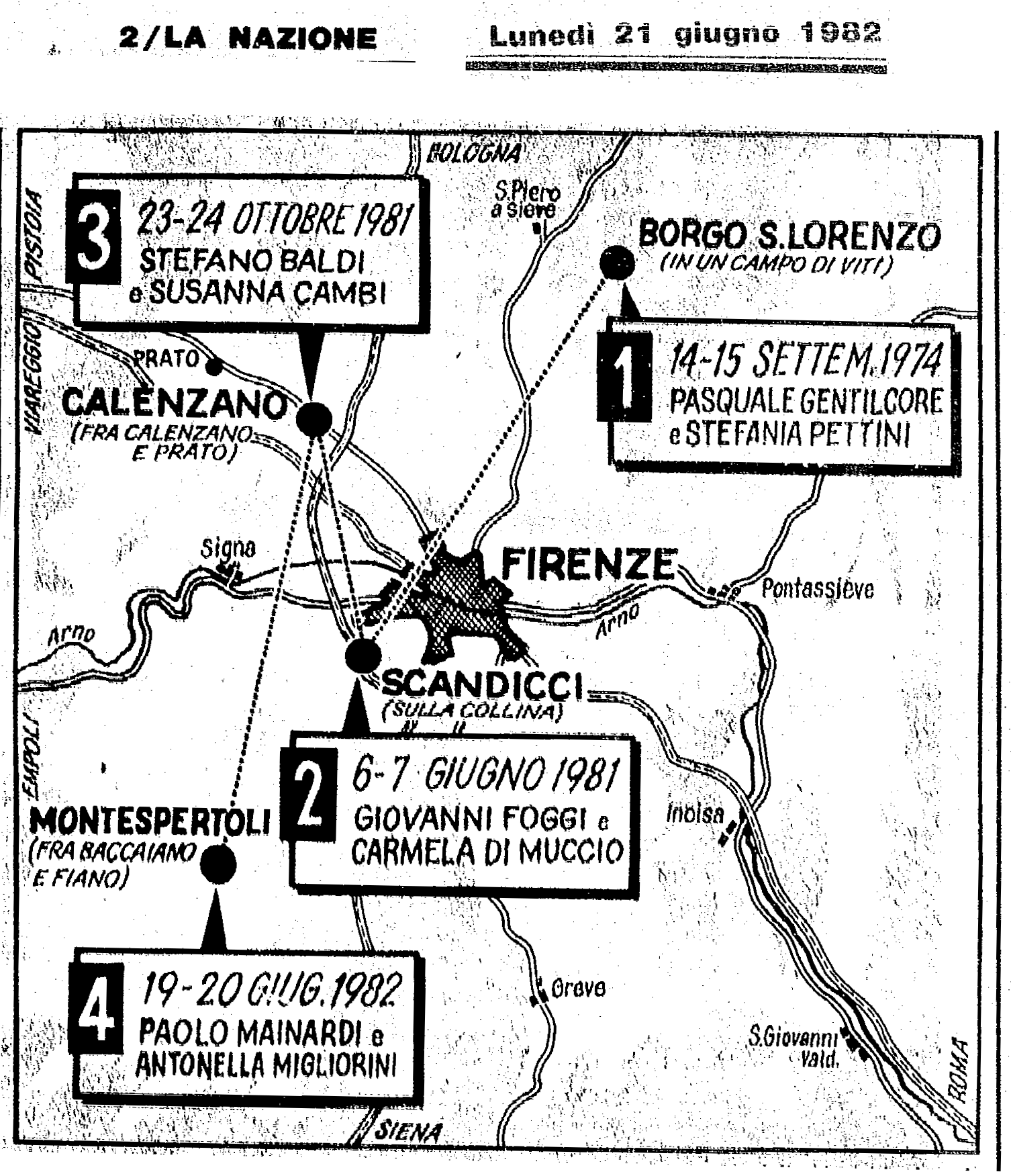
LINK Before the summer of 1982, the investigators had not yet connected the Signa crime with the crimes of the Monster, as can also be seen in the map below published two days after the Baccaiano murders.
Map of the Monster’s murders from 1974 to 1982. The 1968 case is absent
The connection was made on the basis of five Monster’s spent cartridges, about a month later. They were inside the Mele court file at the archives of the Court of Florence. Examining magistrate Vincenzo Tricomi had requested to search them in the evidence room but they were unexpectedly found in a folder of the Mele case records together with the ballistics report of ’68,unbeknownst to the judicial authority.
«The then investigative judge was informed. He requested the court file. Around July 20, 1982, it was on his table. For fortuitous and inexplicable combination, the bullets and the shell casings found after the crime were attached to the file.» Rotella’s judgment, p. 20
INCONSISTENCIES The above paragraph written by judge Rotella contains an approximation. The fact that the specimens he spoke of were actually the real pieces of evidence found at the ’68 crime scene had to be proven and not taken for granted, being bodies of crime “archived” out of the rules. Shell casings and bullets among the Mele’s case records did not offer the probative strength of bodies of evidence in the right places (the evidence room or crime scene) and an immediate check should have been carried out to confirm their authenticity. Bullets and shell casings must have been compared with their descriptions in the ’68 ballistic report (which did not contain macro-photos). If matched, they were the same ones found at the crime scene in 1968. Otherwise, they were not. In 1982, the investigators deduced that the Monster was the murderer of 1968 since there were Monster’s bullets and shell casings in the ’68 case folder. Nothing of strange, apparently, but if they had requested the necessary comparison with the ballistic report, they would have discovered that the evidence found mismatched with those described in 1968. Someone had replaced them.
The likely Monster’s weapon is a .22 LR caliber Beretta Model 70
COMPARISON If the pieces of evidence of the crime in Signa were replaced with Monster’s spent cartridges, the killer had had access to the Mele case records before the crime of 1974. He had tried to copy Signa’s gun and had attached the finds from his gun to the file, in order to connect his weapon to the crimes he would have committed in the future, sidetracking the investigators. Impossible to do? The correct question is: who would not have been able to consult records of the Mele case file? If someone gave you 10 dollars without a watermark, would you accept it? I do not think so. The concept should also be applied to the “evidence” of the Locci-Lo Bianco crime. The enclosed finds were 5 shells and 5 bullets of Winchester series H cartridges exploded from a .22 caliber, the same type of weapon that later used the Monster and which is mentioned in the ballistic report. However, brand of cartridges and type of weapon are not enough to confirm if they are the same pieces of evidence from 1968. The author of misdirection, having read the report, could have gone to a gun shop, bought a .22 caliber pistol, and that type of cartridges. To verify the authenticity of the finds, it is necessary to take the survey of ’68 and verify that the primary prints of the weapon on the shells and bullets found at the crime scene are compatible with those found in the folder. It was not impossible to access the file of the Mele case, to find the weapon, ammunition, and evidence for replacement, but to produce signs identical to the original ones.
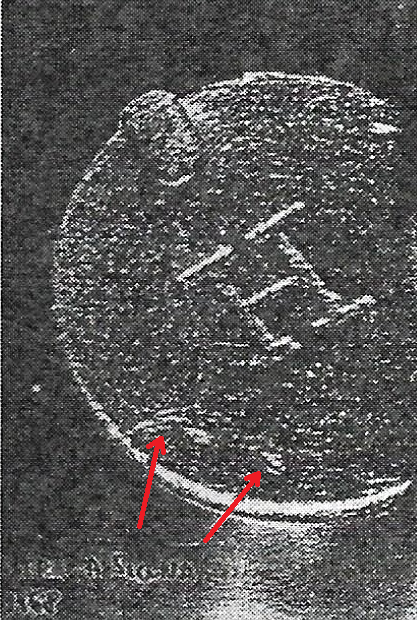
SHELL CASINGS WERE REPLACED The three main marks that an automatic .22 caliber pistol leaves on the fired shells are the firing pin, extractor, and ejector marks. On the other hand, the bulging of the case at 6 o’clock with respect to the firing pin mark is a consequence of the use of high-speed cartridges in the .22 caliber pistol, not a particular sign. In this case, it is quite easy to verify if the finds match their description. The ejector of the Monster’s weapon imprints on fired shells a characteristic mark which was described for the first time in 1974 by ballistic expert Innocenzo Zuntini.
It is anomalous that in 1968 the same expert described the ejector mark left by the murder’s gun (the real one) in a rather different way. In fact, the expert writes:
“We have observed that on all the confiscated shell casings the extractor mark (which would normally appear beyond the edge of the back of the cartridge roughly at 3 o’clock) and ejector mark (which normally would be detected on the edge of the back of the cartridge roughly at 8 o’clock) are nearly undetectable.” ’68 Zuntini’s ballistic report, p. 8
On the certainly authentic cases of the Signa crime, i.e. those examined 14 years before the connection, the marks of the extractor and, above all, of the ejector are almost undetectable, so much so that Zuntini is unable to determine precisely where they are (despite knowing in theory where you should see them). How come? And why do the “prints” of the Monster’s gun (next image), who were invisible to Zuntini in ’68, “magically” appear on the alleged ’68 shell casings found in the Mele file?
The ejector marks on the cartridge cases found in the Mele file are incompatible with those described in ’68. If Zuntini’s observation at the time of Signa is taken at face value, it follows that someone replaced the evidence after Zuntini had examined it. Someone tampered with the bullets and shell casings of the ’68 case to make people believe that the Monster’s gun had shot in Signa. The only one who could carry out this misdirection was the holder of the Monster’s weapon, that is, the serial killer himself or an accomplice of him.
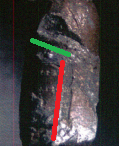
DIFFERENT BULLET This conclusion based on the expert’s reports is supported by another observation relating to the E bullet. This find has a particularity that can be useful for possible comparisons. In 1968, it was described by Zuntini this way:
“e) bullet extracted from Lo Bianco’s body at autopsy; made of lead, copper plated, with 6 grooves etc. as the previous ones […] it shows in its deformed ogival part a metal burr points to the right, that is to the same direction of the rifling grooves twist.” ’68 Zuntini’s ballistic report, p. 10
Pseudo bullet E
As you can notice, the metal burr on the “ogival base” of the bullet (underlined in green) is not really a “burr” and is almost orthogonal in the opposite direction to the rifling (underlined in red). The author of misdirection was unable to reproduce Zuntini’s description and, moreover, he swapped right with left. Regardless of how the green underlined scratch was produced, this bullet confirms that a replacement of the original evidence occurred.
DIFFERENT GUN A comparison between the spent cartridges found in the Mele case folder and Zuntini’s observations reveals the incompatibility of the main marks on the shell casings, including that of the firing pin. The police report on the Signa case of September 21, 1968, says that, after an initial analysis, Zuntini had hypothesized that the gun used by the murderer was a Beretta, the most popular brand of pistols in Italy.
“[…] the ballistics expert Colonel of Artillery Zuntini Innocenzo, who is on duty at the Artillery Command of the 7th Comiliter of Florence, ascertains from the examination of the shell casings found [on the crime scene] that it is a pistol, presumably Beretta caliber .22 , old, rusty and worn.”’68 police report, p. 21
The ballistic report delivered to the Prosecutor’s office in Florence on the following October 30 does not mention the Beretta brand, even if tests at the shooting range were logically also carried out with Beretta .22 caliber pistols, therefore with a gun Beretta 70 series such as the one supposed to have been used by the Monster.
«Test firings with 35 different weapons .22 caliber long rifle type were conducted but in none of them we were able to find a firing pin that gave a percussion mark of the same shape of that impressed on the seized shell casings.» ’68 Zuntini’s ballistic report, p. 21
It can be concluded that Signa’s weapon was probably not even a Beretta. Zuntini was unable to ascertain the brand of the gun, despite having hypothesized that it was a Beretta, while he easily found a positive match between the serial killer’s weapon and the Beretta Model 70 in the first real case attribute to the Monster in 1974. This constatation definitively excludes that the weapon of ’68 was the same that fired the shell casings found in the Mele case folder in 1982.
“The mark of the fire pin on the edge has the shape of a rectangular bar, size 1,6 x 0,75 mm, which is typical of the Beretta’s gun.” ’74 Zuntini’s ballistic report, p. 1
What remains of the connection between the ’68 case and the Monster, then? The assumption that it was difficult to access a Court clerk’s office to consult documents and replace pieces of evidence stored (without the knowledge of the judicial authority) among records of a closed case. This is an illusion disproved by the comparison between the pieces of evidence found in the Mele case file and the ’68 ballistic report, regardless of how and by whom the misdirection was carried out (probably the Monster himself).
CITIZEN FRIEND The official, belated version on the origin of the connection between the ’68 case and the crimes of the Monster is that a Carabinieri marshal, Francesco Fiori, recalled the events in Signa and reported them to the investigative judge (La Nazione, 27 January 1984, page 2). If so, the author of the misdirection was very lucky. But it is likely that things went differently and that it was precisely the same man who replaced bullets and shell casings the one that pushed the investigators on the red herring in the summer of 1982. Official documents of the time signed by investigative judge Vincenzo Tricomi and PM Silvia Della Monica (she seems to be victim of a miscommunication) indicate that it was an anonymous tip and not the Carabinieri to suggest the connection.
“Following an anonymous tip that reported the existence of a fifth double murder committed by the so-called “monster”, we traced it back to the murders of Lo Bianco Antonio and Locci Barbara committed in 1968 for which Locci’s husband had been convicted. All five of the aforementioned murders are linked by the use of the same .22 caliber gun.” October 29, 1982, juridical request by Vincenzo Tricomi
This version is indirectly confirmed by an appeal by the Carabinieri to an anonymous writer who called himself “a citizen friend”, published in La Nazione, on 20 July 1982. The appeal was printed just a few hours before the discovery of the evidence in the folder of the Mele case.
“An appeal for the monster by the Carabinieri An appeal by the command of the Carabinieri investigative department at Borgo Ognissanti is directed to a person who several times has made anonymous contributions to the investigation on the murders of the maniac, the so-called monster, in order to get back in touch. The man, who signed his last letter “A citizen-friend” and who wrote three letters stating he did not want to reveal his identity not to be considered a mythomaniac, should provide his collaboration again, even if only by calling the Carabinieri investigative department.” July 20, 1982. Appeal on La Nazione
The author of the misdirection had consulted the Mele case file prior to the 1974 crime. He had read the ballistics report, picked up a similar gun, and left his bullets and shells in the folder. He had to have the necessary skills, both in the ballistic and investigative fields, as well as contacts with the judicial police in Perugia, where the Mele case file was retained between 1972 and 1974. After starting his series of murders, in 1982, he had suggested the connection to the Carabinieri, signing his final letter “un cittadino amico”. “Cittadino” and “amico” in Italian translate “citizen” and “friend”, which are the last possible Zodiac’s signatures, according to a 1974 report by FBI experts. These words were affixed to the letters postmarked February 3 and May 8, 1974, mailed in San Francisco a few months before the Monster’s crime in Rabatta. Why did the “Italian serial killer” carry out this misdirection? Probably because the ’68 crime would have cleared him of all his series of murders that he wanted to commit, if he had been capable to link it to them. If he had proof that he was outside Italy in 1968 and shot with the gun used in Signa, he would be possibly excluded from the future suspect list. The responsible for this misdirection is someone who could say to the police: “I am innocent because I was not in Florence in 1968.”
Where are the investigative reports on the “citizen-friend”? (Chapter added September 17, 2022) In 2022, a researcher in the Monster case, Marco Aufiero, announced that in 2019 the Prosecutor’s Office ascertained the existence of a reply from the carabinieri to Della Monica’s request. The agents of the “Arma”, in 1982, sent the magistrate a letter which, however, did not refer to Signa but to another episode. Perhaps Della Monica, informed of the existence of a letter on ’68 from Tricomi, the judge responsible for the investigations, misunderstood the fact that it was addressed to her? What is probable is that on July 20, 1982, when the appeal of the command of the carabinieri to the “friendly citizen” was published in La Nazione, the carabinieri had already seen the copy of the ballistic report of ’68 kept according to law by expert Zuntini. They already knew that there are some correspondences between the finds from Signa and the Monster case, even if they are not yet sure of a connection. Surely they also informed Judge Tricomi. Why, then, are there no report on this fact? Why is there is no report on the “citizen-fried”? Where have his letters gone? Perhaps the answer is that many of the carabinieri investigating the Monster are the same ones who carried out the investigations in Signa – even then under the guidance of Colonel Olinto Dell’Amico – and that, in recent years, none of themhave ever thought of combing through the file on that double murder. In order not to disfigure, or worse, the command decides that it is necessary to attribute the merit of the investigative idea exclusively to a carabiniere and cut the “citizen-friend” from the reconstruction of the facts. So here is Marshal Francesco Fiori, who stated in a witness statement (without oath) in 1986 that he had reminded of Signa of his own in the summer of 1982 and that he had immediately informed the investigative detail command and judge Tricomi.


 Zodiac, Mostro di Firenze


You must be logged in to post a comment.